

👋 Hey, Chris here! Welcome to The Founders Corner. If you’ve been reading along, you’ll know I have very little patience for theory that doesn’t survive contact with a real buyer.
This series is a preview of a new book I’ve written with my partners Richard Blundell and Paul Watson — The Selling Software Algorithm: The Go-to-Market Navigation System for B2B Software Leaders.
It isn’t a strategy deck dressed up as a book. Between the three of us we’ve spent close to seven decades inside B2B software as founders, operators, investors and coaches — building companies, exiting some, and quietly breaking a few along the way, which is where most of the real learning lives. Through our work at Vencha we’ve now supported hundreds of founders trying to do the single hardest thing in software: turn a clever product into predictable commercial traction in a market that’s noisy, cautious, and more crowded than it has ever been.
One pattern shows up again and again. Companies rarely struggle because the product is bad. They struggle because they have no navigation system for going to market. This book is that system.
Last time, we closed the loop on the Selling Software Algorithm itself: nine steps distilled into one Playbook, ready to hand to a new hire on day one.
This time, we step outside the book and into the wider Founders Corner toolkit, starting with the question every one of those nine steps quietly assumed you’d already answered correctly: is the pain you built it all around actually severe enough to carry a company?
Here’s the failure this piece exists to prevent. A founder runs the testing calls. Ten buyers describe the same frustration, some of them with real feeling. The pain goes on the slide, the slide goes into the deck, the deck goes into the raise. Eighteen months later the pipeline is full of warm conversations that never quite close, and every lost deal goes down as “timing”. Nobody ever disagreed that the problem existed. They just never had a reason to pay to make it go away.
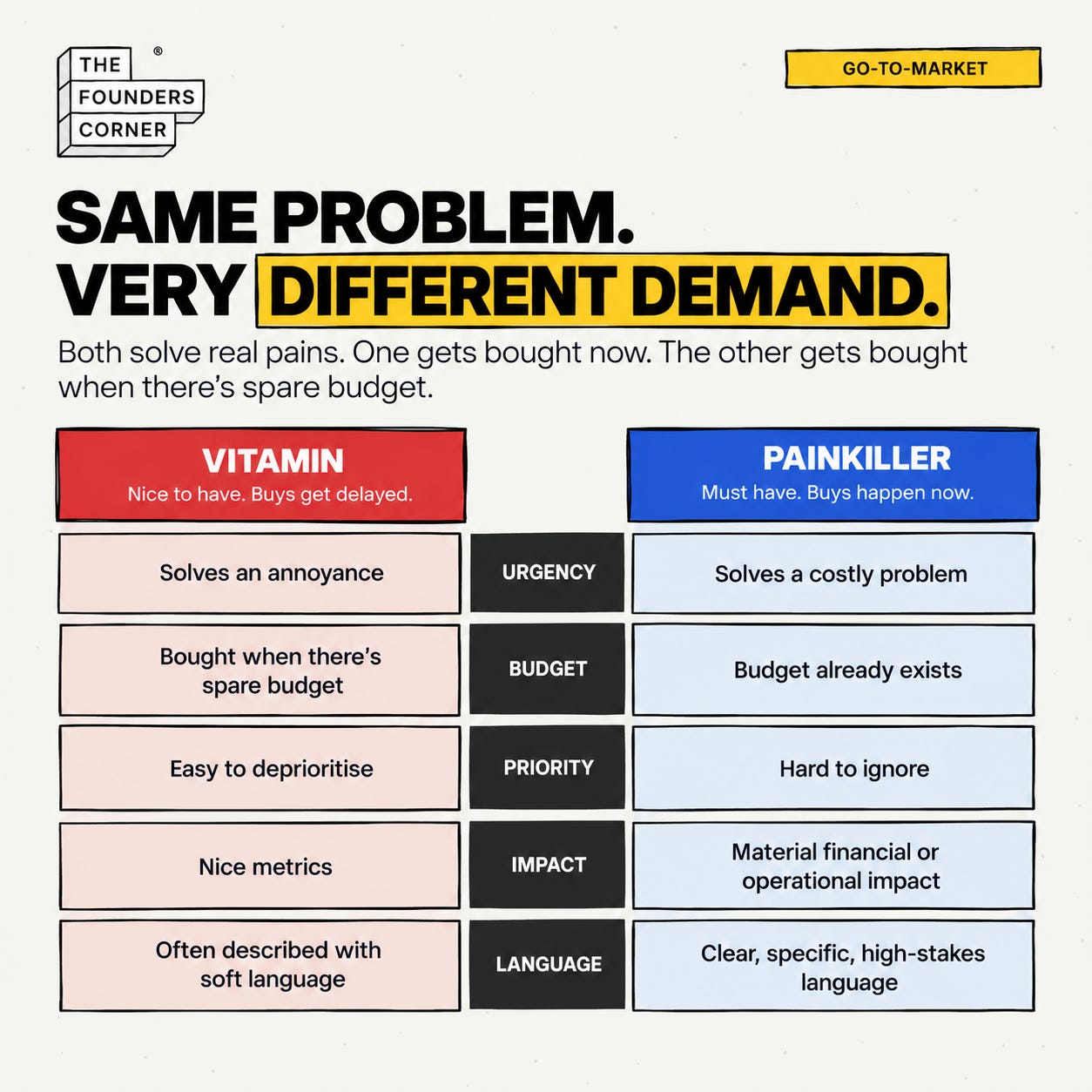
Table of Contents
A Simple Example: The Pilot Everyone Loved
Why This Question Comes After the Algorithm, Not Before
Painkiller or Vitamin
The Five Dimensions That Actually Matter
The Guard Rail: Why Budget Presence Outranks Everything Else
What the Numbers Say About Optional Pain
The Nice-to-Have Trap
The Honest Case Against Scoring Pain
Reading Your Own Red Flags Honestly
Five Questions to Answer Before You Score Anything
Scoring Your Pain Before You Scale Around It
A Simple Example: The Pilot Everyone Loved
Picture a familiar shape of company. Not a real one, but you’ll recognise it.
The product helps operations teams see where internal handovers break down. The demo is lovely. Every head of operations who sees it nods, because every head of operations has lived the problem. Three of them agree to a pilot. The pilots go well. The users like it. Somebody posts a screenshot on LinkedIn.
Then renewal comes round, and the conversation moves to a different floor.
The CFO asks which budget it comes out of. Nobody’s quite sure. It isn’t IT’s problem, so it isn’t IT’s budget. Operations has a budget, but it’s already committed to headcount and a system they signed three years ago. The head of operations still likes the product. She just can’t find the money without taking it from something she likes more.
Two of the three pilots don’t convert. The third converts at a discount.
None of that was a product failure. The pain was real, widely felt, and optional. That’s the specific gap this article is about.
Why This Question Comes After the Algorithm, Not Before
The Algorithm sentence, the Playbook, the whole nine-step build: all of it assumes the three visceral pains you tested are real.
Testing ten buyers and hearing the same frustration repeated back is powerful evidence. It’s far better than what most companies have, which is a founder’s hunch and a competitor’s homepage.
But repetition is not the same as severity.
A pain can be widely felt and still be optional. Everyone in the room can agree it’s annoying, and nobody in the room can be held responsible for leaving it alone. Those are the pains that produce enthusiastic testing calls and quiet pipelines.
So this sits after the Algorithm rather than before it for a reason. You need the evidence first. Ten calls, real Economic Buyers, a ranked list. Only then is there something worth stress-testing.
And before you point a sales motion, a content plan and a market map at that list, it’s worth putting the pain itself through a harder test than “did people nod when I described it.”
Painkiller or Vitamin
The distinction is old and still gets ignored constantly.
A painkiller gets bought because not buying it has a cost the buyer already feels. Lost revenue. Regulatory exposure. A process that breaks under its own weight every month-end. The cost is already on someone’s desk, with their name attached to it.
A vitamin gets bought when there’s spare budget and spare attention. Both of those evaporate the moment a downturn or a reorg arrives, and the vitamin is usually the first line item somebody crosses out.
The book makes the same point from the other direction. When we describe the Perfect Customer Profile, the question we push founders to ask is where they become an invaluable painkiller rather than a vitamin. And when we describe the buyer readiness stages, the Stage 5 buyer, the one every founder dreams about, is defined by one thing above all: procurement approved, budget assigned. If the pain is low, the deal is low. If the pain is high, the deal is high.
Here’s the uncomfortable part. Founders rarely describe their own product as a vitamin. They just describe a painkiller in vitamin terms (”improves visibility”, “enhances collaboration”), or a vitamin in painkiller language (”eliminates risk”, “mission critical”). Either way, the description stops being evidence.
Most only find out which one they actually built when a renewal comes due.
Want to get in front of 250k+ founders and investors?
For sponsorship opportunities across The Founders Corner newsletter and LinkedIn (160k followers), email: founderscornermedia@gmail.com
The Five Dimensions That Actually Matter
A rigorous read on this needs more than a gut check. “Do people care about this?” is too easy to answer yes to.
So the assessment breaks a problem description into five independent dimensions, each scored out of ten.
Budget Presence. Is there already real, allocated spend against this problem? Not hypothetical future budget. Not “they’d find the money if they saw the ROI”. Money already leaving the business because of this pain, through a tool, a team, a consultant or a workaround.
Urgency and Economic Impact. Does the consequence of not solving it touch revenue, regulation or operational breakdown? Or is it mainly emotional discomfort? Frustration is a useful signal in a testing call. On its own, it isn’t a purchase order.
Willingness to Pay. Is there an identifiable buyer who’d personally champion this? Not a department. A person, with a name, whose objectives get easier if the problem goes away.
Frequency. Does the problem recur weekly or monthly, or once a year? A pain that bites every Monday keeps itself on the agenda. A pain that bites every January gets forgotten by March.
Nice-to-Have Trap Severity. Would the business survive perfectly well without solving it at all? This one scores the danger, not the opportunity, and we’ll come back to it.
The point of splitting them is that they fail independently. A pain can be urgent and unfunded. Frequent and trivial. Expensive and ownerless. A single gut-feel score blends all of that into one comforting number. Five scores show you exactly which leg of the stool is missing.
The Guard Rail: Why Budget Presence Outranks Everything Else
These dimensions aren’t weighted equally.
Budget Presence carries 30% of the overall score. Urgency 25%. Willingness to Pay 20%. Frequency 15%. The Nice-to-Have score is then applied as a penalty of up to ten points on top.
Then there’s a hard guard rail.
If Budget Presence scores below four out of ten, the overall result is capped at 55, regardless of how urgent or frequent everything else looks.
Run that against a pain that tests brilliantly. Urgency nine. Frequency nine. A named champion, so Willingness to Pay eight. But no line item anywhere it could come out of, so Budget Presence three.
On enthusiasm alone, that looks like a company. Under the guard rail, it can’t score higher than 55, which keeps it inside the Moderate tier.
That’s a deliberate, conservative choice, and it’s the right one. No amount of enthusiasm compensates for a buyer who has nothing to pay you with. A problem that’s dramatic but unfunded is still unfunded.
It also reflects how deals actually die. The Economic Buyer in the book is the person whose name sits against a budget line your solution will affect. If there is no line, there’s no one whose name is on it, and the deal has nobody to sign it. It doesn’t get rejected. It drifts.
What the Numbers Say About Optional Pain
This isn’t just a framework preference. The data points the same way, from two different directions.
Start with what kills companies. CB Insights’ 2026 update looked at 431 VC-backed startups that shut down since 2023. Running out of capital topped the list at 70%, but their own reading is that cash is almost always the final cause of death rather than the root one. Underneath it sat the more telling reasons: poor product-market fit at 43%, bad timing at 29%, and unsustainable unit economics at 19%.
In other words, the money ran out because the market didn’t pull hard enough to replace it.
Then look at what kills deals. Matt Dixon and Ted McKenna, the team behind The Challenger Sale, analysed 2.5 million recorded sales conversations for The JOLT Effect. Somewhere between 40% and 60% of qualified pipeline ended not in a loss to a competitor, but in no decision at all.
That’s the competitor most founders never put on the slide. Doing nothing.
Neither figure isolates problem severity, and I wouldn’t claim one does. Product-market fit failures have plenty of causes, and Dixon’s own research is careful on this point: less than half of those no-decision losses came from buyers preferring the status quo. The rest were buyers who wanted to move and were frozen by the fear of getting it wrong.
That nuance matters, and it’s useful. A buyer who prefers the status quo has a severity problem. A buyer who wants to change but daren’t has a risk problem. Those need completely different fixes, and the first one can’t be fixed in the sales process at all.
If you’re building right now, these five are worth your time
Why Most Founders Are Solving the Wrong Pain Entirely: ten pains go into the room, three come out, and only those three ever move a deal.
The AI Search Playbook That Gets Your Startup Recommended: three prompts that show whether a model puts you on the shortlist when a buyer describes their exact pain.
How to Turn Content Into Paying Customers: The 3-Pillar Playbook: three tested pains, three pillars, and the one question every topic has to pass before it gets written.
Would Anyone Notice If Your Competitor Stole Your Homepage?: seven seconds, one armour-piercing message, and the swap test most hero lines fail.
The 100 Accounts Your Sales Team Should Know by Name: how a filtered spreadsheet becomes 100 accounts and 300 named buyers your reps recognise on sight.
The Nice-to-Have Trap
The fifth dimension exists because founders are the worst-placed people to spot it in their own product.
You’ve lived with the problem longer than any buyer has. You’ve thought about it more carefully. You can describe its second- and third-order effects in detail. All of that makes it feel enormous to you, and none of it makes it enormous to them.
A nice-to-have has three tells.
It competes with “do nothing” as the realistic alternative. Not a rival product. Not a spreadsheet someone maintains with grim resentment. Just carrying on as before.
It improves comfort rather than economics. The team is happier. The dashboard is nicer. Nothing on the P&L moves.
It has no forcing function attached. No regulator, no audit date, no customer threatening to leave, no board asking why the number slipped.
A painkiller has none of those properties. The company can’t quietly decide not to deal with it, because something outside the company eventually forces the issue.
So here’s the one-year test. Ask what happens if the buyer simply ignores the problem for another year. Not what they’d lose in theory. What actually happens, to whom, and who notices.
If the honest answer is “not much”, the severity score gets penalised accordingly, however good the demo felt.
The Honest Case Against Scoring Pain
It would be strange to write this without giving the sceptics a fair hearing, because some of their objections are good.
“New categories don’t have a budget line yet.” True. If you’re genuinely creating a category, there’s no line item with your category’s name on it, and a strict Budget Presence score looks unfair.
“Strong pains create budget.” Also true. Budgets get reallocated mid-year when something hurts enough. The money doesn’t have to exist in advance if the pain is loud enough to go and find it.
“Some of the most severe problems are annual.” The audit, the renewal cycle, the regulatory filing. Frequency scores them low, and yet they can be existential when they land.
“It’s only as good as what you type into it.” The score reflects the founder’s description, and founders describe their own problems generously.
All four are fair. None of them is an argument for skipping the test.
On new categories: budget presence was never about a line item with your name on it. It’s about money already being spent on the problem. Headcount doing the work by hand. Consultants brought in twice a year. A legacy system everyone hates but nobody’s allowed to switch off. If you can’t find any of that, you’re not creating a category. You’re creating a hope.
On pains that create budget: they do, and they announce themselves when they do. You’ll hear it in testing as “we’d have to take it from somewhere”, followed by the name of the somewhere. If nobody names a somewhere, the pain isn’t loud enough yet.
On annual pains: that’s why Frequency carries 15% and not 50%. An annual pain with real budget and real consequence still scores well. It just can’t hide a missing budget behind a dramatic story.
And on garbage in: yes. Which is why the next section matters more than the score.
“Your buyers will happily agree the problem exists. The only question that matters is whether leaving it alone costs them anything they’ll be asked to explain.”
Reading Your Own Red Flags Honestly
Run your own top pain through this and you get a short list of specific warning signs alongside the score. Not vague encouragement. Not “consider strengthening your value proposition”.
The flags tend to cluster around the same few gaps:
No named signer. The buyer is described as a department, or as “leadership”.
No current spend. Nothing is being paid today to manage the problem, even badly.
Comfort language. The consequences are about frustration, visibility or morale, with nothing that reaches revenue, compliance or a broken process.
Annual or ad hoc frequency with no forcing event attached.
“Do nothing” is the real competitor, and the description never says what doing nothing costs.
Some of the most useful red flags aren’t in the scoring at all. They’re in the vagueness.
Vague answers to “who signs for this” or “how often does this actually bite” are red flags worth writing down in their own right. A founder who can’t answer those precisely usually hasn’t tested with enough real buyers yet. Or, more uncomfortably, they’re describing a problem they find interesting rather than one the market finds expensive.
Those are very different situations. The first is fixed with five more testing calls. The second is fixed with a harder conversation, usually with yourself.
Five Questions to Answer Before You Score Anything
The tool can only score what you give it. So before you run it, go back to your testing notes and answer these in writing, using the buyer’s words wherever you can.
One: who signs? A role and, ideally, a name from a real call. If three buyers gave three different answers, write all three down. That’s information.
Two: what is it costing them today? Not what it could cost. What it costs now, in money, hours, headcount or penalties, as the buyer described it.
Three: whose budget would this come out of? The cost centre, the line, the existing spend it would replace. If the answer is “new budget”, note who would have to approve it.
Four: how often does it bite? The last time it happened, and the time before that. Dates beat adjectives.
Five: what happens if they ignore it for another year? The specific consequence, and the specific person who’d be asked about it.
If you can answer all five crisply, the score will mostly confirm what you already know. If you can’t, you’ve found the problem before the tool did, and that’s worth more than the number.
Scoring Your Pain Before You Scale Around It
The overall score lands in one of four tiers:
Critical Problem (80–100). A high-conviction opportunity worth building a company around.
Significant Problem (60–79). Worth pursuing, with iteration on how you frame and target it.
Moderate Problem (40–59). Needs stronger positioning, a sharper buyer, or a pivot in framing before you scale anything.
Weak Problem (0–39). High risk of building a vitamin and calling it a painkiller.
Notice where the guard rail puts an unfunded pain. Capped at 55 means it can never leave the Moderate tier, however good everything else looks. That isn’t a verdict on the founder. It’s a prompt to go and find the money, or the buyer whose money it is, before building any further.
This is exactly what the Problem Severity Validator produces. Describe the problem, the target customer, how it’s solved today and whether budget exists. It returns the five dimension scores, the tier, and the specific red flags behind the number, in about a minute.
Run it on your top pain. Then run it on your second and third. The ranking that comes back may not match the one from your testing calls, and where it doesn’t, the gap is worth a conversation.
Next in the series, we leave the pain itself behind and ask a different question: even if the pain is real, is this actually the right moment to go after it.
-Chris Tottman
Most founders can describe their top pain fluently. Far fewer can say, with a straight face, that there’s already budget allocated against it.
The Problem Severity Validator scores your pain across five weighted dimensions and tells you, in about a minute, whether you’re holding a painkiller or a vitamin.