

👋 Hey, Chris here! Welcome to BrainDumps—a weekly series from The Founders Corner. If you’ve been reading along, you know this series is a preview of a bigger project. Well, it’s finally here: The Big Book of BrainDumps is out now!
It isn’t a theory book—it’s the founder’s field manual. Inside, you’ll find 70 powerful frameworks distilled from 30+ years scaling software companies to hundreds of millions in ARR, 20+ years investing in 500+ B2B tech startups, and over $1B of shareholder value created. From raising capital to hiring your first VP of Sales, this book turns scars and successes into practical playbooks you’ll return to again and again. I expect most copies will become well-worn, scribbled on, and dog-eared—because it works.
One of the biggest mistakes B2B SaaS companies make is believing they are selling software.
They’re not. At least not really.
Customers rarely buy software because they care deeply about workflows, dashboards, integrations, automations, or AI models in isolation. Those things matter — but they are rarely the true driver behind purchasing decisions.
Beneath almost every serious software purchase sits something much more human:
Pressure
Ambition
Fear
Insecurity
Politics
Reputation
Recognition
The desire to succeed
This is where most software messaging falls apart. Founders become obsessed with features while buyers are quietly wrestling with career-defining problems behind closed doors.
And that’s exactly why Maslow’s Hierarchy of Needs remains surprisingly relevant in modern SaaS sales and positioning. Because the best software companies don’t simply solve operational pain. They solve emotional pain too.
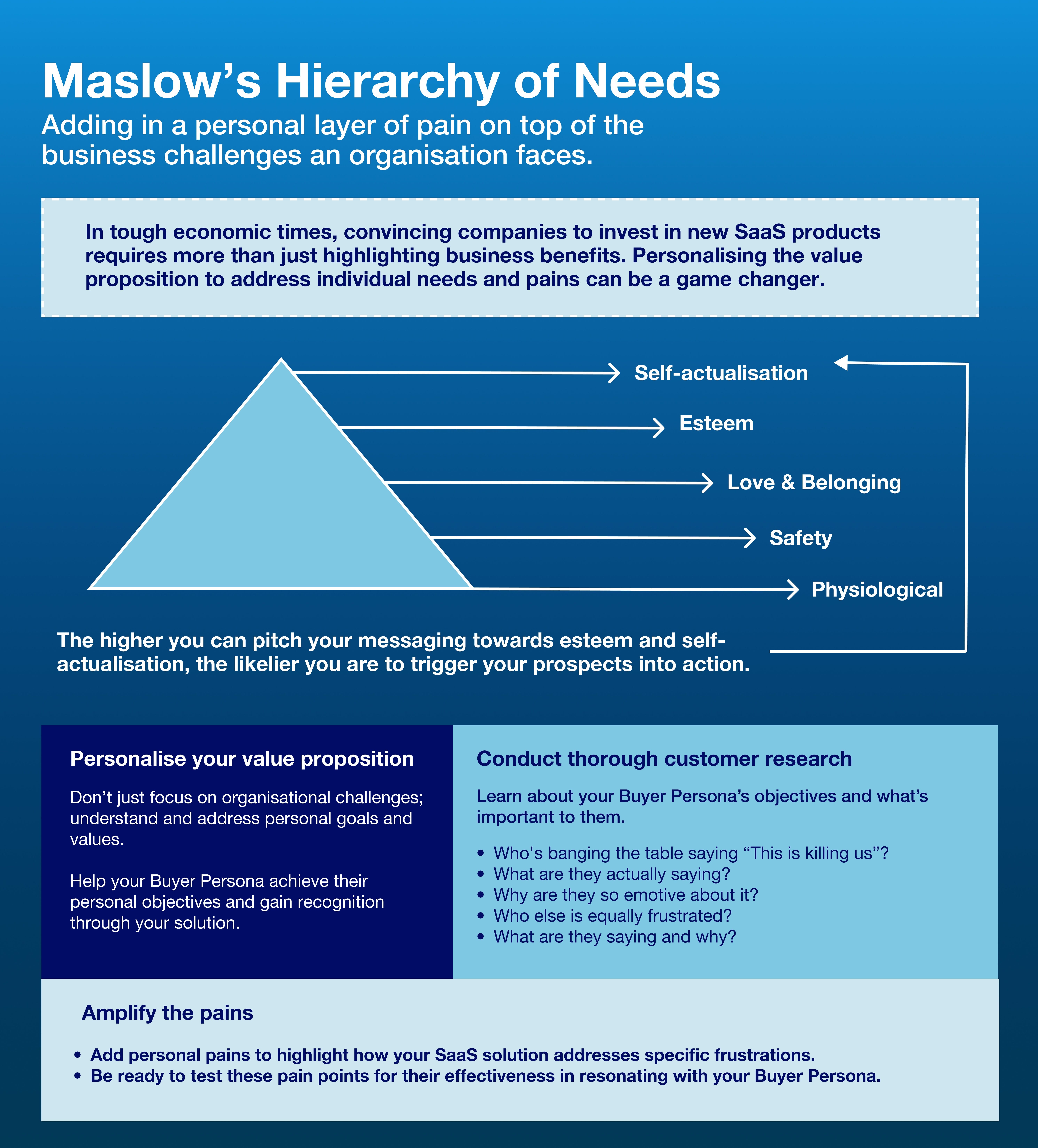
Table of Contents
Software Purchases Are More Emotional Than Most Founders Realise
Every Buying Decision Has A Personal Layer Hidden Underneath It
The Best SaaS Messaging Speaks To Identity
The Most Successful SaaS Products Often Make Their Buyers Look Brilliant
Fear Is Often A Bigger Driver Than Ambition
Great Founders Learn To Uncover The Real Pain
The Best SaaS Marketing Combines Logic With Emotion
Customer Research Is The Real Competitive Advantage
The Higher Up The Pyramid You Can Position Your Value, The Stronger Your Messaging Becomes
Great SaaS Companies Understand Human Psychology Better Than Their Competitors
Software Purchases Are More Emotional Than Most Founders Realise
Maslow’s famous hierarchy explained that human beings are motivated by different levels of need — beginning with basic survival and moving upward through safety, belonging, esteem, and ultimately self-actualisation.
Most SaaS messaging operates painfully low down that pyramid. It talks about:
Efficiency
Compliance
Risk reduction
Cost savings
Operational optimisation
And while those things absolutely matter, they often fail to create urgency on their own — because they live largely in the “safety” layer of the hierarchy.
The truth is that most transformational software purchases happen much higher up the pyramid. They happen when the buyer believes the solution will help them achieve recognition, status, influence, credibility, career progression, or internal success.
That is the real unlock.
The best SaaS messaging doesn’t just explain what the software does. It explains what success looks like for the human being buying it.
Every Buying Decision Has A Personal Layer Hidden Underneath It
Founders often talk about “the customer” as though organisations themselves buy software.
But organisations do not make decisions. People do. And people bring emotion into every purchasing process, whether they admit it or not.
Consider what’s really going on beneath the surface:
The Head of Operations drowning in manual workflows isn’t just frustrated because the process is broken — they’re frustrated because their team’s performance is suffering publicly.
The CFO evaluating automation software isn’t merely interested in reducing costs — they may also want to demonstrate strategic leadership to the board.
The HR Director purchasing AI recruitment tooling may be trying to reposition their department internally as innovative and commercially valuable.
Once you understand the personal motivations underneath the operational challenge, your positioning changes completely.
You stop selling software features. You start selling professional transformation.
The Best SaaS Messaging Speaks To Identity
Great software brands stand out because they understand identity-level messaging. They know their buyers want to feel competent, respected, forward-thinking, and successful.
This is why messaging framed around personal achievement is often far more effective than messaging framed purely around process improvement.
Consider the difference:
❌ “Our platform reduces reporting time by 40%.”
Useful. Rational. Logical. But forgettable.
✅ “Become the leader who transformed operational efficiency across the business.”
That lands differently.
One speaks to process. The other speaks to identity and esteem — and esteem is an enormously powerful buying driver inside organisations.
The Most Successful SaaS Products Often Make Their Buyers Look Brilliant
This is one of the most underrated truths in enterprise software.
Great SaaS products frequently succeed because they make internal champions look smart. Inside every successful software implementation, there is usually someone whose reputation becomes tied to the success of the rollout.
That individual wants the project to work — not only because the business benefits, but because they benefit too:
Recognition matters
Career momentum matters
Internal credibility matters
The smartest SaaS companies understand this and actively support it through their positioning, onboarding, customer success, and case studies. They help buyers become heroes internally.
And once software starts helping people win politically and professionally inside their organisations, retention becomes dramatically stronger — because now the software is attached not only to operational value, but personal value as well.
Fear Is Often A Bigger Driver Than Ambition
Maslow’s framework reminds us that fear remains one of the most powerful forces in decision-making. Many SaaS purchases are triggered less by aspiration and more by anxiety:
Fear of falling behind competitors
Fear of inefficiency
Fear of making mistakes
Fear of losing market share
Fear of failing publicly
Fear of becoming irrelevant
This is why truly effective SaaS positioning often amplifies the cost of inaction. The best messaging doesn’t simply explain what improves after adoption — it also highlights what continues hurting if nothing changes.
Buyers need emotional contrast. They need to feel both the opportunity and the pain. That tension creates urgency.
Great Founders Learn To Uncover The Real Pain
One of the biggest growth unlocks for SaaS founders is learning how to uncover deeper customer pain during discovery conversations.
Most buyers initially speak at surface level:
Workflows
Reporting
Manual processes
Integration gaps
Admin burden
But beneath those operational frustrations usually sits something far more emotionally charged:
Missed targets
Internal pressure
Board scrutiny
Career frustration
Team burnout
Political tension
The founders who scale fastest are the ones who learn how to uncover that second layer. Because once you understand the emotional weight attached to the problem, your entire go-to-market strategy sharpens:
Your messaging improves
Your demos improve
Your case studies improve
Your sales conversations improve
And critically — your urgency improves
The Best SaaS Marketing Combines Logic With Emotion
Purely emotional messaging without operational credibility feels manipulative. Purely rational messaging without emotional resonance feels forgettable. The strongest SaaS brands combine both.
They clearly demonstrate measurable business outcomes while simultaneously tapping into the emotional reality of the buyer’s world.
This balance matters enormously in B2B software — buying decisions are rarely made by one person alone. Logical justification is required for procurement and stakeholder alignment, but emotional conviction is often what initially drives momentum internally.
In many ways, enterprise software sales are simply structured emotional decisions wrapped in spreadsheets.
Customer Research Is The Real Competitive Advantage
Most founders assume positioning is created internally. In reality, the best positioning comes directly from customer language.
That’s why customer interviews remain one of the most powerful strategic exercises any SaaS business can undertake. You need to understand:
What frustrates your buyers daily?
What pressures are they under?
What outcomes are they measured against?
What does success look like for them personally?
What happens if they fail?
How are they judged internally?
Those answers are pure gold — because they reveal the emotional architecture underneath the buying process. And once you understand that architecture, your messaging becomes infinitely more persuasive.
The Higher Up The Pyramid You Can Position Your Value, The Stronger Your Messaging Becomes
Maslow’s hierarchy teaches a deceptively important lesson for SaaS founders: the higher up the hierarchy your product messaging can operate, the more emotionally powerful it becomes.
If your software only solves low-level operational inconvenience, urgency will always be limited.
But if your software helps people achieve recognition, strategic influence, leadership credibility, career progression, or internal transformation — the emotional stakes rise dramatically.
That is where the strongest SaaS brands operate. They don’t simply position themselves as tools. They position themselves as enablers of success.
Great SaaS Companies Understand Human Psychology Better Than Their Competitors
At its core, software is still about people:
People trying to solve problems
People trying to reduce stress
People trying to perform better
People trying to achieve something meaningful
The founders who understand this deeply build stronger positioning, stronger products, and ultimately stronger companies.
Because while technology evolves constantly, human psychology changes remarkably slowly.
And the SaaS businesses that understand human motivation best are usually the ones that win.
Most founders lose their raise before they ever send the first email.
The ones who close have something the rest don’t: they know exactly how investors read a pitch deck before you’re even in the room, which AI prompts are quietly transforming how founders prepare, how to turn a cold outreach into a warm conversation, what a two-minute briefing can do that a ten-slide deck can’t, how to stress-test your pitch before an investor ever sees it, and how to build a fundraising narrative that actually sticks.
That edge isn’t luck. It’s 30 years sitting across the table from founders, 500+ investments, and the patterns that quietly decide who gets funded and who gets ghosted.
We’ve packaged all of it into 60+ premium tools. One subscription. Everything unlocked.
Start with these six — they’ve already changed the outcome for thousands of founders before you:
Your Pitch Deck’s First Reader Isn’t Who You Think — Before any human sees it, something else decides its fate. Know what it is before you hit send.
The 6 Claude Prompts That Change How You Raise — Most founders use AI to write emails. The ones closing rounds use it like this instead.
The Claude Prompt That Turns a Cold Outreach Warm — One prompt. The difference between ignored and in the room.
The Two-Minute Investor Briefing — Investors don’t have time. This format respects that — and gets the meeting anyway.
I Asked Claude to Reject My Pitch — Here’s What It Found — The holes investors find but never tell you about. Find them first.
How to Build Your Fundraising Narrative — Not your deck. Not your numbers. The story that makes both of them land.
Your next raise depends on which side of this you’re on. Upgrade now.
Your insights about emotional drivers in SaaS sales are spot on. It’s easy to overlook these aspects. How can founders ensure they are addressing these emotional needs in their messaging?
Good One. Happy to connect with you. Excited to introduce you to fintech : https://rokdaa.com/ Great traction. Raising a round now. DM if interested. We should talk.