

👋 Hey, Chris here! Welcome to The Founders Corner. If you’ve been reading along, you’ll know I have very little patience for theory that fails the moment it meets a real buyer.
This series is a preview of a new book I’ve written with my partners Richard Blundell and Paul Watson — The Selling Software Algorithm: The Go-to-Market Navigation System for B2B Software Leaders.
It isn’t a strategy deck dressed up as a book. Between the three of us we’ve spent close to seven decades inside B2B software as founders, operators, investors and coaches — building companies, exiting some, and quietly breaking a few along the way, which is where most of the real learning lives. Through our work at Vencha we’ve now supported hundreds of founders trying to do the single hardest thing in software: turn a clever product into predictable commercial traction in a market that’s noisier and more crowded than it has ever been.
One pattern shows up again and again. Companies rarely struggle because the product is bad. They struggle because they have no navigation system for going to market. This book is that system.
Last time, we measured whether now is the right moment for this market at all, across demand, technology, competition, regulation and founder timing.
This time, we assume the timing checks out and turn to the people already standing in that market with you: where you actually beat them, where they beat you, and the ground nobody has claimed yet.
Here’s the failure this piece exists to prevent. A founder is asked how they compare to the competition and answers honestly: better product, better support, easier to use, fairly priced, faster to ship. Some of that might even be true. So the homepage says all five. So does the deck. So does the sales team, in a different order on every call. And the buyer, who sat through three vendor pitches that week, walks into the shortlist meeting unable to say what makes this one different, because “better at everything” is what all three of them said. Nobody lost on a dimension. They lost by never choosing one.
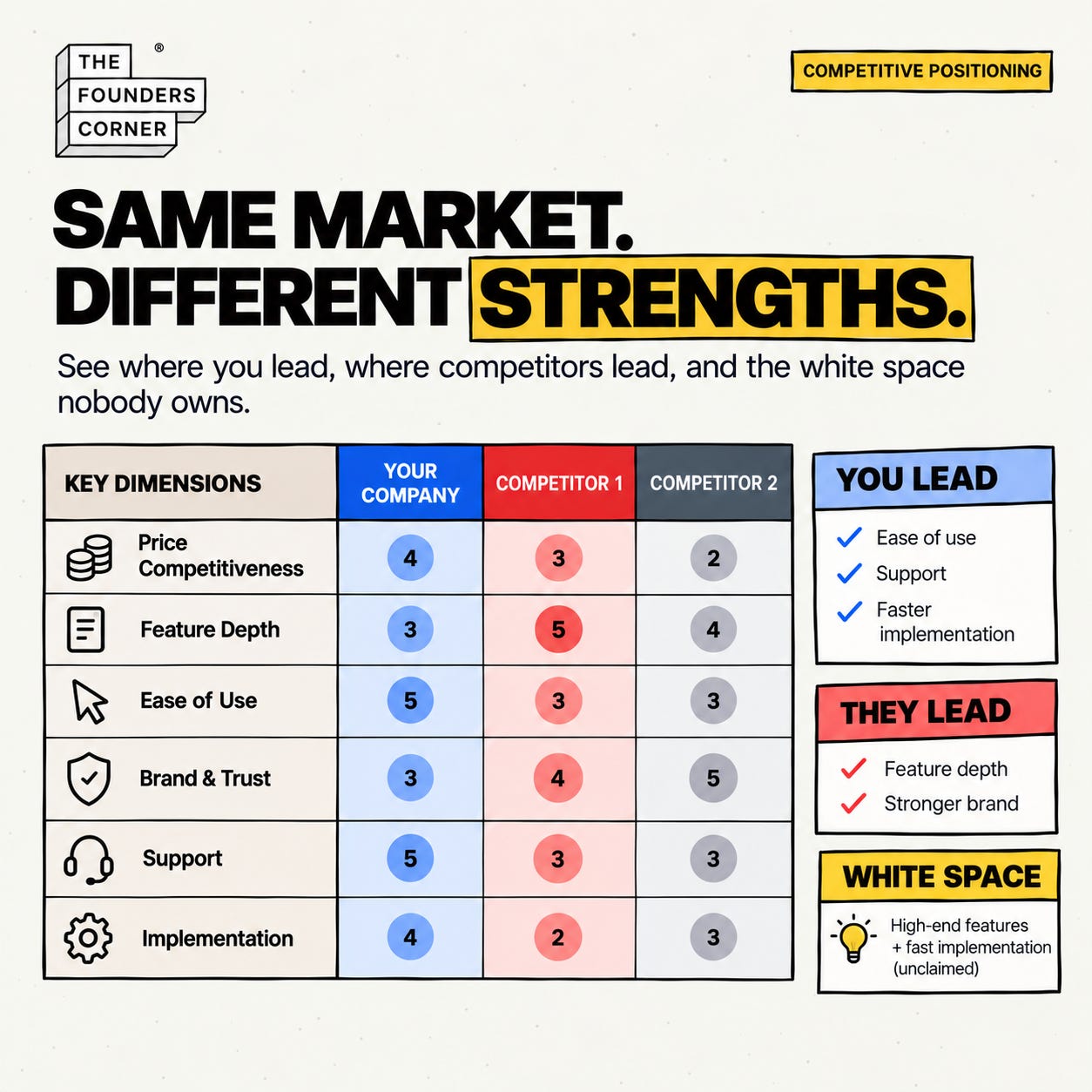
Table of Contents
A Simple Example: Three Vendors, One Shortlist
The Radar Chart Every Founder Draws in Their Head, Badly
Choosing Dimensions That Mean Something
Scoring Yourself Honestly Is the Hard Part
Where You Lead, Where You Trail
What the Research Says About Being Different
White Space: The Dimension Nobody Owns
Why Leading Everywhere Is Its Own Warning Sign
When the Answer Is Niche Down, Not Fight Harder
The Honest Case Against Picking Two
Turning a Comparison Into a Position
A Simple Example: Three Vendors, One Shortlist
Picture a head of operations at a facilities business with forty sites. Not a real one, but you’ll recognise her.
She’s replacing the spreadsheet her team uses to schedule field engineers. Three vendors make the shortlist. She gives each of them an hour.
The first vendor walks through the whole product. Scheduling, routing, invoicing, a customer portal, a mobile app, an analytics suite, and a roadmap slide with eleven things on it. Competitive pricing. Award-winning support. A modern interface. The demo is good. Everything is good.
The second vendor does much the same, with a different colour on the slides.
The third vendor spends ten minutes on the product and fifty on two things.
Their support team picks up in under five minutes, every time, including weekends, because field engineers don’t stop working at five on a Friday. And they’ll migrate her existing schedule data themselves, inside a week, because they know that’s where these projects usually stall.
A month later her CFO asks why she’s recommending vendor three.
She can’t remember much about the first two. She can remember vendor three’s two reasons almost word for word, because she’s already repeated them to two colleagues.
The first two vendors weren’t worse. They were forgettable. On a shortlist, those are the same thing.
Vendor three probably scored lower on feature depth than vendor one. It didn’t matter. It won because it had decided which two dimensions it would be remembered for, and only said those out loud.
That decision is what this article is about.
The Radar Chart Every Founder Draws in Their Head, Badly
Ask a founder how they compare to their two closest competitors and you’ll usually get a confident, entirely unstructured answer: better here, worse there, roughly the same on the rest.
It’s not wrong, exactly. It’s just not precise enough to build a homepage message or a sales battlecard on.
And it’s being asked to carry more weight than ever. Crayon’s 2025 State of Competitive Intelligence report found sellers going head-to-head with a competitor in 68% of deals, while the average team rated its own competitive selling at 3.8 out of 10.
Crayon sells competitive intelligence software, so it has an interest in competition looking fierce. The direction still matches what most founders see in their own pipelines.
The unstructured answer has three specific problems.
It’s flattering. Founders score themselves on their best day and competitors on their worst demo. Nobody does this on purpose. It’s just what happens when the only evidence is memory.
It’s unranked. “Better here, worse there” doesn’t tell you which gap is biggest, which one is costing you deals, or which one you should stop paying to maintain.
It’s unshareable. It lives in one founder’s head. Sales tells one version, marketing writes another, and the product team builds against a third.
The matrix fixes all three by forcing the same comparison onto explicit dimensions, scored consistently. “We’re better on support” stops being a feeling and becomes a number next to a competitor’s number.
A feeling can’t be argued with. A number next to a competitor’s number can, and that’s the point.
Want to get in front of 250k+ founders and investors?
For sponsorship opportunities across The Founders Corner newsletter and LinkedIn (160k followers), email: founderscornermedia@gmail.com
Choosing Dimensions That Mean Something
The default set covers six dimensions, each scored one to five for you and for two to four named competitors:
Price Competitiveness. Not just the list price. What a buyer actually pays, including implementation, add-ons and the seats nobody mentioned in the demo.
Feature Depth. How much of the job the product does without workarounds, integrations or a services contract.
User Experience. How quickly a new user gets value, and how often they need help to do so.
Brand and Trust. Whether a cautious buyer can put your name in front of their CFO without a long explanation.
Support and Service. How fast, how competent and how human the help is when something breaks.
Innovation Speed. How quickly the product improves, and whether customers can feel it.
The dimensions can be swapped for whatever actually decides deals in your category. Implementation time. Security and compliance posture. Depth of integrations. Specialist knowledge of one vertical.
The discipline is the same either way: score everyone, including yourself, on the same scale, and let the gaps do the talking rather than the adjectives.
Two rules make the choice much easier.
Pick from deals, not from your feature list. Pull the last ten won and lost deals and write down the reason the buyer gave. Not the reason you suspect. The one they said. Those reasons are your dimensions.
Include the competitor you never name. In most early-stage categories the biggest competitor is the spreadsheet, the existing process, or the person who currently does the job by hand. The tool takes up to four named competitors, and one of them can be “doing nothing”. Score it honestly. On price, doing nothing is usually a five.
If a dimension has never decided a deal, it doesn’t belong on the chart, however good you are at it.
Scoring Yourself Honestly Is the Hard Part
The row that matters most is the one you’ll be most tempted to round up. Your own.
Here’s how I’d keep it honest:
Score from evidence, not intention. The roadmap doesn’t count. Neither does “we’re about to”. Score the product a buyer would get if they signed today.
Start at three. A four or a five needs proof you could show a sceptical buyer: a review, a measured response time, a deal you won back from a competitor and the reason why.
Let someone who lost a deal score you. A salesperson who lost to a competitor last month knows exactly where that competitor beats you, and has no reason to be polite about it.
Score competitors on their best day. Use their real product, their customer reviews and what their customers say, not the clumsy demo you saw at a trade show three years ago.
Do it in one sitting. Scores drift when they’re done in different weeks by different people in different moods. The same scale only works if it’s applied the same way.
This is uncomfortable, and it should be. The point isn’t to produce a chart that looks good in a board pack. It’s to produce one that tells you something you didn’t already believe.
An inflated row doesn’t make you stronger. It just moves the gap somewhere you can’t see it.
Where You Lead, Where You Trail
The output sorts every dimension into a lead or a trail relative to the competitor average, ranked by size of gap.
The maths is simple, which is part of why it works:
Gap = your score − the average of your competitors’ scores
Here’s a worked example. A fictional field-service scheduling company, scored against two competitors:
Support and Service. You 5. Competitors 3 and 3. Gap +2.0
User Experience. You 4. Competitors 3 and 3. Gap +1.0
Price Competitiveness. You 3. Competitors 4 and 2. Gap 0
Innovation Speed. You 2. Competitors 2 and 3. Gap −0.5
Feature Depth. You 3. Competitors 5 and 4. Gap −1.5
Brand and Trust. You 2. Competitors 5 and 4. Gap −2.5
A two-point lead on Support and Service is your strongest, most defensible differentiator, worth leading with in messaging. User Experience is a credible second.
A two-and-a-half point trail on Brand and Trust is the one that’s urgently costing you deals rather than something to quietly live with. And notice where it costs them: not in the demo, where support and UX get their chance to shine, but before it, when a cautious buyer quietly decides who gets onto the shortlist at all.
Small gaps get a lighter instruction. A half-point trail on Innovation Speed means monitor it and don’t let it widen, not panic.
The useful shift here is to stop treating every trail as a problem to fix. Each one gets one of three answers:
Fix it. It’s costing deals in your target segment, and the gap is closable.
Contain it. It matters, but you’ll never lead on it. Get to good enough and stop there.
Concede it. Your segment doesn’t care. Say so, out loud, and stop spending money pretending otherwise.
Some trails are problems. Others are the price of the position you’ve chosen. The chart’s job is to make you decide which is which.
What the Research Says About Being Different
This isn’t a new idea dressed up in a radar chart. Three of the best-known schools of business strategy, written decades apart, land in almost exactly the same place.
Michael Porter, “What Is Strategy?”, Harvard Business Review, 1996. Porter draws a hard line between operational effectiveness, doing the same things as rivals but better, and strategy, which means choosing a different position with real trade-offs. His most quoted line is that “the essence of strategy is choosing what not to do.” Being a bit better on everything, in his framing, is operational effectiveness. It’s useful, but competitors can copy it, so it rarely lasts.
Michael Treacy and Fred Wiersema, The Discipline of Market Leaders, 1995. Their argument is that market leaders choose one value discipline, whether operational excellence, product leadership or customer intimacy, and excel at it, while keeping the other two at a threshold level that’s good enough. The companies they saw drifting were the ones that were mediocre at all three, never breaking through on any single one.
W. Chan Kim and Renée Mauborgne, Blue Ocean Strategy, 2005. Their strategy canvas is, in effect, the same chart as this one: the factors an industry competes on along the bottom, each company’s score drawn as a line. One of their clearest warning signs is a value curve that closely tracks your competitors’ curves. That’s what crowded, undifferentiated competition looks like on paper.
Their best-known example is wine. Casella Wines launched [yellow tail] into the US market with just two wines, a Chardonnay and a Shiraz. It deliberately eliminated or reduced the factors the industry treated as quality, like complexity, ageing and an enormous range, and created new ones nobody was competing on: easy drinking, easy choosing, and fun.
Within two years it had become the fastest-growing brand in the histories of both the Australian and US wine industries. By 2003 it was the best-selling red wine in a 750ml bottle in the United States.
It didn’t out-everything the wine industry. It scored lower on most of the factors the industry cared about, and much higher on a few that buyers cared about.
All three frameworks lean on case studies chosen with hindsight, and none was written with seed-stage software in mind. But they come from different decades and different schools, and the instruction underneath is consistent: choose where you’ll lead, and let the rest be adequate.
Three schools of strategy disagree about a lot. They agree on this.
If you’re building right now, these five are worth your time
Would Anyone Notice If Your Competitor Stole Your Homepage?: seven seconds, one armour-piercing message, and the swap test most hero lines fail.
The Test That Tells You If Anyone Will Actually Pay: five weighted dimensions, and the guard rail that caps an unfunded pain at 55 however urgent it sounds.
The 9-Step GTM System Every Founder Should Build Before They Scale: nine steps, one living document, so every new hire knows who to target and what to say.
Why Most Founders Are Solving the Wrong Pain Entirely: ten pains go into the room, three come out, and only those three ever move a deal.
The AI Search Playbook That Gets Your Startup Recommended: three prompts that show whether a model puts you on the shortlist when a buyer describes their exact pain.
White Space: The Dimension Nobody Owns
The more interesting output sits underneath the gaps: dimensions where every company scores low, including you.
In the worked example, Innovation Speed scores 2, 2 and 3. That’s an average of 2.3 out of 5 across the whole field. Nobody has claimed it yet, and the tool calls this out explicitly as a first-mover opportunity with minimal competitive resistance.
Most competitive analysis stops at “how do I beat them on their strengths”. This asks a more useful question: what has nobody bothered to be good at?
That’s exactly what Casella did with [yellow tail]. Nobody in wine was competing on being easy to choose. Every bottle in the aisle was trying to look more serious than the one next to it.
There’s a catch, though, and it’s an important one. A dimension usually sits empty for one of three reasons:
Nobody has noticed it. The real opportunity. Everyone is busy copying the market leader’s chart.
It’s hard or expensive to be good at. Still an opportunity, if you can find a cheaper way to do it, or you’re willing to pay for something competitors won’t.
Buyers don’t care about it. Not an opportunity at all. It’s empty because it’s worthless.
The chart can’t tell these apart on its own. Your buyers can. Before you build a position on white space, take it into your next five testing calls and watch what happens when you describe it. A buyer who leans forward is telling you it’s the first kind. A buyer who nods politely is telling you it’s the third.
And if it is real, the timing logic from last time applies here too. Claiming empty ground is cheap while it’s empty. The price goes up the moment a second company notices it.
White space is only valuable if a buyer would pay to stand in it.
Why Leading Everywhere Is Its Own Warning Sign
Score yourself honestly and lead on four or five of six dimensions, and the recommendation isn’t celebration. It’s a warning against spreading thin.
There are usually only two ways to get that result.
You’ve scored yourself generously. Go back and apply the rules above. Most “leads everywhere” charts survive about ten minutes in a room with the sales team.
You’ve picked dimensions you’re already good at. Which makes the chart a mirror, not a map. Swap in the dimensions your lost deals were actually decided on and see what happens.
Even when it’s genuinely true, maintaining a marginal lead on everything is expensive and forgettable. Expensive because you’re funding five roadmaps instead of two. Forgettable because of how little attention any vendor actually gets.
Gartner’s research on B2B buying found that buyers spend only around 17% of the entire purchase journey meeting with potential suppliers, all of them combined. Compare three suppliers and Gartner estimates each one gets maybe 5 or 6% of the buyer’s time.
That’s the window you have to make your case in. Five polite advantages don’t fit into it. Two sharp ones do.
The advice is to pick two or three dimensions to own definitively in messaging, rather than diluting a real advantage into five polite ones nobody remembers by the second meeting.
You can still be good at the other three. You just stop talking about them first.
Two things a buyer can repeat beat five things they have to be reminded of.
When the Answer Is Niche Down, Not Fight Harder
The opposite pattern gets an equally direct answer.
Trail on more dimensions than you lead, especially against three or more competitors, and the recommendation shifts from “compete harder across the board” to “pick a segment where your actual strengths matter most”.
Competing everywhere against well-funded incumbents is an expensive way to lose slowly. A focused position, built on the two dimensions where the gap genuinely favours you, wins faster.
This is the oldest lesson in the book, quite literally. The introduction tells the story of Jack, whose retail operations software only started to move once the team wrote down a target so specific it felt almost absurd: Heads of Retail Operations in chains with between twenty and one hundred stores, reporting into the CFO, losing hours every week to reconciling spreadsheets.
“It was uncomfortably narrow. And it unlocked everything.”
Within six months his revenue had doubled. And once he’d dominated that niche, companies outside it started arriving inbound, drawn by how clear the positioning was.
Niching down doesn’t mean finding a smaller market. It means finding the buyers who rank your two strongest dimensions first.
In the worked example, the company leads on support and user experience, and trails badly on brand and feature depth. So the question isn’t “how do we catch up on brand?” It’s “who cares most about support and ease of use, and cares least about a famous name and an enormous feature list?”
Probably a mid-market operator with field teams working weekends and no internal IT department. That’s a segment where the incumbent’s strengths matter less and yours matter most.
The book puts it in one line worth keeping on a sticky note: “You cannot serve the entire market, but you can dominate a narrow band within it.”
The Honest Case Against Picking Two
It would be odd to write this without giving the other side a fair hearing, because some of the objections are good ones.
“Buyers compare on everything.” Enterprise procurement sends out RFP scorecards with sixty lines on them. You can’t skip lines just because they’re not your two.
“Narrow positioning shrinks the market.” If you only talk about support, the buyer who cares about analytics walks straight past you.
“The scores are just opinions.” One to five on Brand and Trust is a judgement call, and two people in the same company will score it differently.
“Competitors will just copy your two.” If support is your edge, a well-funded rival can hire a bigger support team next quarter.
All four are fair. None of them is an argument for leading on everything.
On scorecards: this is exactly Treacy and Wiersema’s threshold point. You need to clear the bar on every line to make the shortlist. You only need to lead on two to win once you’re on it. Thresholds get you shortlisted. Leads get you chosen.
On market size: Jack’s story is the answer. Focus tends to widen the inbound funnel over time, not shrink it, because a clear position travels further than a vague one.
On opinions: agreed, which is why the scale, the evidence rules and the single sitting matter. A consistent opinion, applied the same way to everyone, is far more useful than an inconsistent one held privately in the founder’s head.
On copying: also true, and it’s a serious enough question that it gets the whole of the next article.
“A buyer will remember one thing about you after the second meeting. Decide what it is, or they will.”
Turning a Comparison Into a Position
This is exactly what the Competitor Positioning Matrix produces: a radar chart, a ranked list of leads and trails, the white space nobody owns, and a short set of strategic recommendations that follow directly from the numbers rather than from whoever argued loudest in the positioning workshop.
Run it with your sales lead in the room, not on your own. Score the competitors first, then yourself, so your own row is anchored to theirs rather than the other way round.
Then run it a second time with “doing nothing” as one of the competitors. For a lot of early-stage companies, that’s the comparison that actually explains the pipeline.
Next in the series, we look past today’s feature comparison and ask a harder question: even if you’re ahead right now, how long would it take a well-funded competitor to catch up entirely.
-Chris Tottman
Most competitive analysis is a confident paragraph. Precise competitive analysis is a number next to a competitor’s number, on the same scale.
The Competitor Positioning Matrix scores you against up to four competitors across six dimensions and finds the white space nobody has claimed.