

👋 Hey, Chris here! Welcome to BrainDumps—a weekly series from The Founders Corner. If you’ve been reading along, you know this series is a preview of a bigger project. Well, it’s finally here: The Big Book of BrainDumps is out now!
It isn’t a theory book—it’s the founder’s field manual. Inside, you’ll find 70 powerful frameworks distilled from 30+ years scaling software companies to hundreds of millions in ARR, 20+ years investing in 500+ B2B tech startups, and over $1B of shareholder value created. From raising capital to hiring your first VP of Sales, this book turns scars and successes into practical playbooks you’ll return to again and again. I expect most copies will become well-worn, scribbled on, and dog-eared—because it works.
There’s an uncomfortable truth in startup land that rarely gets discussed openly:
Two founders can build the same product, in the same market, with similar resources — and achieve radically different outcomes.
The difference often isn’t strategy, timing, or even execution.
It’s personality.
Not in the superficial sense of “introvert vs extrovert,” but in the deeper psychological traits that shape how founders think, decide, lead, and react under pressure. Over time, these traits compound — quietly influencing culture, risk appetite, resilience, and ultimately, company success.
This BrainDump captures something investors understand instinctively but founders rarely examine deliberately: entrepreneurs exhibit distinct personality patterns — and those patterns matter.
Let’s unpack them.
Table of Contents
Entrepreneurs vs Employees: Why the Psychological Gap Matters
Openness: The Engine Behind Innovation and Risk-Taking
Energy, Not Charisma: Extraversion as Stamina
Confidence Without Apology: Modesty, Conviction, and Leadership
Calm Under Fire: Emotional Stability in High-Uncertainty Environments
Trust as a Strategy: Skepticism, Control, and Culture
The Founder Tradeoffs: Strengths, Blind Spots, and Self-Awareness
Why Investors Care More Than They Admit
The Real Takeaway: Personality as a Strategic Advantage
Entrepreneurs vs Employees: A Different Psychological Profile
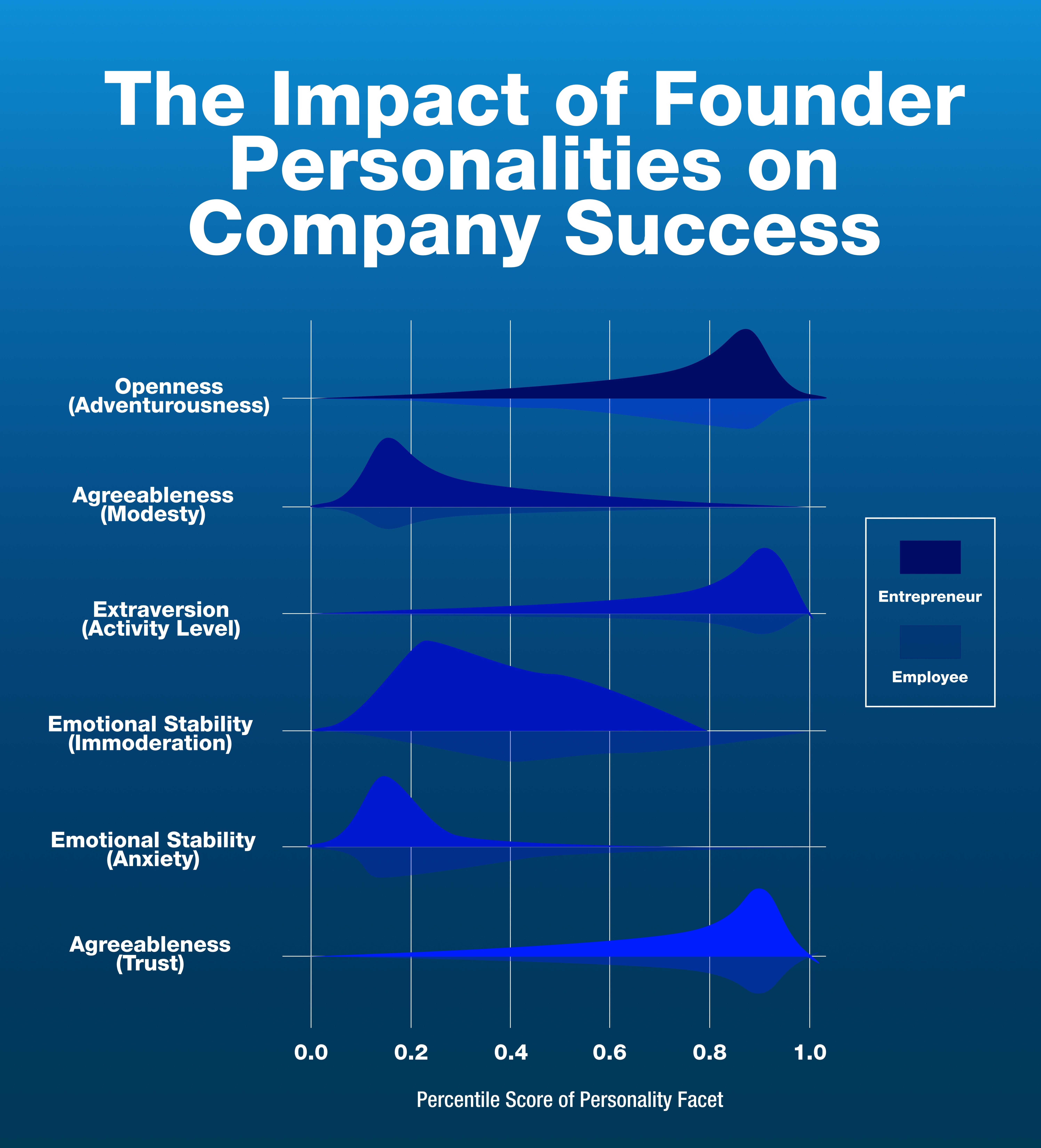
Founders are not just employees who decided to “start something.” On a psychological level, they consistently differ across several core personality dimensions — differences that map closely to the realities of building a high-growth company.
This doesn’t mean one profile is “better” than another. But it does explain why entrepreneurship attracts — and rewards — a very particular mix of traits.
1. Openness: The Engine of Innovation
One of the strongest differentiators is openness, particularly adventurousness.
Founders score significantly higher here than traditional employees. This shows up as:
A willingness to explore unproven ideas
Comfort operating without clear answers
Curiosity about new markets, models, and technologies
A tolerance for ambiguity
This trait is the fuel behind innovation. It’s what allows founders to see opportunities where others see risk, and to act before certainty exists.
But openness cuts both ways.
Without discipline, it can turn into distraction — chasing novelty instead of building depth.
The most successful founders combine openness with focus.
2. Extraversion (Activity Level): Energy as a Competitive Advantage
Founders tend to exhibit higher activity levels, a facet of extraversion that has little to do with being “outgoing” and everything to do with stamina.
Building a startup is a sustained energy test:
Multiple roles, simultaneously
Constant context switching
High decision density
Long periods without external validation
High activity levels allow founders to operate at this pace — and to pull others along with them. Teams often take their emotional and operational cues from the founder’s energy.
This is why burnout is such a hidden risk.
When the founder slows down, the company often does too.
3. Agreeableness (Modesty): Confidence Without Apology
Another consistent difference shows up in lower modesty, a subset of agreeableness.
This isn’t arrogance — it’s self-belief.
Founders must:
Pitch bold visions
Ask for capital
Defend controversial ideas
Push against scepticism
Advocate relentlessly for their company
Too much modesty makes this impossible.
That said, unchecked confidence can alienate teams and partners. The founders who scale best learn to pair conviction with listening — confidence with curiosity.
4. Emotional Stability: Calm in the Chaos
Founders typically score lower on anxiety, a key component of emotional stability.
This matters more than almost any other trait.
Startups are environments of constant threat:
Cash risk
Competitive pressure
Rejection
Uncertainty
Personal financial exposure
Founders who remain calm under pressure can make rational decisions when others freeze or panic.
However, the BrainDump also highlights a nuance: founders may struggle with immoderation — difficulty switching off, regulating impulses, or sustaining balance.
This is why support systems matter.
Resilience isn’t just emotional toughness — it’s recovery.
5. Trust: Healthy Skepticism, Not Cynicism
Founders often score lower on trust, another facet of agreeableness.
At first glance, this sounds negative. It isn’t.
Lower trust reflects:
Skepticism around deals
Caution with partners
Critical evaluation of claims
Awareness of downside risk
In early-stage companies, this is protective. Blind trust is expensive.
But taken too far, mistrust corrodes culture. The founders who succeed long-term learn when to scrutinise — and when to delegate.
Trust becomes a strategic choice, not a default setting.
What This Means for Founders
There is no “perfect founder personality.”
But there are predictable strengths and blind spots.
High openness enables innovation — but needs structure.
High energy drives momentum — but requires recovery.
Low modesty enables conviction — but demands humility.
Low anxiety supports leadership — but doesn’t remove stress.
Low trust protects downside — but must not kill collaboration.
The founders who win aren’t those with ideal traits — they’re the ones with self-awareness.
They:
Build teams that complement their personality gaps
Create routines to counter their weaknesses
Seek feedback early, not defensively
Invest in personal development as seriously as product development
Why Investors Care (Even If They Don’t Say It)
Investors rarely talk explicitly about personality traits — but they evaluate them constantly.
They’re asking:
Will this founder break under pressure?
Can they take feedback?
Will they scale themselves as the company scales?
Are they resilient, adaptable, and coachable?
Personality doesn’t replace metrics — but it shapes how metrics are achieved.
This is why two startups with similar numbers can receive very different investor reactions. One feels inevitable. The other feels fragile.
The Real Takeaway
Founder personality doesn’t determine success — but it tilts the odds.
When founders understand their own psychological wiring, they stop fighting themselves and start designing around reality. They build better teams, make better decisions, and create companies that are robust, not brittle.
Self-awareness isn’t soft.
It’s strategic.
And in a world where execution compounds faster than ideas, that may be the most underappreciated advantage of all.
-Chris Tottman
WHAT A TITLE LMAO
Thanks for a great post Chris. In point I agree, there are certain types that seek a path of an entrepreneur life, but I need to challenge this somewhat.
Entrepreneurs usually come in various flavors, but I think one thing that you don't bring up here is a level of grandeur and/or narcissism that comes with being an entrepreneur. You need a certain level of this, since the odds of success is narrow, and you need to believe highly enough of yourself to even try.
I guess you could file this under adventurous, but I think it's deeper than just seeking adventure.
Thoughts?