

Here’s a question worth sitting with for a moment.
If I asked you right now (not to go away and prepare, but right now) what your revenue will look like in 36 months, could you answer with confidence? Not a rough guess. Not a number you inflated for the last pitch deck. A real, scenario-tested, assumption-backed answer.
Most founders can’t. And it costs them. Sometimes everything.
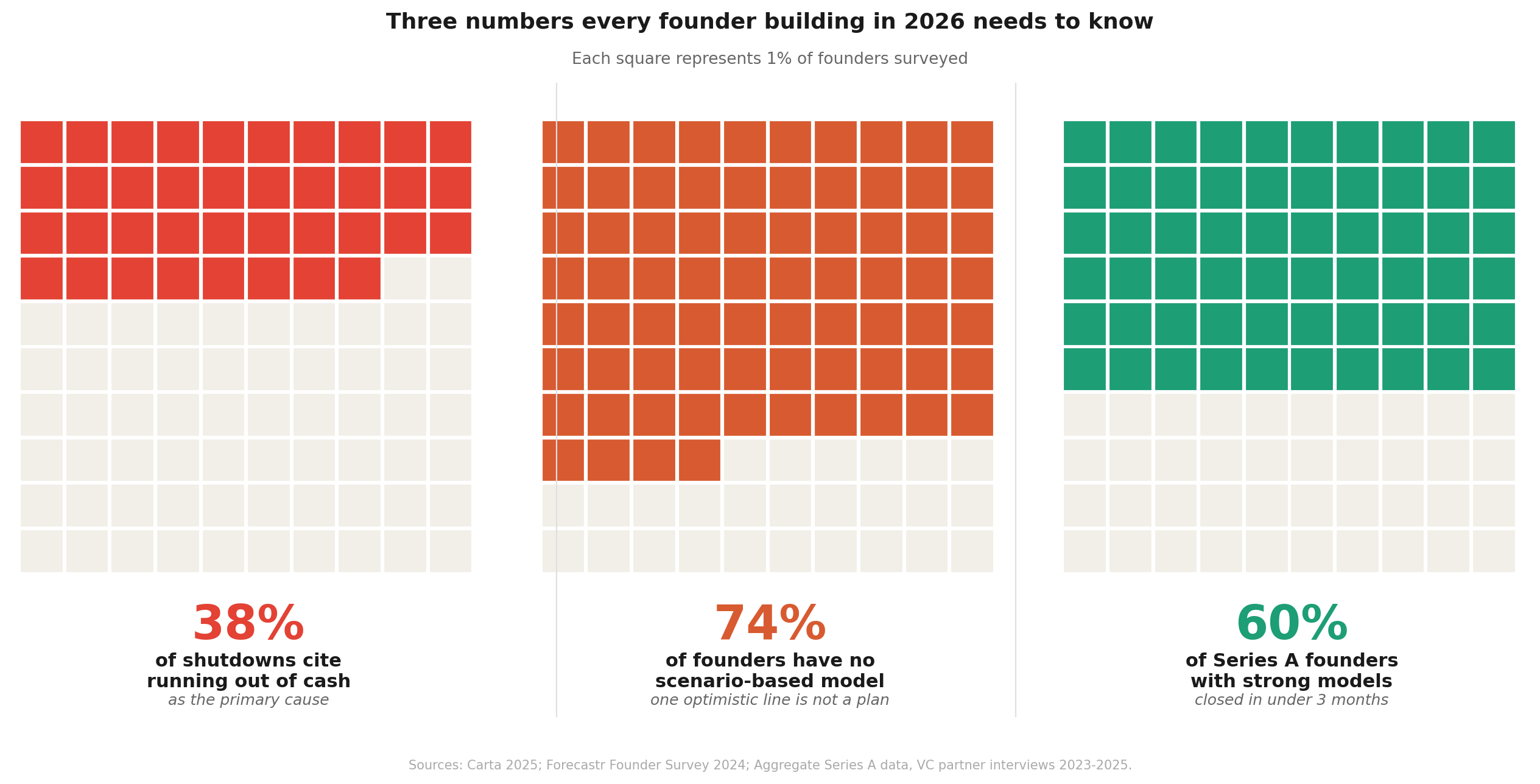
The Brutal Reality Most Founders Never See Coming
In 2024, 966 US startups shut down. That’s a 25.6% increase on the year before.
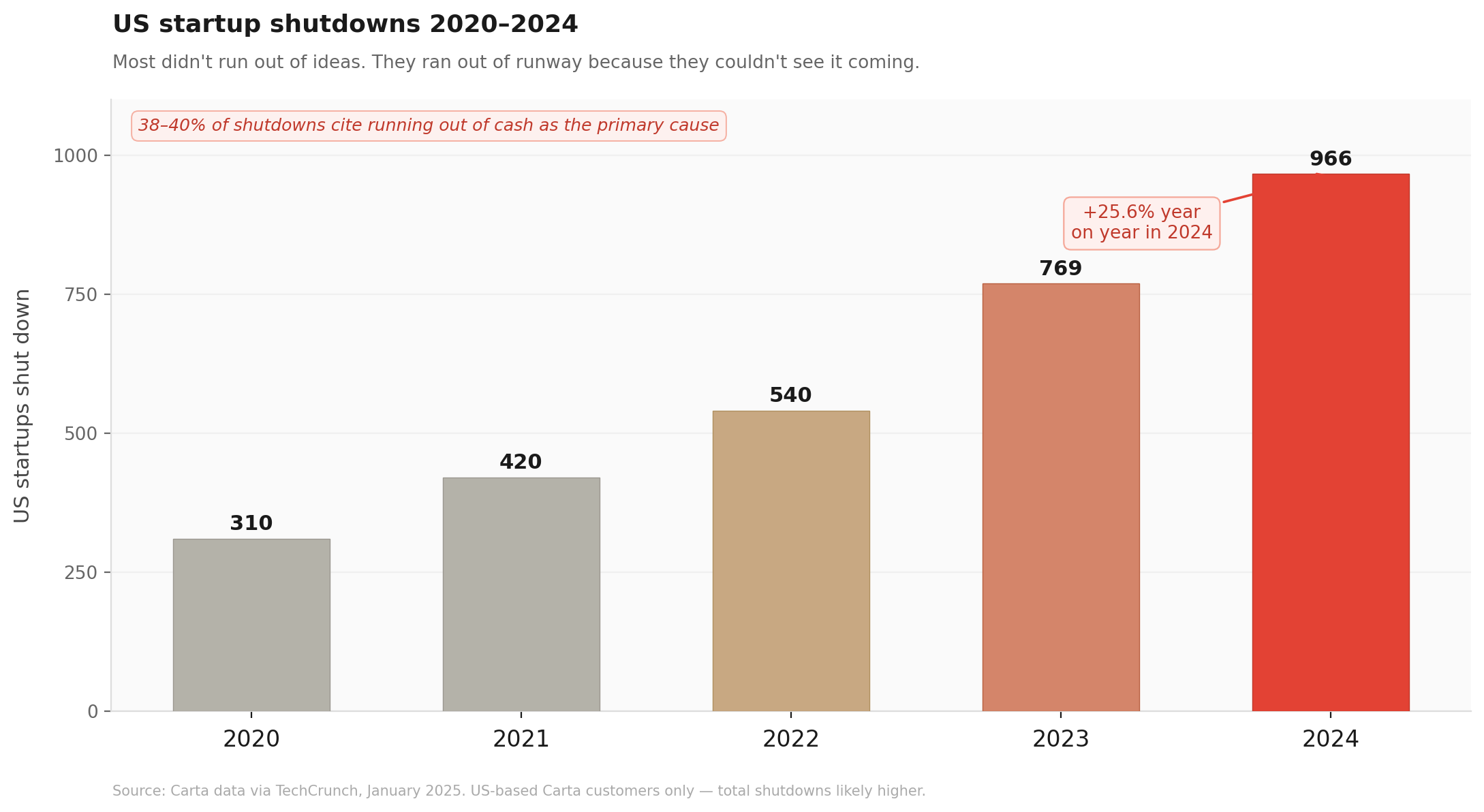
The leading cause? Running out of cash. Accounting for 38 to 40% of all startup deaths according to data compiled through 2025.
Here’s what’s devastating about that statistic. Running out of cash is rarely a sudden event. It’s a slow drift: a gap between what founders assumed would happen and what actually did. The forecast was wrong, or worse, there was no real forecast at all.
The number wasn’t modelled. The scenarios weren’t stress-tested. The hiring plan was based on the bull case, not the base case. And by the time the gap became visible, it was already too late to course-correct.
This is not a cash flow problem. It’s a visibility problem.
What Investors Already Know
When a founder walks into a fundraising conversation, experienced investors aren’t just looking at what the business is today. They’re trying to understand whether the founder understands what the business is becoming.
The 36-month revenue forecast is one of the most revealing documents in any pitch. Not because investors believe the numbers (they don’t, and they’ll tell you that). But because the assumptions behind those numbers tell them everything about how the founder thinks.
Are the growth assumptions grounded in real conversion data, or pulled from the air? Is churn modelled? Is expansion revenue separated from new revenue? Are there multiple scenarios, or just one optimistic straight line upward?
In 2025, investors are more rigorous about this than ever before. The days of growth at all costs are over. VCs now require Series A-level metrics even at Seed stage, and they press founders on breakeven timelines, capital efficiency, and scenario modelling in ways that weren’t standard three years ago.
The founders who nail this aren’t just better at finance. They’re better at thinking.
The Difference Between a Forecast and a Guess
A lot of founders have a spreadsheet they call a revenue forecast. Very few have an actual revenue model.
Here’s the distinction that matters.
A guess is a single line: monthly revenue growing at some percentage, month after month, until the numbers look impressive enough to show an investor. It feels like planning. It isn’t.
A forecast is something entirely different. It’s a living model with three scenarios: bull, base, and bear. It has assumptions you’ve stress-tested. It knows what happens if your churn rate creeps up by 2%. It shows what month you become cash-flow positive in each scenario. It models the lag between hiring and productivity. It accounts for the difference between bookings and recognised revenue.
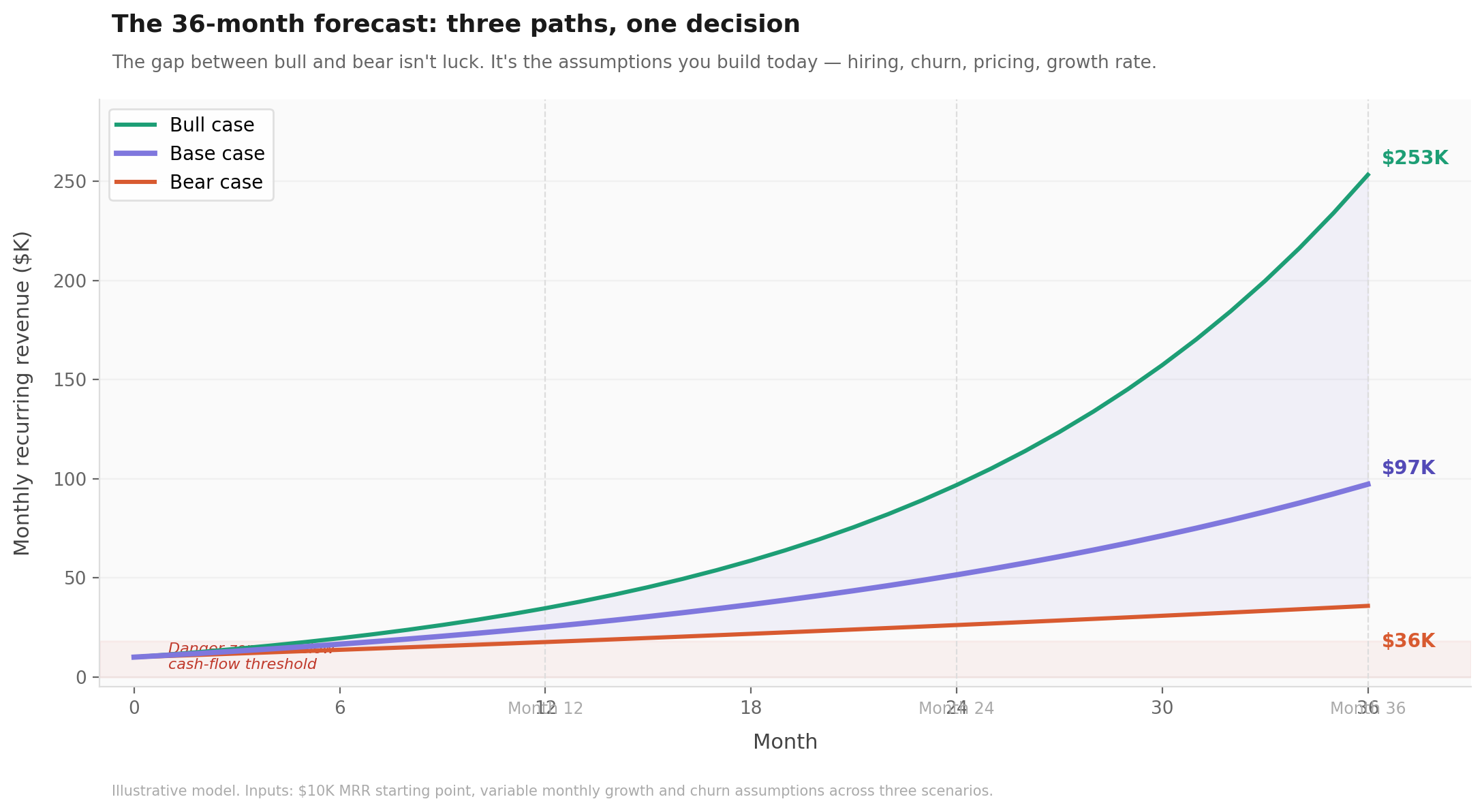
The 36-month window is not arbitrary either. It’s the horizon that matters most for early-stage companies. It’s long enough to show the compounding effect of retention. It’s the period investors use to model returns. And it’s the timeframe where the decisions you make today (on hiring, pricing, customer acquisition) either compound beautifully or unravel slowly.
Thirty-six months is where the real story lives.
The Assumptions That Actually Drive the Number
Most founders obsess over the revenue line. Experienced operators obsess over the assumptions underneath it.
There are five inputs that move a 36-month forecast more than anything else.
Monthly growth rate. Even small differences compound dramatically over 36 months. A 7% monthly growth rate versus a 5% monthly growth rate looks manageable in month six. By month 36, it’s the difference between a business that works and one that doesn’t.
Net revenue retention. As we’ve covered in this newsletter before, NRR is the signal that separates sustainable businesses from ones that are permanently filling the bucket while it leaks. A forecast without a real NRR assumption is a forecast built on sand.
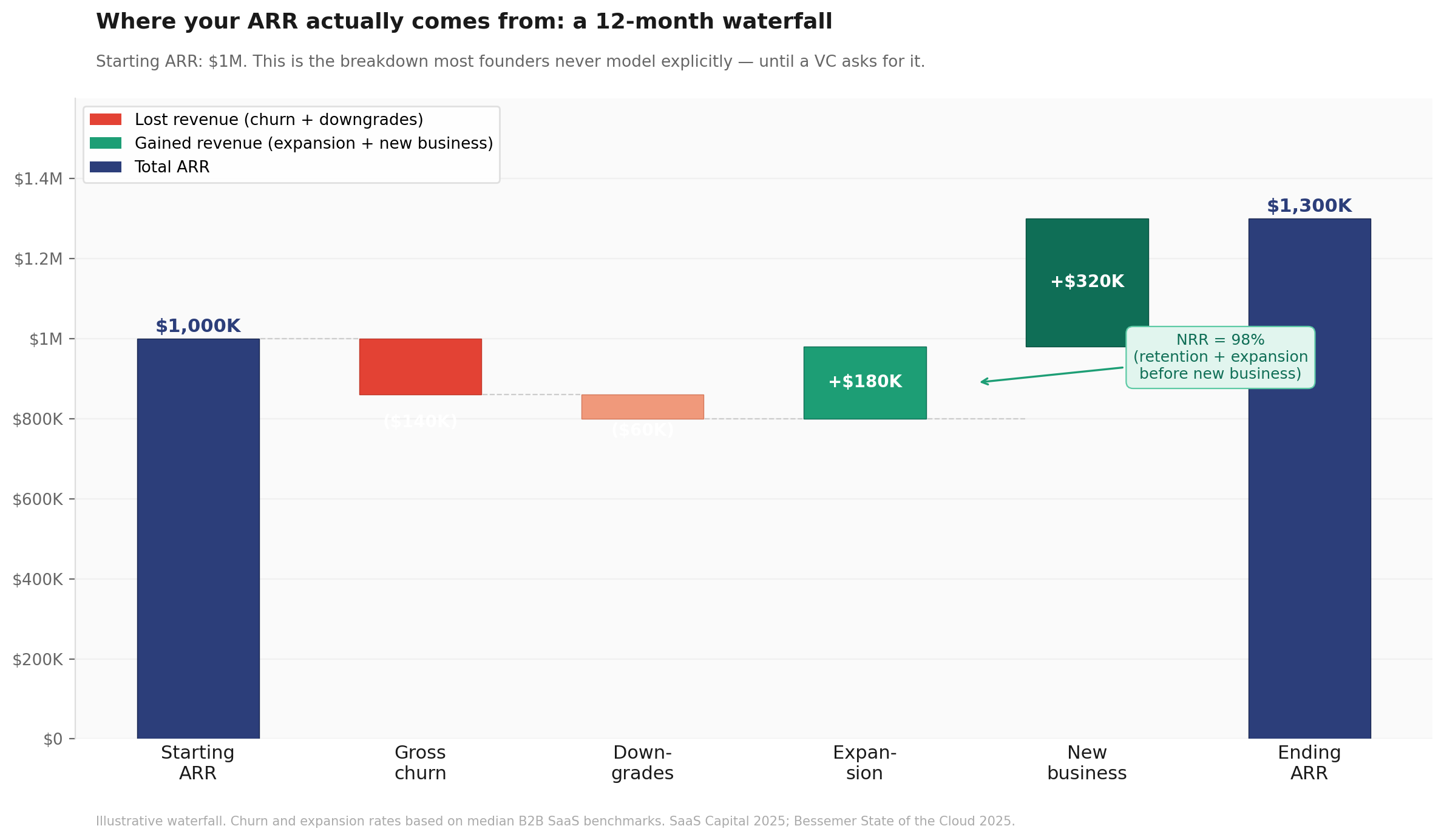
Customer acquisition cost and payback period. If your CAC payback is 18 months, you need 18 months of runway before that customer contributes to growth. Founders who model this properly know exactly how much capital they need to reach self-sufficiency. Those who don’t discover the gap in a board meeting.
Hiring lag. The time between making a hire and that person becoming fully productive is consistently underestimated. Most early-stage companies assume new hires contribute immediately. A properly built forecast models a 60 to 90 day ramp, because that’s what actually happens.
Churn. Not the churn rate you hope for. The churn rate you’ve actually seen, and what happens to the model if it gets 30% worse.
Build your forecast around these five inputs and you will understand your business in a way that most of your peers simply don’t.
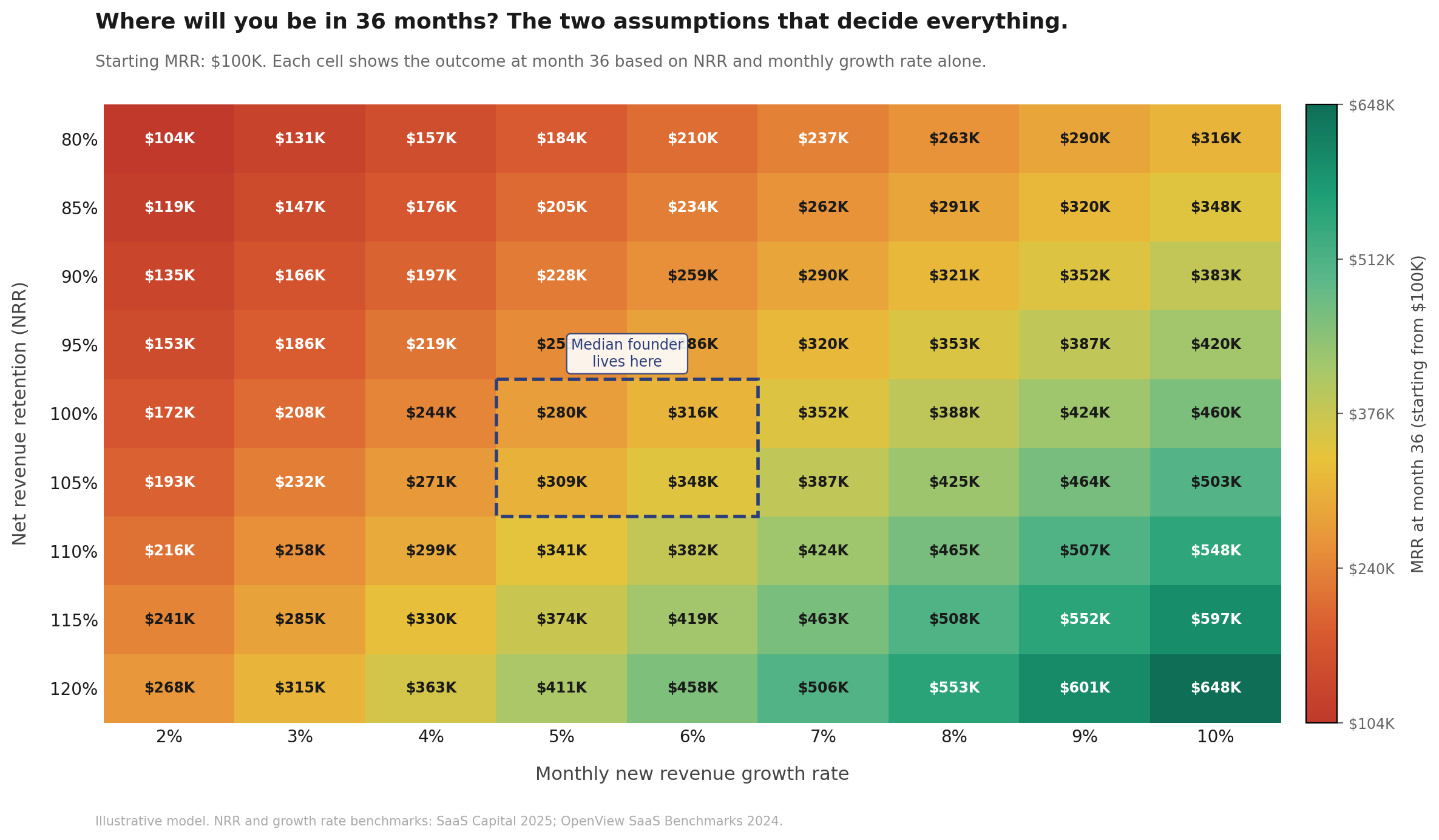
And here’s what most founders miss entirely: your revenue model isn’t one size fits all. A Sales-Led company has completely different unit economics to a Product-Led Growth company. An AI SaaS business with usage-based pricing compounds differently to a traditional subscription model. A Hybrid motion has different CAC payback dynamics to a pure PLG play. Modelling the wrong business type gives you a number that looks right but tells you nothing useful. And that’s often more dangerous than having no model at all.
If You Found This Useful
This newsletter covers the frameworks, tools, and hard-won lessons that serious founders actually need. If you’re finding value here, these are some of my articles our readers come back to most:
The Venture Capital Due Diligence Playbook - How investors actually evaluate startups once they start digging.
The Investors Actually Writing Cheques In 2026 - A look at a growing but misunderstood source of capital.
SAFE Notes, Dilution & Cap Table Reality - What founders often misunderstand about ownership before a round.
And if you’re not yet a paid subscriber, what follows is a good reason to become one.
🔒 The 36-Month Revenue Forecast
This is the tool I wish existed in my first decade of scaling companies. I’ve seen what happens when founders walk into a Series A without a stress-tested model. I’ve also seen what happens when they walk in with one. The difference in the room is immediate, and so is the difference in the terms they walk out with.