

👋 Hey, Chris here! Welcome to BrainDumps—a weekly series from The Founders Corner. If you’ve been reading along, you know this series is a preview of a bigger project. Well, it’s finally here: The Big Book of BrainDumps is out now!
It isn’t a theory book—it’s the founder’s field manual. Inside, you’ll find 70 powerful frameworks distilled from 30+ years scaling software companies to hundreds of millions in ARR, 20+ years investing in 500+ B2B tech startups, and over $1B of shareholder value created. From raising capital to hiring your first VP of Sales, this book turns scars and successes into practical playbooks you’ll return to again and again. I expect most copies will become well-worn, scribbled on, and dog-eared—because it works.
There’s a moment in every startup when strategy stops being the deciding factor.
The plan is good.
The market is clear.
The product works.
And yet performance stalls.
In those moments, what determines whether a company pushes through or quietly plateaus isn’t intelligence, experience, or even effort — it’s emotional leadership.
This is where Primal Leadership comes in.
It’s a concept that investors rarely name explicitly, but instinctively evaluate every time they meet a founding team. And it explains why some leaders create environments where people thrive under pressure — while others drain energy, clarity, and momentum without realising it.
Table of Contents
What Primal Leadership Really Is
The Emotional Intelligence Core
The Five EQ Capabilities
The Four Types of Primal Leadership
The Impact on Teams and Performance
Why This Matters So Much for Founders
Practical Tips for Practising Primal Leadership
What Investors See (Even If You Don’t Say a Word)
The Real Takeaway
What Primal Leadership Really Is
Primal leadership is based on a simple but powerful idea:
The leader’s emotional state sets the emotional tone of the organisation.
Whether you like it or not, as a founder or senior leader:
Your mood spreads
Your reactions ripple
Your behaviour becomes the norm
Teams don’t just execute strategy — they mirror leadership energy.
Primal leadership recognises this reality and turns it into a tool rather than a liability.
The Emotional Intelligence Core
At the heart of primal leadership sits emotional intelligence (EQ) — not as a buzzword, but as a practical leadership discipline.
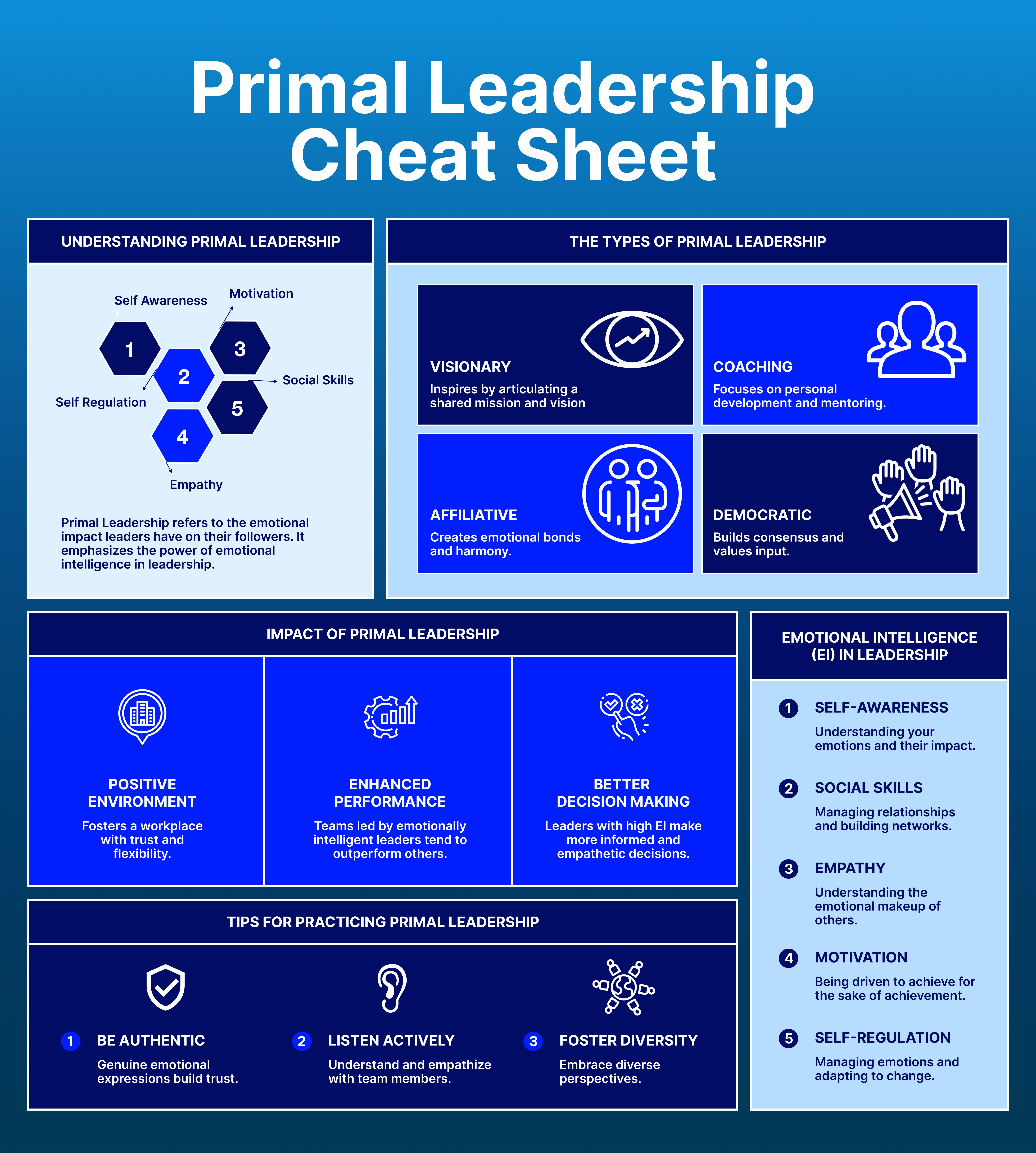
The cheat sheet breaks EQ into five core capabilities:
1. Self-Awareness
Understanding your own emotional triggers, strengths, and blind spots.
Founders who lack self-awareness often believe they’re being “direct” when they’re actually being destabilising.
2. Self-Regulation
The ability to manage emotional reactions — especially under stress.
This is critical in startups, where fear, urgency, and uncertainty are constant companions. Leaders who can regulate themselves create psychological safety for everyone else.
3. Motivation
Intrinsic drive that goes beyond incentives.
Primal leaders don’t need external pressure to perform — and that internal motivation becomes contagious.
4. Empathy
Understanding how others are experiencing pressure, change, and uncertainty.
Empathy allows leaders to respond appropriately rather than react impulsively.
5. Social Skills
The ability to influence, communicate, and resolve conflict effectively.
In fast-moving environments, social skill isn’t “nice to have” — it’s execution leverage.
The Four Types of Primal Leadership
Primal leadership isn’t a single style. The best leaders move fluidly between four modes depending on the moment.
Visionary
Used when direction is needed.
Visionary leaders articulate why the work matters and where the company is going. This style is powerful during change, pivots, or periods of uncertainty.
Coaching
Used when growth is the priority.
Coaching leaders focus on long-term capability building — developing people rather than just extracting output.
Affiliative
Used when trust needs rebuilding.
This style strengthens relationships, repairs fractures, and reinforces belonging — especially after high-stress periods.
Democratic
Used when buy-in matters.
Democratic leaders involve the team in decisions, increasing commitment and surfacing diverse perspectives.
The key insight: great leaders don’t default to one style — they choose deliberately.
The Impact on Teams and Performance
When primal leadership is present, organisations consistently show:
✅ A Positive Work Environment
People feel safe, motivated, and engaged — not watched or managed.
✅ Enhanced Performance
Emotional clarity reduces friction, speeds execution, and improves focus.
✅ Better Decision-Making
Teams are more willing to surface risks, challenge assumptions, and think clearly under pressure.
This is why emotionally intelligent leadership often outperforms technically superior leadership over time.
Why This Matters So Much for Founders
Startups amplify everything:
Stress
Emotion
Conflict
Urgency
Founders who are unaware of their emotional impact accidentally become the biggest source of instability in their own company.
Primal leadership helps founders:
Avoid emotional whiplash
Build resilient cultures
Reduce burnout
Improve investor confidence
Scale decision-making beyond themselves
It’s not about being calm all the time — it’s about being intentional.
Practical Tips for Practising Primal Leadership
The cheat sheet highlights four behaviours that make the biggest difference:
Be Authentic
People trust leaders who are real — not performative.
Listen Actively
Listening isn’t passive. It’s a signal that people and information matter.
Foster Diversity
Diverse perspectives improve emotional and strategic outcomes.
Embrace Emotional Awareness
Your emotional state is part of your leadership toolkit. Use it consciously.
What Investors See (Even If You Don’t Say a Word)
Investors assess primal leadership instinctively:
Does this founder energise or drain the room?
Do people speak freely around them?
Is there psychological safety?
Can this leader handle pressure without destabilising the team?
This is why two founders with identical metrics can receive very different reactions.
One feels steady.
The other feels fragile.
The Real Takeaway
Primal leadership isn’t soft leadership.
It’s high-performance leadership for high-pressure environments.
Founders who master it don’t just build companies — they build systems where people can do exceptional work without burning out or breaking trust.
And in a world where execution speed and resilience determine survival, that may be the most under-rated competitive advantage of all.
-Chris Tottman
A wise CEO once told a much younger me "Organisations are shadows of their leaders. Choose what shadow you want to cast carefully."