

I want to start with a number that should stop every founder in their tracks.
In 2018, B2B GTM effectiveness stood at 78%. By 2025, it had fallen to 47%.
That means today, more than half of every pound and dollar your sales and marketing teams spend is waste. Not inefficiency. Not underperformance. Structural, systemic waste.
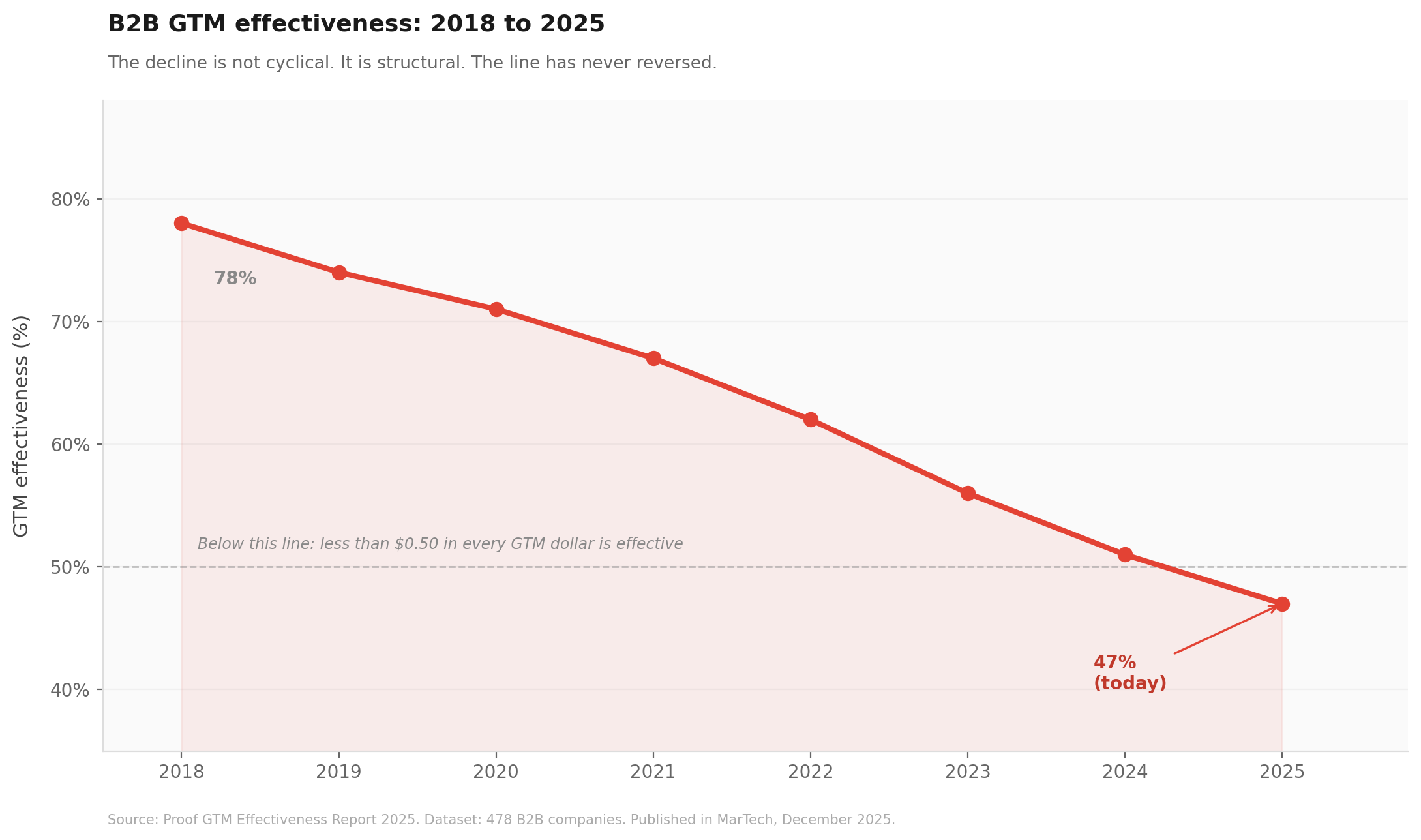
The decline is not because GTM teams got less sophisticated. The opposite is true. They got more sophisticated while the marketplace got more complex. Buyers became nonlinear. Decision cycles doubled. Procurement scrutiny intensified. And somewhere between 2021 and today, between 40 and 60% of deals in the average pipeline started ending in no decision at all.
The market changed. Most GTM strategies didn’t.
Brought to you by Nume.ai
There are a handful of moments that decide whether your company lives or dies.
You usually find out about them too late.
A spike in burn.
A silent drop in runway.
Costs creeping in places you’re not watching.
By the time it shows up in a spreadsheet, the damage is already done.
Nume fixes that.
It connects to your bank, Xero, QuickBooks, and watches your numbers in real time.
Not reports. Not dashboards you forget to check.
Actual alerts when something changes, straight to Slack.
And when you need answers, you just ask:
How long is our runway if we keep hiring?
What changed in burn this month?
Where are we leaking cash?
No digging. No lag. No £15K CFO.
Just instant clarity on the numbers that actually matter.
Try it here with a 14-day free trial, then use code CHRIS50 for 50% off your first month.
The Real Killer Is Not What You Think
When founders ask me why their GTM isn’t working, they expect me to talk about messaging, or ICP targeting, or the wrong hire in the CRO seat.
Those things matter. But they are rarely the root cause.
The root cause is almost always a structural mismatch between the GTM motion they chose and the economics of their business.
Put simply: they are selling a product that costs a certain amount, through a process that costs far more to operate than that amount can ever justify.
70% of GTM strategies fail not because of execution. They fail because of misalignment between teams and motion, before execution even begins.
Here is the principle every founder needs to internalise before they hire their first salesperson, choose their first channel, or build their first pipeline.
Your ACV is your GTM compass.
It tells you how you should sell, who should sell it, how long you can afford for a deal to take, and what kind of customer success motion you can sustain. Get that alignment right and the rest of GTM becomes a scaling problem. Get it wrong and you are permanently fighting economics that cannot work, regardless of how hard the team runs.
The Five Motions and Why They Are Not Interchangeable
There are five primary GTM motions in B2B SaaS. They exist on a spectrum from high volume and low ACV at one end, to low volume and high ACV at the other. And they are not interchangeable.
Product-Led Growth (PLG). The product sells itself. Users discover, try, and buy without a sales team involved. This works when ACV is below $5,000, time to value is fast, and the buyer is the user. Slack. Figma. Notion. The economics only work at scale: you need vast user numbers to generate meaningful revenue without a sales layer.
Inside Sales (one stage). A single rep discovers and closes. Works for ACV of roughly $5,000 to $20,000, where the buyer is accessible and the deal is low complexity. Fast cycles. High volume.
SDR and AE (two stage). A separate development rep qualifies and an account executive closes. ACV of $20,000 to $75,000. This is where most mid-market SaaS companies live, and where most GTM motion mistakes happen. The overhead of a two-stage sales process requires the ACV to justify it. Many founders run this motion on ACVs that cannot sustain it.
Field Sales. In-person, relationship-led, high complexity. ACV of $50,000 to $150,000. Long cycles, high-touch, significant investment per deal. Works only when the deal size and strategic value justify the cost of the motion.
Named Accounts. A handful of strategic relationships, each worth $100,000 to well over $1,000,000 in ACV. Every resource is concentrated. Nothing is wasted on volume.
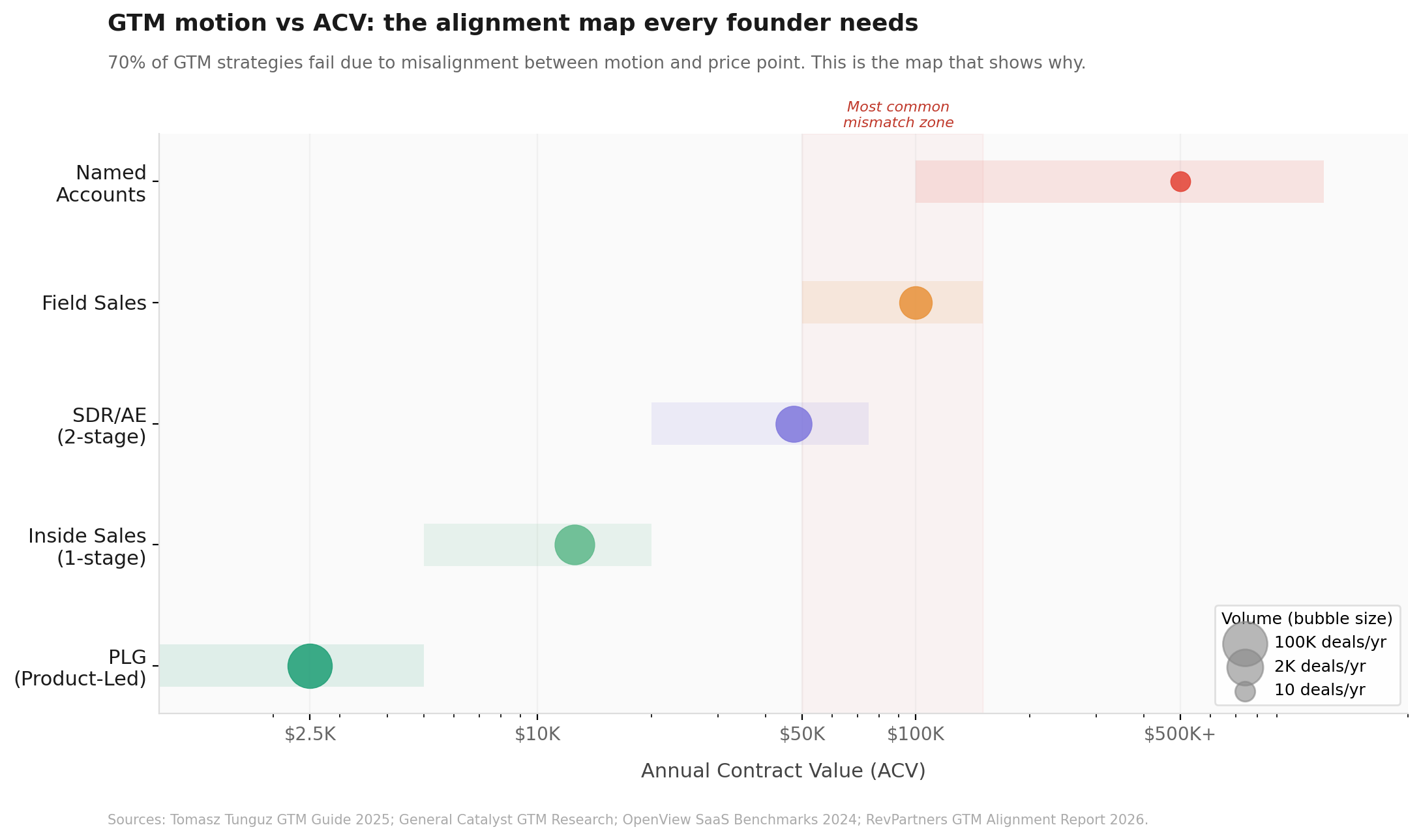
The most common and most damaging mistake I see in early-stage companies is running a Field Sales or SDR/AE motion on an ACV of $8,000. The deal size can never recover the cost of acquisition. CAC payback stretches to infinity. The company burns cash not because it isn’t growing, but because the motion is structurally incompatible with the price point.
Your ACV is not just a pricing decision. It is a GTM architecture decision.
The Mismatch No One Talks About
There is a second mismatch that is even more insidious, and almost never diagnosed correctly.
It is the mismatch between what the buyer expects and how you are selling.
High ACV deals are typically reserved for sales-led because most people aren’t ready to commit $50,000 or more without talking to someone. Conversely, low ACV products sold through heavy sales touch feel expensive and friction-filled. The buyer experience is wrong before the conversation even begins.
This plays out in metrics in a specific way. You see qualified leads going cold. You see demo-to-close rates that are inexplicably low. You see churn in the first 90 days from customers who seemed to buy enthusiastically.
None of that is a product problem. It is a motion problem.
The right GTM motion means the buyer’s experience of purchasing your product matches what they expected when they first encountered it. Self-serve buyers want to put a card down. Enterprise buyers want a conversation and a proof of concept. Mid-market buyers want a demo and a pilot. When those expectations are violated, deals die quietly and nobody can explain why.
The CAC Viability Problem
Here is the calculation most founders never do before they commit to a GTM motion.
Take your ACV.
Multiply it by your gross margin.
Then apply your target payback window.
That gives you the maximum you can spend to acquire a customer before the economics stop working.
Now look at the fully-loaded cost of your current sales motion: salaries, commissions, tools, marketing spend, management overhead.
Divide that by the number of customers you closed last quarter.
If the second number is higher than the first, you have a CAC viability problem. And no amount of hiring, no additional marketing budget, no new sales methodology will fix it, because the motion itself cannot support the economics.
This is the diagnostic most founders only run after a board meeting where someone finally puts the numbers on a whiteboard.
Run it now. Before the next hire. Before the next channel test. Before the next quarter of burn.
The question isn’t “can we close deals?”
It is “can we close deals at a cost that allows the business to survive?”
The Channels That Are Actually Working in 2026
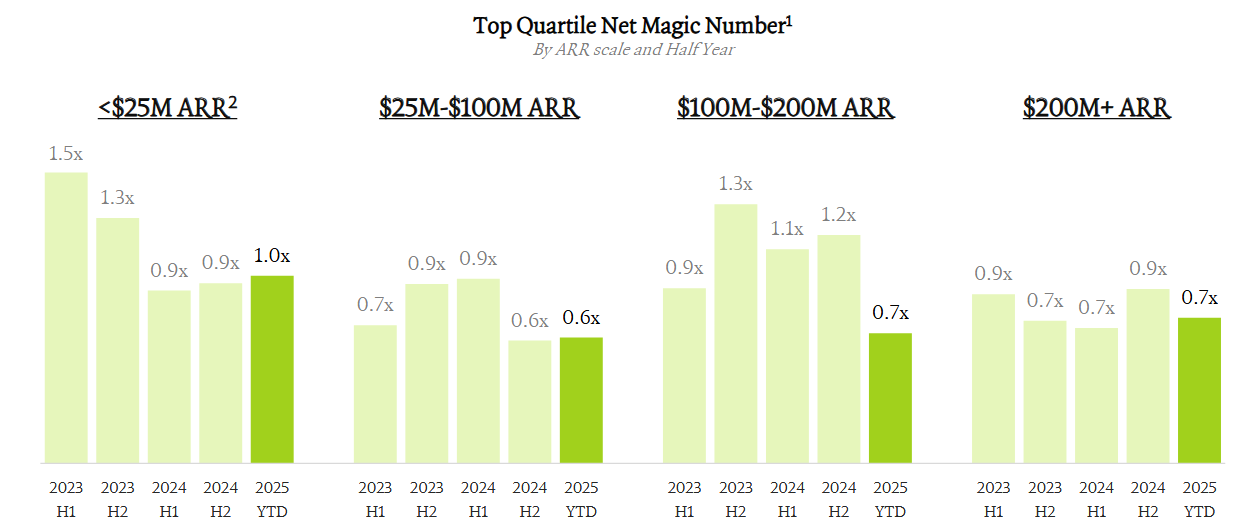
If the motion mismatch is the structural problem, the channel mix is the tactical one. And in 2026, the channel data is clearer than it has ever been.
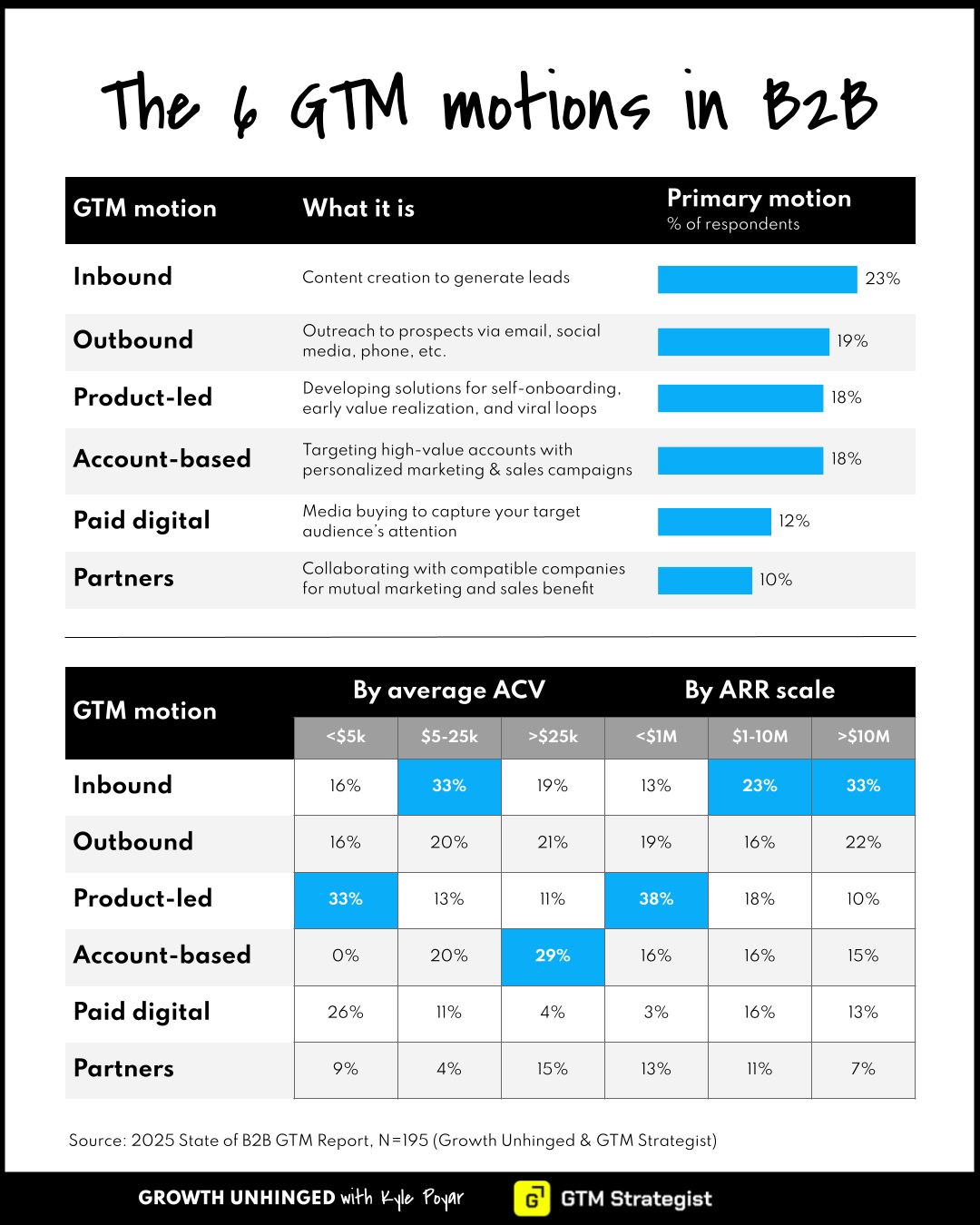
The data from 195 companies and six GTM motions in 2025 is unambiguous on a few points.
LinkedIn is the only major advertising platform achieving positive ROAS for B2B, at 113%. Google non-branded search is at 78%, below breakeven. Meta is at 29%. The channel shift is not a preference. It is arithmetic.
Intent-based outbound dramatically outperforms problem-based outbound. Timeline-focused cold email hooks achieve a 10% reply rate versus 4.4% for traditional problem-statement hooks. That is a 2.3x performance difference on the same list, the same rep, the same effort.
Partner-sourced pipeline now accounts for 26 to 28% of revenue for the average B2B company, up from 18 to 20% in 2024. The fastest-growing GTM motion is not a new digital channel. It is ecosystem-led growth.
And the average software company is now running 10.5 simultaneous GTM initiatives. That number is unsustainable for most teams. The companies pulling ahead in 2026 are the ones ruthlessly cutting to three or four motions and executing them better than anyone else.
The Default Alive Question
There is a term in early-stage investing: Default Alive.
It asks a simple question. If your revenue growth continues at its current rate and your costs remain constant, will you reach profitability before you run out of money?
Most founders think this is a financial question. It isn’t. It is a GTM question.
Because the single biggest lever between Default Alive and Default Dead is not headcount, not office space, not infrastructure. It is the efficiency of your customer acquisition.
A company with a well-matched GTM motion, running the right channels, with CAC that the ACV can sustain, compounds toward Default Alive with every passing month. A company with a mismatched motion burns faster as it grows, because every new customer it acquires costs more to get than it can ever generate.
The GTM Motion Fit Calculator was built to answer this question before it becomes a crisis.
🔒 The GTM Motion Fit Calculator
I want to be direct about why this tool exists.
In 20 years of backing over 500 B2B companies, the single most common reason a promising company stalled was not the product. It was a GTM motion they could not afford to run, operating on a price point that could not sustain the economics of how they were selling.
By the time most founders discovered this, they had burned 12 months and significant capital running a motion that was structurally incompatible with their business. The GTM Motion Fit Calculator was built so that doesn’t happen to you.
Here is what it does.