

There’s something nobody tells you about using AI for your raise, until you’ve been doing it for a few weeks:
You don’t have a Claude problem. You have a chatbot problem.

You open a tab. You ask it to write a follow-up. You copy the answer into your outreach tool. Tomorrow, you do it again. Next week, you’ve forgotten which opener you tried on which investor, so you ask Claude to write another one, from scratch, with no memory of what already worked.
That’s not an AI workflow. That’s data entry with better sentences.
The founders getting through this market faster aren’t the ones with a better prompt. They’re the ones who stopped treating Claude like a vending machine you visit once and started treating it like a coworker that holds context, runs a loop, and only stops to ask you when it actually matters.
This is the full system. Nine prompts. Memory, sourcing, outreach, replies, follow-up, performance review, deliverability, guardrails, investor updates, and the maintenance pass that keeps it all from going stale. Run in order, in one pinned conversation, they turn Claude from something you visit into something that runs alongside you.
The math nobody runs before they build this 📊
Cold outreach to investors is a volume-and-precision game, and most founders are optimizing neither. Baseline cold investor email reply rates sit around 1% to 5%, which is brutal on its own. But that number moves hard depending on execution: an analysis of over 1,200 cold investor emails found personalized messages reply at roughly 5x the rate of generic ones, and emails referencing specific traction numbers reply at nearly 2.8x the baseline.
Stack two or three of those levers and you’re in a completely different game. The problem is doing that consistently, for every single investor, every single week, without it eating your whole calendar.
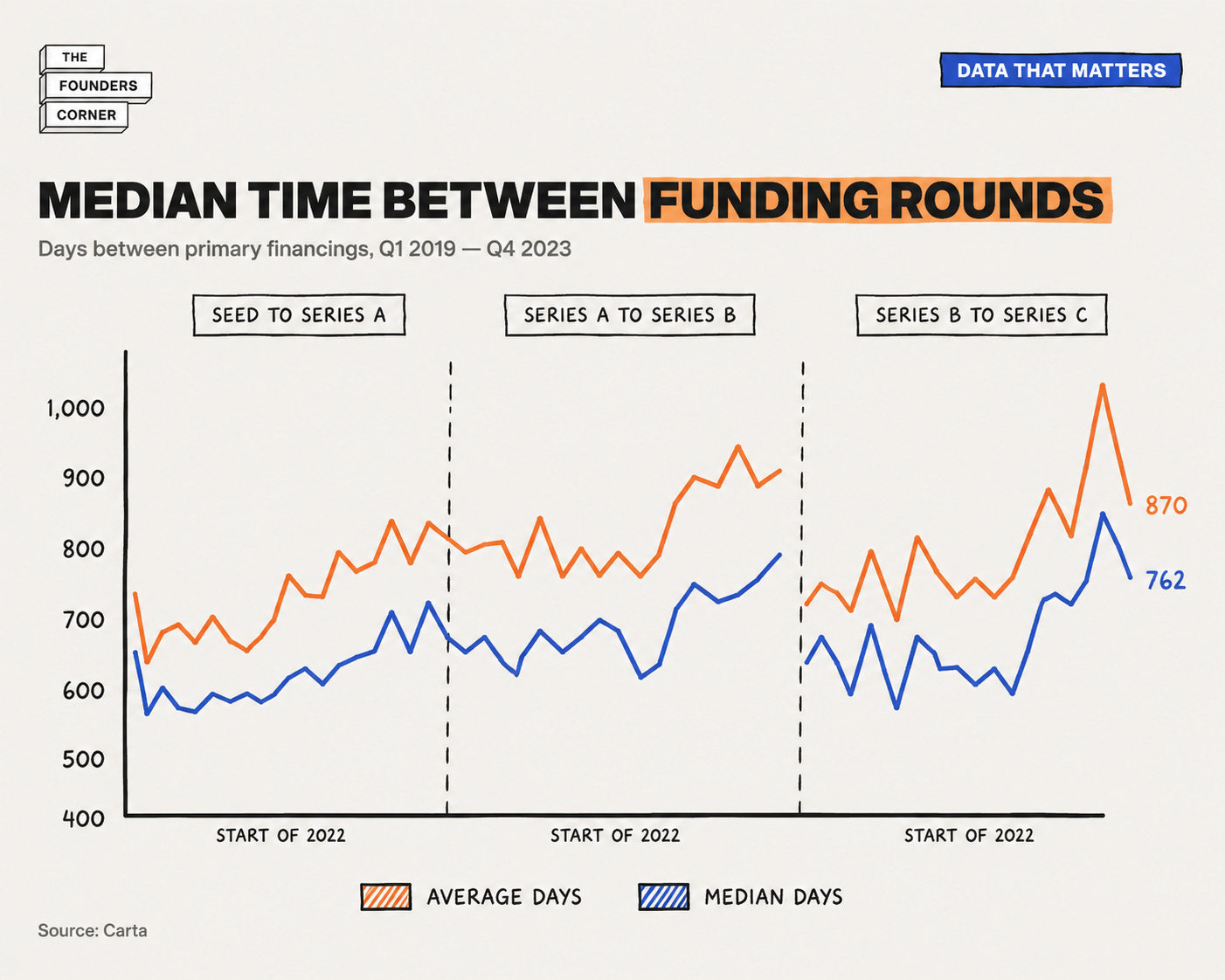
The median time between funding rounds has also stretched from roughly 451 days in 2021 to about 744 days by Q4 2024. Your raise is very likely going to take longer than the last one did, whether you’re ready for that or not. The founders who handle that stretch well aren’t the ones grinding harder in month four. They’re the ones who built something in month one that’s still running in month four without them.
That’s the entire case for an agent instead of a chatbot. Not novelty. Arithmetic.
Why the “open Claude, ask a question” workflow quietly fails
A chatbot has no memory between tabs. Ask it to write ten cold emails today and ten more next week, and it has no idea which of last week’s ten got a reply, which subject line worked, or which investor you already have a call booked with. You become the memory. You become the loop. You become the thing that has to remember to open the tab in the first place.
An agent is the same model, Claude, doing the same reasoning, but wired to three things a chatbot never has: a memory it updates itself, a set of actions it’s actually allowed to take, and a cadence that runs without you remembering to press go.
None of that requires new software. It requires a different first prompt, and a system that builds on it.
Want to get in front of 250k+ founders and investors?
For sponsorship opportunities across The Founders Corner newsletter and LinkedIn (160k followers), email: founderscornermedia@gmail.com
Is your raise already running itself? Five questions to find out
1. If you closed your laptop for a week, would your outreach still be moving? If the honest answer is no, you don’t have a system. You have a to-do list with better vocabulary.
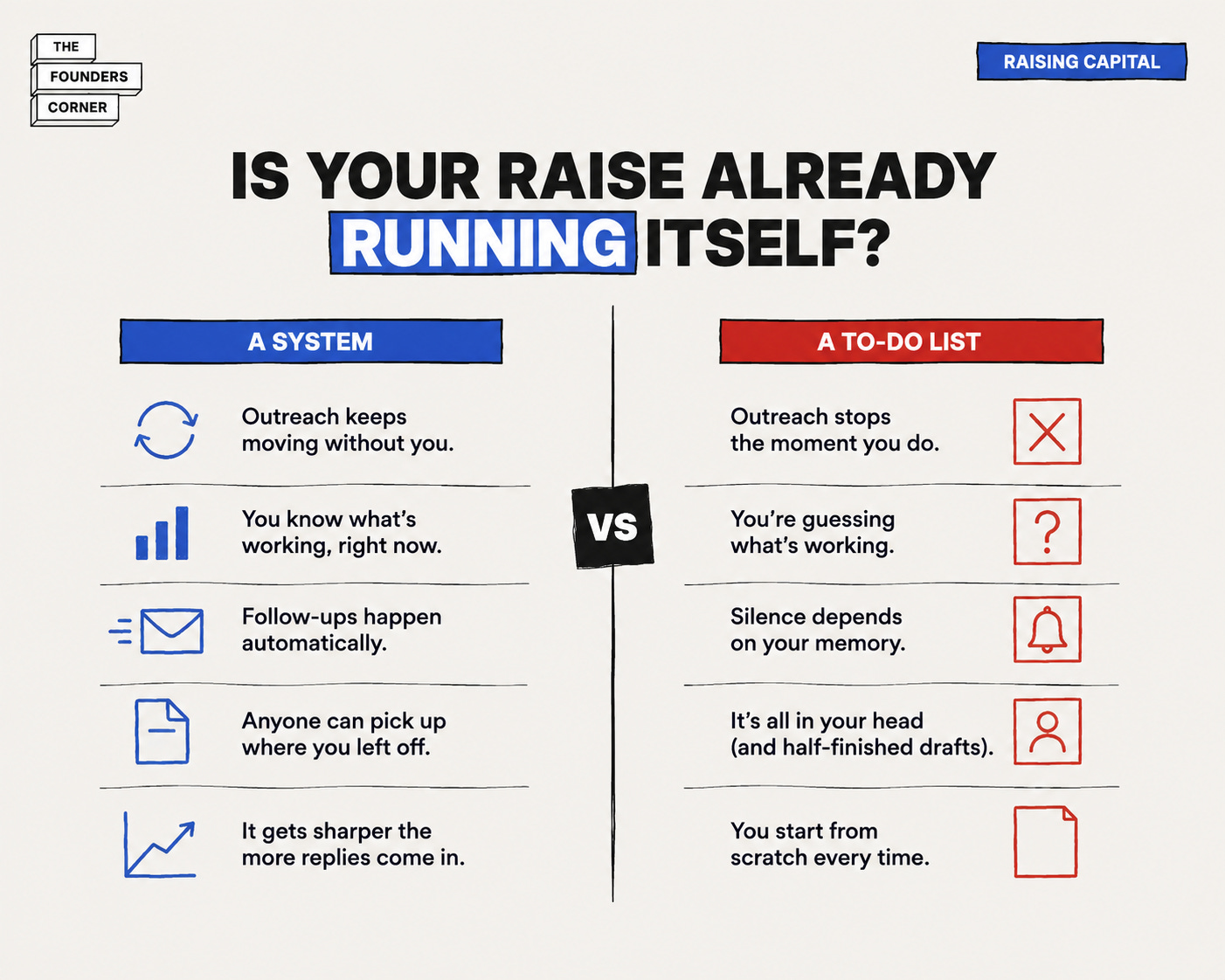
2. Do you know, right now, without checking, which subject line is outperforming the others this month? Most founders couldn’t answer this in five seconds. The ones closing fastest usually can.
3. When an investor goes quiet for five days, does something follow up automatically, or does it depend on you remembering? Silence is the default outcome of fundraising. What happens next shouldn’t depend on your memory.
4. Could you hand your outreach log to a co-founder today and have them pick up exactly where you left off? If it’s all in your head and half-finished drafts, you don’t have a log. You have a bottleneck with one point of failure: you.
5. Are you writing a new email from scratch every time, or is something getting sharper the more replies come in? A system that learns from outcomes gets better every week. A blank tab doesn’t.
🟦 Prompt 1: The raise memory setup
Run this first. Once. In a fresh conversation, ideally a Claude Project you keep pinned rather than a chat you close after one email.
This is the only prompt in the system that isn’t a task. It’s the frame that makes every other prompt below actually function as an agent instead of a one-off request. Without it, Claude answers each prompt in isolation. With it, Claude holds your company facts, your target list, and your outreach history across every session, and updates that memory itself as you feed it outcomes.
Be specific in what you paste in. The more precise your starting facts, the less Claude has to guess later.
You are going to act as the operating system for my fundraise, not a
one-off assistant. Every prompt I run after this one assumes you're
holding the following context and updating it as I give you new
information.

Set up and maintain these four sections:

1. COMPANY FACTS: name, one-sentence description, stage, sector,
   traction (revenue, users, growth rate), amount raising, use of funds
2. TARGET PROFILE: the specific investor type I should be contacting
   (stage, check size, sector focus, geography)
3. OUTREACH LOG: every investor I've contacted, with date, channel,
   and status (no reply / opened / replied / meeting booked / passed)
4. WHAT'S WORKING: which subject lines, opening angles, or channels
   have actually gotten replies, updated as I report real outcomes

Here's my starting information:
[COMPANY NAME · ONE-SENTENCE DESCRIPTION · STAGE · TRACTION · AMOUNT
RAISING · TARGET INVESTOR PROFILE]

Confirm you're holding this as ongoing context. From now on, whenever
I say "log this" or "here's what happened," update the relevant
section and show me the current state before doing anything else.
Do not draft or send anything until I explicitly ask in a later prompt.
💡 Why this works: the single line that turns this from a chatbot into an agent is “update the relevant section and show me the current state.” That’s the memory. Everything below assumes it’s running.
If this is useful, this is one piece of a bigger system we’ve been building all year. Worth reading alongside this one:
How to Build Your Fundraising Narrative with Claude: the five-prompt playbook for turning your raw story into the argument that gets you a term sheet before you ever need an agent to manage the replies
I Asked Claude to Reject My Pitch Until It Couldn’t. Then I Raised.: the adversarial system that finds the weak points in your pitch before an investor does
The Claude Prompt That Turns a Cold Email Into One a VC Actually Reads: the five-prompt system behind the exact kind of personalized outreach this agent drafts every week
The 6 Claude Prompts That Change How Investors See You: the positioning layer that makes sure what the agent is sending is actually the right story
The Claude Due Diligence Playbook That Gets You to Closing: what happens after the agent gets you the meeting, and the term sheet lands
The Claude Prompt That Found My Real ARR. Then I Raised.: make sure the traction number this agent is putting in every outreach draft is one you can actually defend
🟦 Prompt 2: The weekly sourcing and outreach draft
This is the loop. Run it once a week, in the same conversation as Prompt 1, and it does the two things that eat the most founder hours: finding who to contact, and writing to them like you actually know who they are.
Using the context you're holding on my raise, propose 10 investors
this week who match my target profile and haven't already appeared
in my outreach log.

For each one:
- Name, fund, and the specific reason they fit (their stated thesis
  or a real portfolio overlap, not "early-stage generalist")
- A cold outreach draft under 100 words, personalized to their actual
  thesis or a named portfolio company, referencing one specific
  traction number from my company facts
- A one-line note on the best channel: direct email, a warm path if
  one plausibly exists through my network, or LinkedIn

Then, for anyone in my outreach log marked "no reply" for 5 or more
days, draft a short follow-up that references the original email
without re-explaining the whole pitch.

Show me everything as drafts only. Tell me which ones you'd prioritize
sending first and why. I will tell you which to log as sent, and you
update the outreach log accordingly.
⚡ The personalization and traction-number instructions aren’t decoration. They’re the two levers with the biggest measured effect on reply rate. Bake them into the prompt so you get them every single week without having to remember to ask.
📋 The full system: what the rest of this build covers
Prompts 1 and 2 give the agent memory and a weekly sourcing-and-drafting habit. That’s real, usable value on its own. But it isn’t the full autopilot yet, that’s what happens once replies start landing and you need something managing the inbox, the timing, and the guardrails without you babysitting every step. Here’s the rest of what’s built out below:
✓ Prompt 3: The reply triage and routing. Classifies every reply into genuine interest / needs more info / soft pass / hard pass / automated, and drafts the exact next message for each category, so a full inbox never turns into an afternoon of deciding what to do.
✓ Prompt 4: The follow-up cadence. The specific three-touch sequence and timing that consistently outperforms a single follow-up, built to run directly off your outreach log’s “no reply” status.
✓ Prompt 5: The weekly performance review. Compares this week’s subject lines and opening angles against last week’s, and tells you plainly which to keep using and which to kill.
✓ Prompt 6: The deliverability guardrail. The volume, pacing, and pattern rules that keep a real outreach cadence from tripping spam filters and burning your sending domain’s reputation.
✓ Prompt 7: The “loop me back in” escalation rule. Defines, in writing, exactly which actions the agent proposes and which it’s never allowed to take without your explicit yes, so it stays a teammate and never becomes a liability.
✓ Prompt 8: The investor update draft. Turns your outreach log and company facts into the monthly update you send to investors who are already committed, without rebuilding it from scratch every time.
✓ Prompt 9: The memory prune and handoff. Keeps the memory file accurate as your stage, numbers, or targeting shift mid-raise, so the agent isn’t still pitching last quarter’s traction in month three, and lets you hand the whole thing to a co-founder in one page.
Paid subscribers also get:
✓ 60+ additional tools covering every other stage of fundraising and running a company: pitch deck screening, investor research agents, due diligence, term sheet analysis, and data room management. The same tool stack this agent slots into.
Start your 7-day free trial → Cancel anytime.
🟦 Prompt 3: The reply triage and routing
This is the moment most founders lose the thread. Ten cold emails go out, three replies land in the same afternoon, and each one needs a different response, sent fast, while you’re also supposed to be running the actual company.
A reply that says “send me the deck” and a reply that says “not right now, keep me posted” both look like small wins in an inbox. They need completely different responses, sent within the hour, not whenever you next have a spare ten minutes.