

👋 Hey, Chris here! Welcome to BrainDumps—a weekly series from The Founders Corner. If you’ve been reading along, you know this series is a preview of a bigger project. Well, it’s finally here: The Big Book of BrainDumps is out now!
It isn’t a theory book—it’s the founder’s field manual. Inside, you’ll find 70 powerful frameworks distilled from 30+ years scaling software companies to hundreds of millions in ARR, 20+ years investing in 500+ B2B tech startups, and over $1B of shareholder value created. From raising capital to hiring your first VP of Sales, this book turns scars and successes into practical playbooks you’ll return to again and again. I expect most copies will become well-worn, scribbled on, and dog-eared—because it works.
There’s a persistent myth in startup culture that leadership is about force of will.
The strongest founders.
The loudest voices.
The ones with the clearest answers.
But if you look closely at the startups that scale without burning people out, retain exceptional talent, and build cultures that endure, a very different leadership model keeps appearing:
Servant Leadership.
It’s quiet.
It’s misunderstood.
And it’s far more powerful than most founders realise.
This BrainDump captures the essence of servant leadership with rare clarity — not as a “soft” philosophy, but as a practical operating system for high-performance teams.
Let’s unpack it.
Table of Contents
What Servant Leadership Actually Means
Maslow’s Hierarchy Reimagined for Leadership
The Principles of Servant Leadership
Why This Matters So Much for Founders
Servant Leadership Is Not…
The Investor Lens (Why VCs Care More Than They Admit)
The Real Insight
Final Thought
What Servant Leadership Actually Means
At its core, servant leadership flips the traditional hierarchy.
Instead of asking:
“How do people serve the leader?”
Servant leaders ask:
“How do I serve the people doing the work?”
The goal isn’t authority — it’s enablement.
The leader’s job is to remove obstacles, create clarity, and build an environment where others can do their best work.
This is especially powerful in startups, where speed, trust, and autonomy matter more than control.
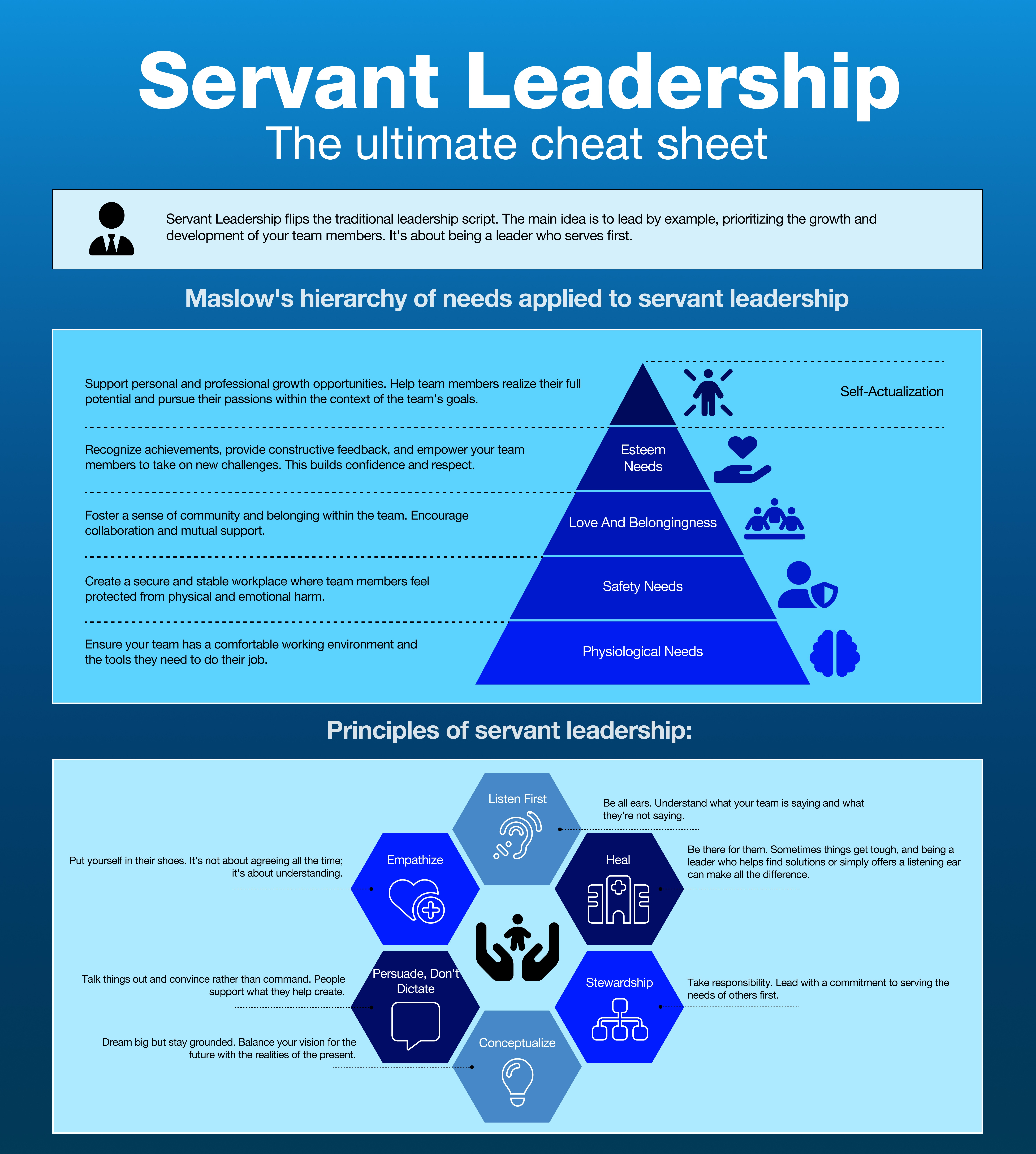
Maslow’s Hierarchy, Reimagined for Leadership
One of the most useful insights in this BrainDump is the application of Maslow’s Hierarchy of Needs to servant leadership.
Great leaders understand that performance is layered.
1. Physiological & Safety Needs
Before anyone can innovate, they need stability.
That means:
Fair pay
Reasonable workloads
Psychological safety
Clear expectations
Chaos doesn’t create creativity.
Safety does.
2. Belonging & Esteem
Once basic needs are met, people want to feel:
Valued
Respected
Included
Trusted
Servant leaders actively build belonging by listening, involving teams in decisions, and recognising contributions.
People don’t commit to companies — they commit to environments where they feel seen.
3. Self-Actualisation
At the top of the pyramid is growth.
This is where servant leadership really differentiates itself.
Servant leaders:
Invest in personal development
Create stretch opportunities
Encourage autonomy and mastery
Help people grow beyond their current roles
When people grow, companies scale.
The Principles of Servant Leadership
The BrainDump distils servant leadership into a set of practical behaviours — not slogans.
Let’s walk through the most important ones.
Listening
Servant leaders listen first — not to reply, but to understand.
This builds trust and surfaces issues early, before they become crises.
Empathy
Understanding people as humans, not resources, isn’t weakness — it’s leverage.
Empathy allows leaders to motivate, support, and retain talent in ways authority never can.
Awareness
Self-awareness is foundational.
Servant leaders understand:
Their own biases
Their emotional impact
Their blind spots
They don’t lead on autopilot.
Stewardship
Instead of ownership mentality (“this is mine”), servant leaders operate with stewardship (“this is ours”).
They protect culture, values, and long-term health — even when it’s uncomfortable.
Commitment to Growth
Servant leaders are measured not by what they achieve personally, but by how many people they help grow.
This is how leadership scales.
Building Community
High-performing teams don’t happen by accident.
Servant leaders deliberately foster connection, collaboration, and mutual respect — because strong relationships compound under pressure.
Why This Matters So Much for Founders
Founders sit at a dangerous intersection:
Extreme responsibility
Constant uncertainty
Intense pressure
Limited margin for error
In these conditions, command-and-control leadership feels tempting.
But it doesn’t scale.
Servant leadership:
Reduces founder bottlenecks
Increases ownership across the team
Builds resilience during downturns
Creates trust with investors
Enables faster, better decisions
Ironically, the leaders who give up control often gain more influence.
Servant Leadership Is Not…
Let’s be clear about what servant leadership is not:
❌ Not passive
❌ Not indecisive
❌ Not “nice at all costs”
❌ Not avoiding hard conversations
❌ Not sacrificing standards
Servant leaders still set direction.
They still hold people accountable.
They still make tough calls.
They just do it in service of the team, not their ego.
The Investor Lens (Why VCs Care More Than They Admit)
Investors don’t just back products — they back teams that can survive scale.
Servant leaders signal:
Low key-person risk
Strong culture foundations
Sustainable performance
Healthy decision-making systems
This is why, in later-stage diligence, investors spend so much time talking to employees — not just founders.
Leadership style leaks into everything.
The Real Insight
Servant leadership isn’t about being selfless.
It’s about being strategic with power.
By focusing on enabling others, leaders unlock:
Better execution
Faster learning
Higher engagement
Greater resilience
In complex systems — like startups — control is fragile.
Trust is robust.
Final Thought
Founders don’t fail because they lack vision.
They fail because they try to carry everything themselves.
Servant leadership is the shift from hero to architect — from doing everything to designing systems where others thrive.
And when that happens, companies stop relying on individual brilliance and start compounding collective strength.
-Chris Tottman
Coming Next
Now that we’ve explored leadership style, the next natural question is:
How do great founders make decisions when information is incomplete, stakes are high, and time is limited?
If I didn't read this i wouldn't know about the roles and characteristics of servant leaders. I saved and archived this post Just maybe if I see myself in that position in the near future. Thank you 🤝
Chris, you have successfully debugged the signaling error inherent in "Servant Leadership."
For a decade, the market has misread this concept as a fragility vector, ethical overhead that pragmatic operators view as softness. By re-indexing the concept against Maslow and defining it as an Operating System, you have stripped away the idealism.
The signal is now pure leverage: You cannot scale an organization if you remain the single point of failure.
The logic is irrefutable, which isolates the remaining friction: Ego. The barrier isn't intellectual anymore; it is biochemical. The question for the founder is no longer about efficiency, but about identity. Are you actually prepared to decentralized command? Or are you, covertly, addicted to the dopamine of being the bottleneck?