

There is a date in the venture calendar that nobody circles, and almost every founder misses.
It is not 1 September.
It is this week. Right now, while partners are still away, half clearing an inbox on a phone, deciding which four or five names they want to look at properly when they get back.
That list is being written today. Quietly, informally, mostly in a notes app. And it is the single most important document in your fundraise, because it decides who gets the good half of September and who gets the polite half.
Founders treat the autumn as a starting gun. Investors treat it as a shortlist they began building in July.
After 20 plus years investing, and having raised as a founder myself, I can tell you the pattern is astonishingly consistent. The rounds that close before Christmas were almost never introduced in the autumn. They were introduced before it.
Here is how the season actually works, why 1 September is already nine days too late, and the four things to have in your hands before tomorrow week.
The Season Nobody Puts In Writing
Venture has two live seasons. September to early December, and January to June. Everything else is administration.
The autumn season has a shape, and it is not evenly distributed.
September is the flood. Partners return with a refreshed pipeline mandate and an empty diary. Six to ten decks a day. Meetings are cheap and easy to get. Almost nobody receives a term sheet in September. What actually happens is that each partner quietly builds a shortlist of eight to twelve companies they intend to keep watching.
October is the decision. Second meetings. Partner meeting airtime. Reference calls you will never hear about. By the end of October, most partners have privately chosen the one or two deals they are prepared to fight for internally before the year ends.
November is the paperwork. Diligence, investment committee, terms, legals. A partner is not shopping in November. They are defending a choice they already made in October.
December is the door. Deals close in the first week. After that the industry goes quiet until the second week of January, and January restarts the entire cycle with a fresh mandate and no memory of your November email.
An investor falls in love in October and is one and done. Everything after that is administration on a decision that was already taken.
Want to get in front of 250k+ founders and investors?
For sponsorship opportunities across The Founders Corner newsletter and LinkedIn (160k followers), email: founderscornermedia@gmail.com
Why The Window Is Twelve Weeks, Not Four Months
Founders count September, October, November, December and see four months of runway. It is not four months.
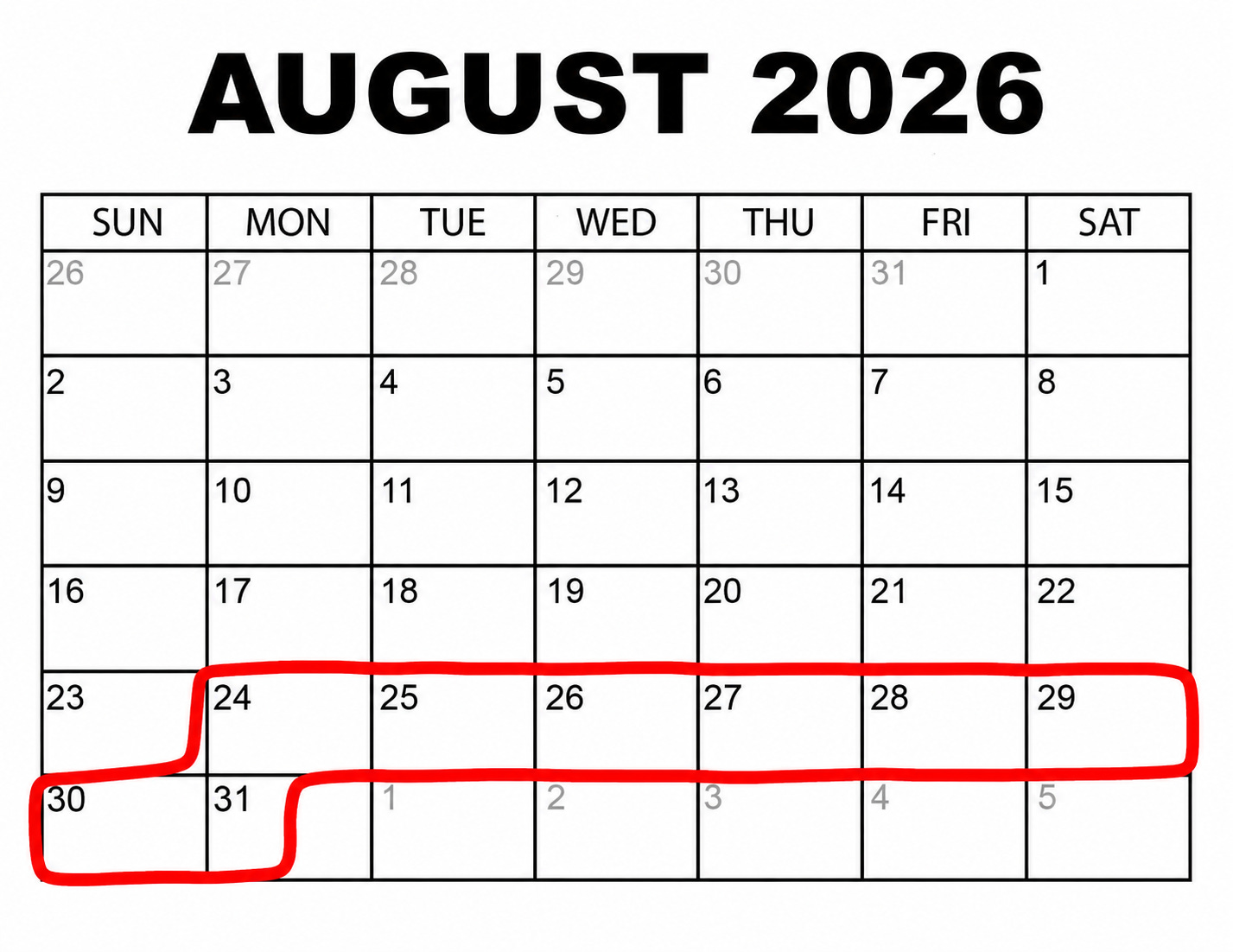
From Tuesday 1 September to Friday 4 December there are 94 days. That is 13.4 weeks before you take anything out.
Then take things out.
US Thanksgiving falls on Thursday 26 November. That entire week is dead for any fund with a US partner, a US LP base, or a likely US co investor. Not one lost day. One lost fortnight of momentum, because the week before becomes a scramble and the week after becomes a recovery.
The first week of December is a closing week, not an opening week. Partners are pushing signed deals over the line before year end. A new name arriving that week gets filed, not read.
Investment committees meet weekly at best, often fortnightly. Between 1 September and the last usable IC before Christmas you have roughly ten to twelve committee dates. Your deal needs two or three of them.
Strip out the dead weeks and the honest working window runs from 1 September to around 25 November. Twelve weeks.
Now hold that against the data.
In DocSend’s seed research, half of all successful raises took 13 to 24 weeks. Founders contacted an average of 66 investors and took 38 meetings to get there.
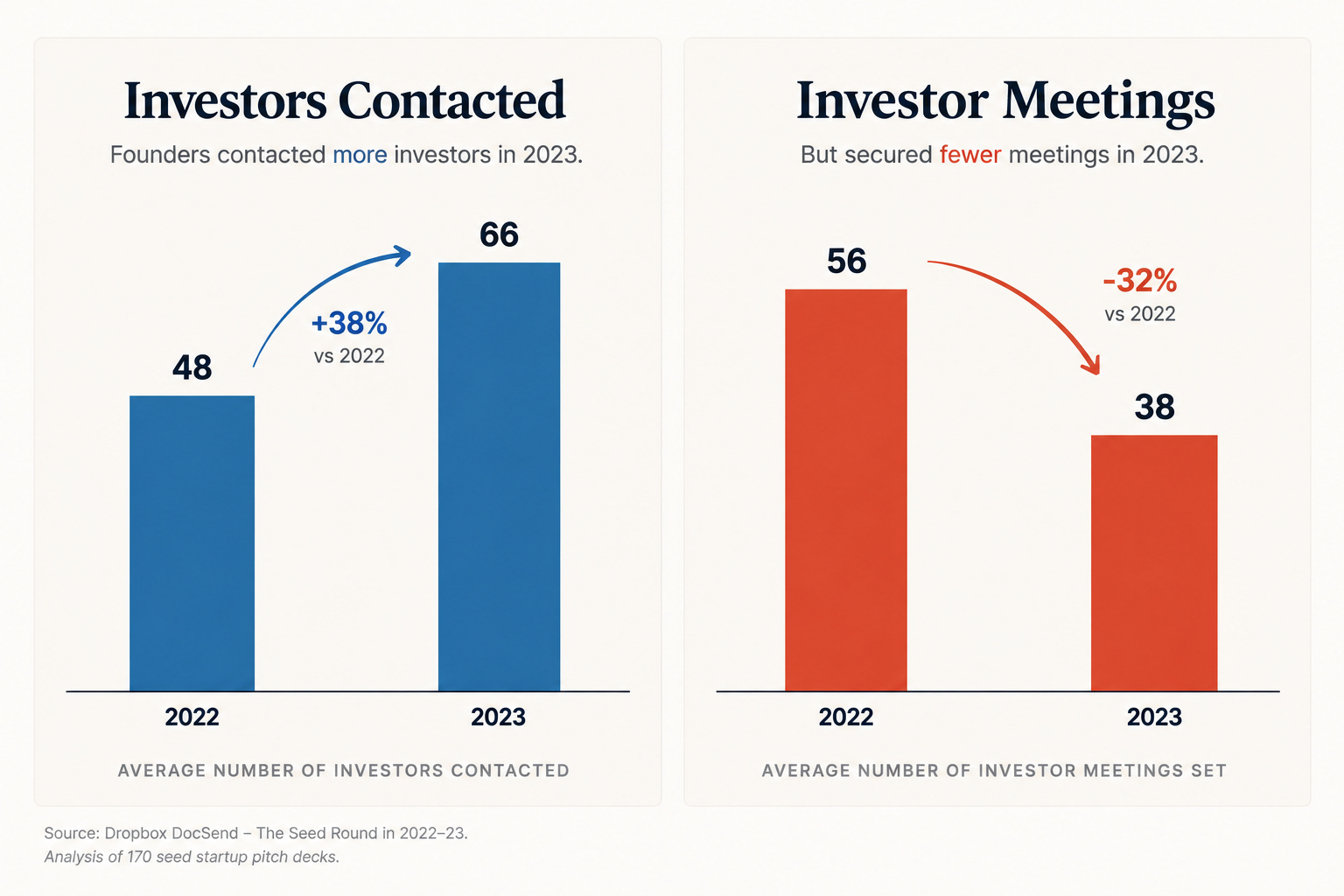
The autumn window is shorter than the average successful raise.
That is the whole article in one line. Founders who “start in September” are not starting early. They are arriving on the day the race begins with the preparation still to do.
Do this before you read any further. Open a calendar. Put your target close date on it. Count back twelve weeks. Whatever date that lands on is the day your raise actually had to begin, and for most founders reading this it is a date that has already passed.
The Slot Problem
This is the part that changes behaviour, so sit with it for a moment.
A partner at a traditional Series A or B firm does one to two new deals a year. At pre seed funds it might stretch to three or four. This is structural, not a market condition. Partners slow down at seven to ten board seats, and every cheque has to be plausibly capable of returning the fund.
Two live seasons a year. One to two deals a year.
Most partners have roughly one slot to fill this autumn.
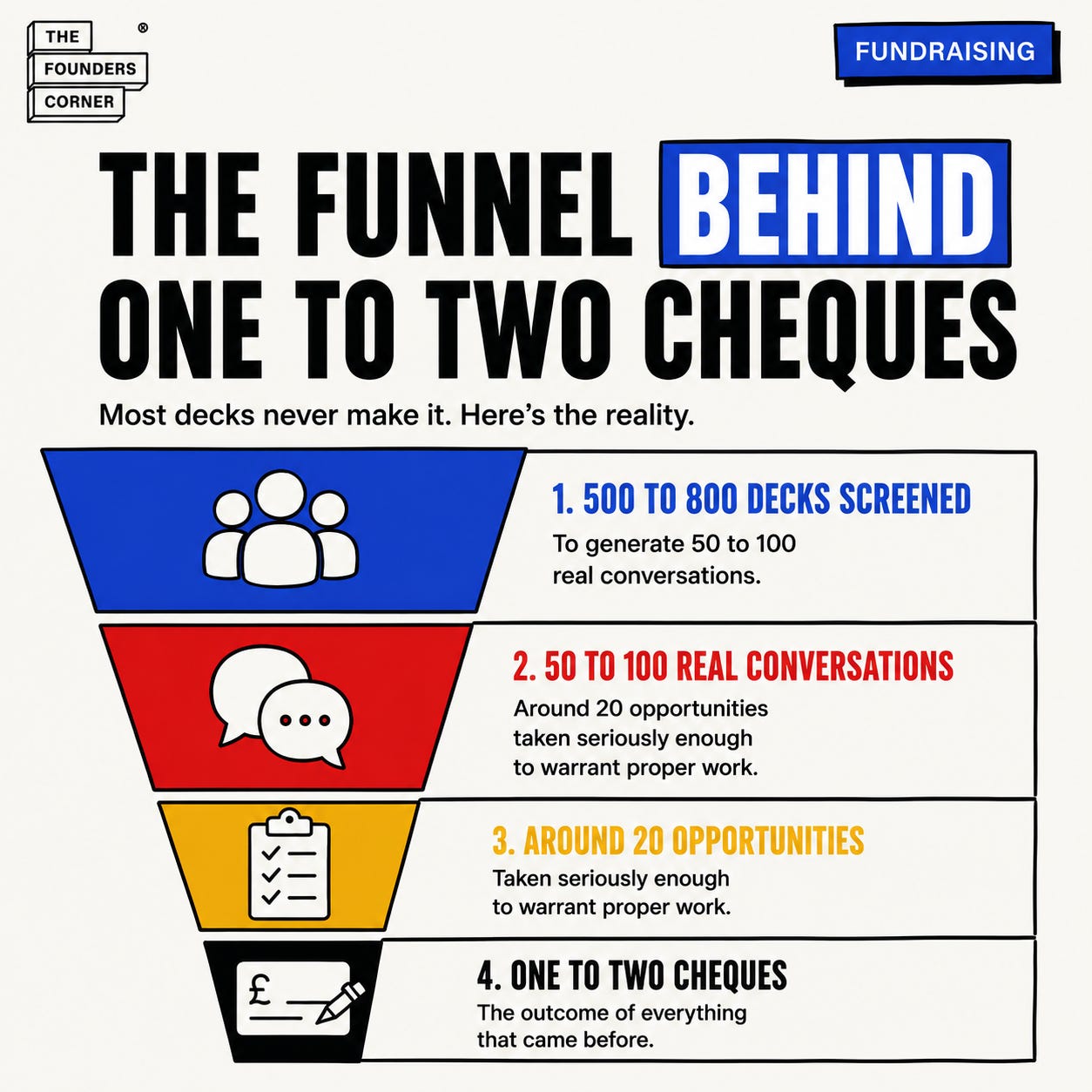
Here is the funnel that produces it:
500 to 800 decks screened to generate 50 to 100 real conversations
Around 20 opportunities taken seriously enough to warrant proper work
One to two cheques
You are not competing to be good. You are competing to be the one.
And then there is the line that matters most. According to Harvard Business Review’s analysis of 900 venture capitalists, more than 70% of deals originate inside the firm’s existing network.
Read that carefully. The majority of funded companies were already known to the investor before a deck was ever formally sent. Not warm introduced on the day. Known. Seen twice. Mentioned by a credible founder in July. Followed since the spring.
When I was raising, I assumed the process began when I hit send. It does not. By the time you hit send, most of the decision architecture is already in place.
The founders who get funded in October were introduced in August.
What A November First Meeting Actually Means
Imagine you do everything right, just late.
You send a genuinely excellent cold email on 4 November. A partner replies. You get thirty minutes on 12 November. You are good in the room. They like you.
Then they open their own calendar.
To back you, they need a second meeting, which lands in Thanksgiving week, so realistically the first week of December. They need reference calls, so mid December, when half your customers are on leave. They need an IC slot, and the December committees are already full of deals that started in September. And their one slot for the year is either spent or spoken for.
So they say the most efficient sentence available to them:
“Really enjoyed this. Let’s stay close and pick it up in the new year.”
That is not a soft no. It is a real yes, delivered into a calendar with no room left in it.
A first meeting after roughly 5 November is a January meeting wearing a November coat.
And you do not get those names back. A partner who met you in November and said “let’s stay close” is far harder to re engage in February than a partner who has never met you at all. You have spent the introduction and received nothing for it.
Two Things Founders Get Wrong About Timing
Both of these are expensive, and I see them every single autumn.
Runway decides when you start, instead of the calendar
Most founders begin raising when the bank balance starts to frighten them.
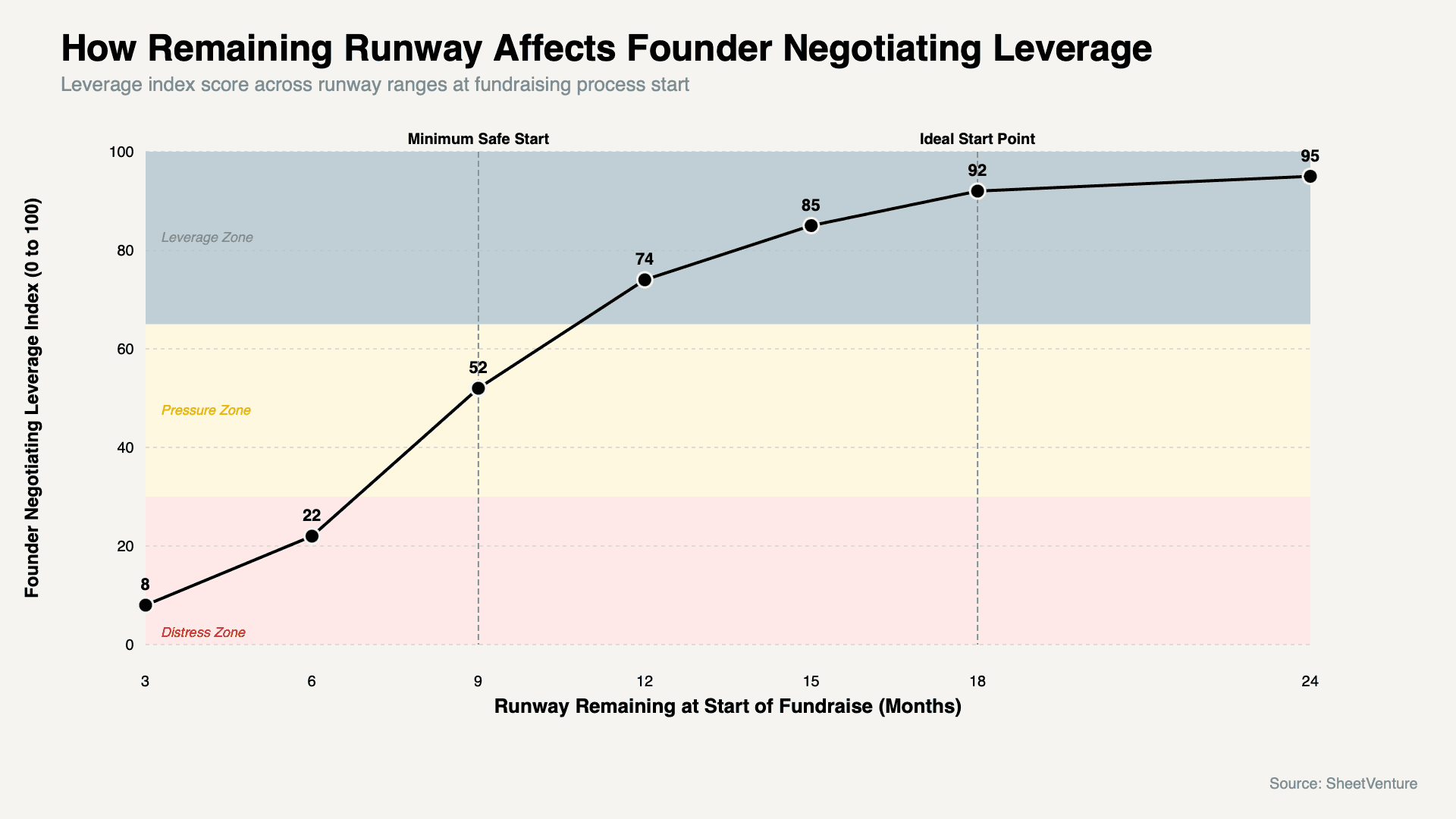
That is the worst possible trigger, because fear is visible and investors price it. The calendar should decide your start date, and your runway should have been extended to meet it. If you need money in the bank by December, the decision to raise had to be made in the summer.
Founders quit six weeks in, right before it works
DocSend found something brutal in their data. Founders whose raises failed gave up after an average of 6.7 weeks. The successful rounds took twelve or more.
Six point seven weeks from 1 September is mid October. That is precisely the moment conviction is forming on the other side of the table, and precisely the moment silence feels most like rejection. A compressed season makes this worse, not better, because there is more silence packed into every week.
The founders who survive that fortnight are the ones who walked in with the map already drawn, and knew the silence was scheduled.
Where Are You, Honestly?
Four checks. Answer them properly, not generously.
Could you send someone a written list of named partners, not firms, today?
Has anyone credible mentioned your company to an investor in the last six weeks?
If a partner asked for your data room on 3 September, could you send a link that afternoon?
Do you know exactly what you are raising, at what price, and why that price survives their model?
Four yeses and you are in the small minority for whom September will be genuinely good. Go and enjoy it.
One or two and you have nine days, and nine days is enough, but only if you spend them on the right four things.
Zero and this autumn is your preparation season, and January is your raise. That is not a failure. It is the single most valuable decision available to you this month, and it is worth more than any amount of deck editing.
The point of the next nine days is to find out which of those three founders you are, before an investor finds out for you.
The Four Questions You Have To Answer Before 1 September
Every autumn raise resolves into four questions. Founders usually answer them in the wrong order, and usually by burning real meetings to find out.
The season is twelve weeks. You cannot afford to learn any of these from a partner.
1. Am I actually fundable at the round I am going for?
Not “do I have a story.” Do the signals match the stage.
Investors rarely reject a company because a single metric is off. They reject because the pattern does not match the stage. ARR fine, growth slow, margins thin, efficiency weak resolves into one sentence in a partner’s head, and the sentence is “not ready yet.”
The most expensive mistake in venture is starting a raise six months early. In a twelve week window it is fatal, because you spend the season proving something the numbers were never going to support, and you arrive in January having already been passed on by the people you most wanted.
Answer this before you write a single email.
2. Will my deck survive the first thirty seconds?
Investors spend roughly three and a half minutes on a deck, and forward two to four slides internally.
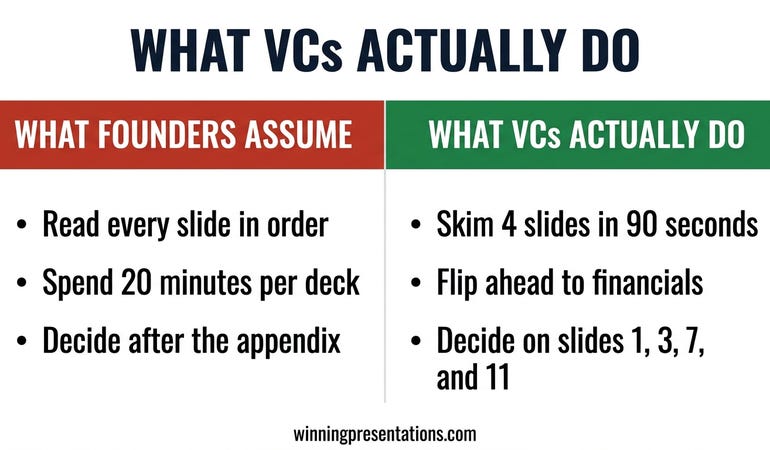
Those slides are the real product. Not the deck. The two slides a partner pastes into a channel with a one line note. If nothing in your deck is forwardable, your deal cannot travel inside the firm without you, and a deal that cannot travel cannot reach a committee, which means it cannot close in December.
In September a partner is screening six to ten of these a day. Thirty seconds is generous.
3. Which investors can actually say yes to me?
This is the quiet filter, and it is where most of the twelve weeks gets spent for nothing.
Stage, sector, cheque size, geography. Four gates, all invisible from the outside, all absolute. If your raise sits outside a fund’s band, the conversation was over before it started, and nobody will ever tell you that. They will simply be slow.
Founders contact an average of 66 investors to close a seed round. In a twelve week window, the difference between 66 correctly chosen names and 66 hopeful ones is the difference between closing in November and starting again in January.
4. What is the number, and does it survive their model?
The question arrives in every second meeting, usually in October.
“So, what valuation are you raising at?”
Most founders guess, or anchor high and hope confidence carries it. Investors are not guessing. They are running a return based model, working backwards from an exit value to the ownership they need, then pricing your round to produce it.
If you do not know that model, you are negotiating blind in the exact month the decision is being taken.
Why These Four, And Why Now
Individually, these are useful in any month of the year.
Together, in the next nine days, they are the whole season.
Answer question one and you know whether you are raising this autumn or preparing for January. Answer two and your deal can travel inside a firm without you in the room. Answer three and your twelve weeks are spent only on people capable of writing the cheque. Answer four and you walk into October pricing the round the way the person across the table already is.
Fundable. Forwardable. Targeted. Priced.
That is the entire autumn, and every one of those four answers is available to you before Tuesday week.
The Four Tools
All four are available exclusively to paid subscribers of The Founders Corner®, and all four are below.
✅ Funding Milestone Navigator - enter your metrics and it scores your readiness against real stage expectations, then hands you the priority gaps to close and what “good” actually looks like at your round. This is your go or no go on the autumn.
✅ The 30 Second Pitch Test - the fast filter every investor runs before deciding whether your deck earns a real meeting. Run your deck through it this week, not in October when it is being forwarded around a firm without you there to explain it.
✅ The Investor Fit Finder - a curated shortlist drawn from 2500+ continuously updated investors, matched to your stage, sector, geography and cheque size, with a transparent fit score on every name. Ten to fifteen right names instead of two hundred hopeful ones.
✅ The VC Method Calculator - the quiet maths behind your valuation, fully editable in Excel. Exit value, required ownership, dilution, IRR and MOIC, so the number you say out loud in October is one that survives their model.
…plus 60+ additional tools across every stage of fundraising and company building: investor research, pitch deck screening, meeting prep, term sheet analysis, financial models, and the full investor database library.
Start your 7-day free trial → Cancel anytime.
Get All Four Below 👇
Twelve weeks. One slot per partner. Several thousand founders reaching for it.
The window opens in nine days, and it does not open twice.
If you want to close a round in 2026, you’ll need these.