

👋 Hey, Chris here! Welcome to BrainDumps—a weekly series from The Founders Corner. If you’ve been reading along, you know this series is a preview of a bigger project. Well, it’s finally here: The Big Book of BrainDumps is out now!
It isn’t a theory book—it’s the founder’s field manual. Inside, you’ll find 70 powerful frameworks distilled from 30+ years scaling software companies to hundreds of millions in ARR, 20+ years investing in 500+ B2B tech startups, and over $1B of shareholder value created. From raising capital to hiring your first VP of Sales, this book turns scars and successes into practical playbooks you’ll return to again and again. I expect most copies will become well-worn, scribbled on, and dog-eared—because it works.
Building a world-class executive team is not a milestone on the journey to scale. It is the journey.
Founders often obsess over product, funding, brand, or growth tactics. But the real inflection point in any scaling business comes down to one decision: who is sitting around the table making the big calls?
A killer executive team is not simply a collection of impressive CVs. It is a deliberately engineered group of leaders capable of holding strategic vision in one hand and operational execution in the other. It is a team built not just on experience, but on potential, alignment, and continuous growth — underpinned by a culture that balances trust with accountability.
If you get this right, everything accelerates. If you get it wrong, everything stalls.
Table of Contents
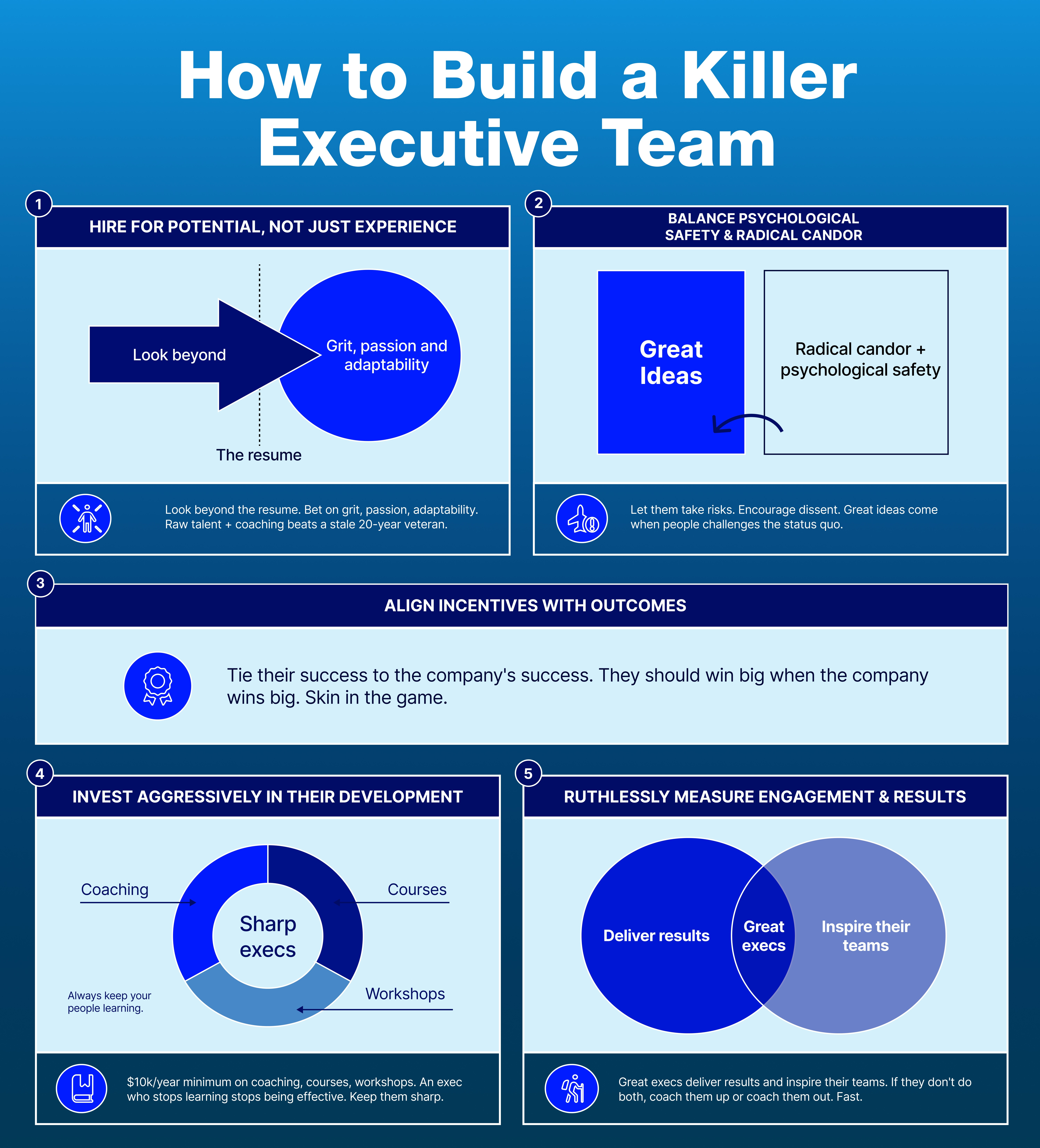
Hire for Potential, Not Just Experience
Create a Culture Where Big Ideas Survive
Align Incentives With Outcomes
Invest Aggressively in Executive Development
Measure Engagement and Results Ruthlessly
Building a Motivated Team Beneath the Executive Layer
Diagnosing When Things Go Wrong: The Five Dysfunctions
From Leadership to Execution: Operational Discipline
The Strategic Lens
Final Reflection
Hire for Potential, Not Just Experience
The temptation when building a senior team is to hire pedigree. Big logos. Prestigious titles. Years of experience in similar roles.
But past success in a stable corporate environment does not guarantee impact in a fast-moving, ambiguous growth business.
The executives who thrive in scaling environments share different traits. They possess grit. They demonstrate adaptability. They show intellectual curiosity. They are energised by ambiguity rather than paralysed by it.
In early and growth-stage companies, playbooks are often being written in real time. Leaders who rely exclusively on what worked before can struggle when confronted with novel problems. By contrast, those with a growth mindset — who learn fast, absorb feedback, and adjust quickly — become force multipliers.
When assessing senior hires, the critical question is not simply, “Have they done this before?” It is, “Can they figure this out when conditions change?”
The best executives are not custodians of the past. They are architects of the future.
Create a Culture Where Big Ideas Survive
Talent alone is insufficient without the right environment.
A high-performing executive team must operate in a culture where ideas are challenged rigorously — but people are respected unconditionally. This requires a careful balance between psychological safety and radical candour.
Psychological safety ensures that leaders feel able to speak openly without fear of ridicule or political retaliation. Without it, dissent disappears, innovation declines, and blind spots multiply.
At the same time, psychological safety without candour leads to polite stagnation. Teams that avoid tension in the name of harmony often fail to confront hard truths.
The strongest executive cultures encourage robust debate. They normalise disagreement. They treat conflict as a tool for clarity rather than a threat to unity.
As a Founder or CEO, you set this tone. When you invite challenge, listen actively, and respond thoughtfully — even when ideas contradict your own — you signal that contribution matters more than hierarchy.
Great ideas rarely emerge from silence. They emerge from friction — in an environment built on trust.
Align Incentives With Outcomes
Even the most capable leaders drift when incentives are misaligned.
A high-performing executive team must share not just responsibility but economic alignment. When leaders benefit directly from company success — and feel the consequences of failure — behaviour changes.
Incentive structures should reward long-term value creation, not short-term optics. Equity participation, performance-linked bonuses, and outcome-based compensation frameworks create shared ownership.
When executives win only if the company wins, they collaborate differently. They think strategically. They make decisions through a collective lens rather than a departmental one.
Alignment eliminates politics. It reinforces unity. It ensures that everyone is rowing in the same direction.
Invest Aggressively in Executive Development
Hiring strong leaders is only the beginning. Sustaining excellence requires continuous sharpening.
Markets evolve. Technology advances. Competitive dynamics shift. Even the most experienced executive can become outdated without deliberate development.
Coaching, peer forums, leadership workshops, and structured feedback loops are not luxuries. They are strategic investments. Continuous development signals that growth is expected at every level of the organisation — including the top.
Moreover, executive development strengthens succession planning and internal resilience. When leaders are encouraged to expand their capabilities, the business becomes less dependent on any single individual.
Sharp executives build sharp teams. Dull executives create drag.
Development is not optional. It is competitive advantage.
Measure Engagement and Results Ruthlessly
A killer executive team does not operate on sentiment. It operates on performance.
Results matter. Metrics matter. Accountability matters.
However, results alone are insufficient. An executive who delivers numbers while leaving cultural damage in their wake creates long-term instability. True leadership impact combines measurable outcomes with team health and inspiration.
Regular evaluation of senior leaders should consider both dimensions. Are they achieving strategic objectives? And are they building engaged, capable teams beneath them?
When underperformance emerges, it must be addressed swiftly. Difficult conversations are part of executive leadership. Avoiding them erodes standards.
A high-performance culture tolerates neither complacency nor toxicity. It demands contribution and collaboration in equal measure.
Building a Motivated Team Beneath the Executive Layer
Once the senior team is in place, the next challenge is motivation.
Traditional motivation models — built on reward and punishment — are increasingly ineffective in knowledge-driven environments. Sustainable performance relies on intrinsic drivers.
Drawing on Daniel Pink’s work in Drive, three forces consistently underpin high motivation: autonomy, mastery, and purpose.
Autonomy empowers individuals to own their outcomes. It signals trust. When leaders allow teams discretion in how they achieve goals, engagement rises.
Mastery provides the pathway for growth. People are energised when they feel they are improving, stretching beyond comfort zones, and developing meaningful capability.
Purpose connects daily tasks to something larger. When employees understand the impact of their work — on customers, colleagues, or society — performance becomes personal.
Recognition reinforces these intrinsic drivers. Public appreciation, thoughtful gestures, and genuine acknowledgment strengthen emotional commitment.
Equally important is the work environment itself. Respect, inclusion, and collaboration create the conditions for sustained excellence. Motivation flourishes in environments where effort is visible and growth is encouraged.
Teams that are intrinsically motivated do not require constant supervision. They require clarity and trust.
Diagnosing When Things Go Wrong: The Five Dysfunctions
Even talented teams encounter breakdowns.
Patrick Lencioni’s framework — The Five Dysfunctions of a Team — offers a powerful diagnostic lens.
At its base lies trust. Without vulnerability-based trust, team members protect themselves rather than serve the collective.
Above that sits fear of conflict. Avoided disagreements produce artificial harmony and poor decisions.
Next comes lack of commitment. When clarity is absent, buy-in falters.
Then avoidance of accountability. Without peer-to-peer responsibility, standards slip.
At the top is inattention to results — when personal or departmental priorities eclipse collective goals.
These dysfunctions are interconnected. Addressing them requires deliberate cultural reinforcement. Leaders must model vulnerability, encourage constructive conflict, drive clarity, and demand accountability.
High-performing teams are not dysfunction-free. They are dysfunction-aware — and proactive in correction.
From Leadership to Execution: Operational Discipline
As the organisation grows, leadership must translate into operational precision.
Chaos may fuel early creativity, but scale demands structure.
Prioritisation frameworks such as the Eisenhower Matrix, Critical Path Method, Pareto Principle, and collaborative tools like Priority Poker provide clarity amid complexity.
Delegation becomes essential. Leaders must move from doing to enabling. Effective delegation ranges from directive instruction for new team members to results-based autonomy for seasoned operators. Mastering this spectrum prevents micromanagement and unlocks scale.
Meeting discipline is equally critical. Excessive meetings drain cognitive energy and fragment attention. Clear agendas, documented outcomes, and a bias toward asynchronous communication reclaim focus.
Productivity principles such as Price’s Law remind us that contribution is rarely evenly distributed. Identifying and supporting high-impact contributors — without overburdening them — strengthens organisational leverage.
Strategic tools like the Balanced Scorecard and frameworks such as VMOST, PESTLE, and the Business Model Canvas ensure that execution remains aligned with vision.
Operational excellence is not about bureaucracy. It is about clarity, alignment, and momentum.
The Strategic Lens
At the highest level, leadership must remain anchored in Vision and Mission.
A compelling Vision articulates where the company is heading. A clear Mission defines why it exists. Together, they provide coherence amid growth.
From this foundation, strategic planning translates ambition into action — through clear objectives, measurable outcomes, resource allocation, and risk management.
Strategy without execution is aspiration. Execution without strategy is noise. The art of leadership lies in integrating both.
Final Reflection
Building a killer executive team is not a one-time initiative. It is an ongoing discipline.
It requires hiring for potential, fostering psychological safety with candour, aligning incentives, investing in development, and enforcing accountability. It demands an understanding of motivation, team dynamics, and operational structure.
Most importantly, it requires self-awareness.
The quality of your executive team will ultimately reflect the quality of your leadership. The culture you tolerate becomes the culture you build.
If you get this right, scale becomes less chaotic and more intentional. Momentum compounds. Confidence grows. Results accelerate.
Because in the end, strategy matters. Product matters. Funding matters.
But leadership — real leadership — is the multiplier.
And that is the ball game.
-Chris Tottman
"Building a killer executive team is not a one-time initiative. It is an ongoing discipline." This is so true. In my experience, working with people is never ending work, but also where the real success is to be found.
Excellent article 💥