

👋 Hey, Chris here! Welcome to BrainDumps—a weekly series from The Founders Corner. If you’ve been reading along, you know this series is a preview of a bigger project. Well, it’s finally here: The Big Book of BrainDumps is out now!
It isn’t a theory book—it’s the founder’s field manual. Inside, you’ll find 70 powerful frameworks distilled from 30+ years scaling software companies to hundreds of millions in ARR, 20+ years investing in 500+ B2B tech startups, and over $1B of shareholder value created. From raising capital to hiring your first VP of Sales, this book turns scars and successes into practical playbooks you’ll return to again and again. I expect most copies will become well-worn, scribbled on, and dog-eared—because it works.
Choosing a co-founder is the most important decision you make in a startup — more important than your product, your first hires, or even your first round of funding.
Why?
Because most startups don’t fail because of the market.
They don’t fail because of competitors.
They fail because of co-founder breakdowns.
Misalignment, mismatched expectations, unresolved tensions, unequal contributions, clashing communication styles — these aren’t inconveniences. They are fatal.
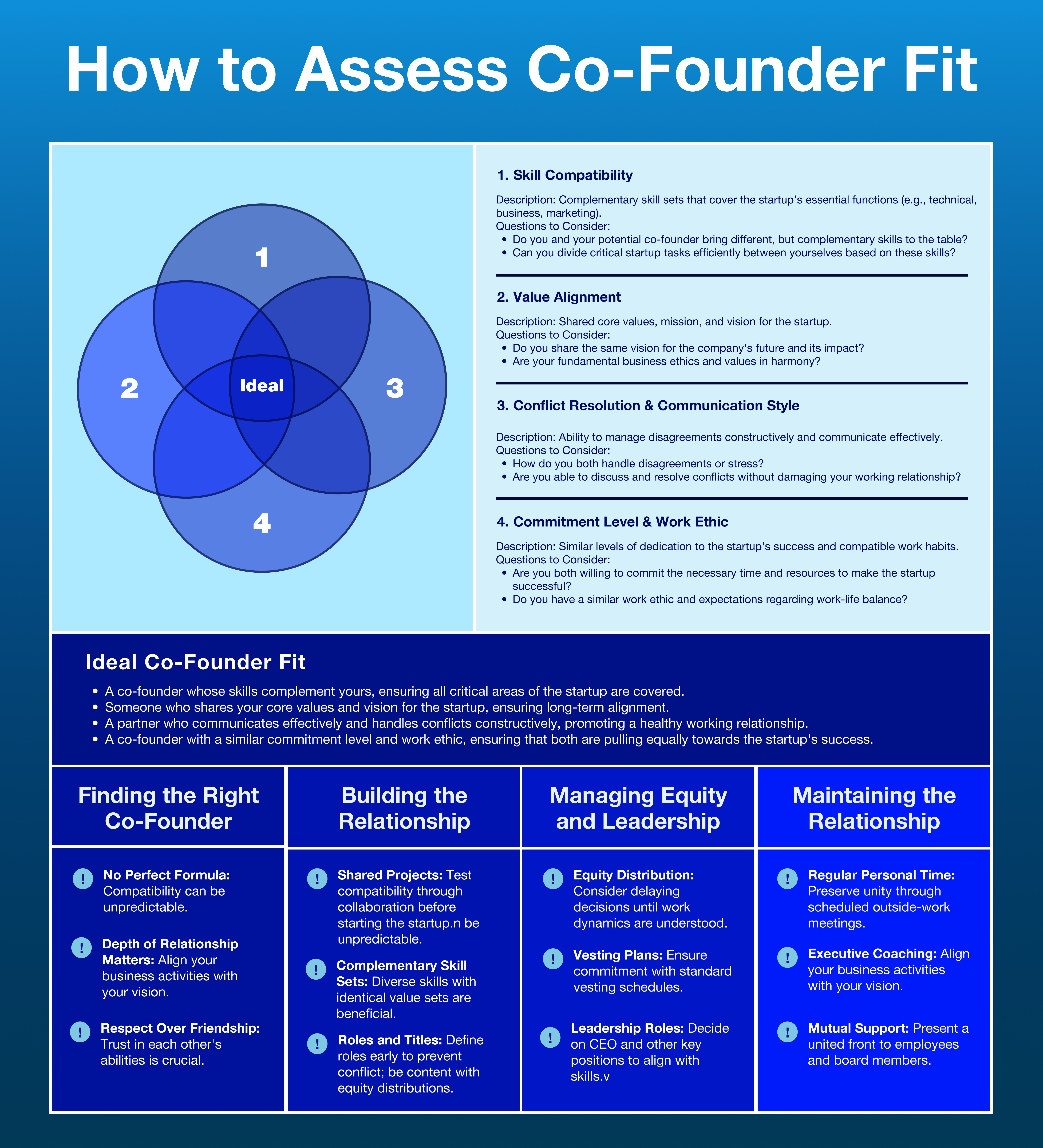
This BrainDump offers one of the clearest, most practical frameworks for assessing co-founder fit that I’ve seen — and it maps perfectly onto the patterns VCs observe across thousands of companies.
Let’s break down what ideal co-founder fit really looks like.
Table of Contents
Skill Compatibility
Value Alignment
Conflict Resolution and Communication Style
Commitment Level and Work Ethic
Ideal Co-Founder Fit
Finding the Right Co-Founder
Building the Relationship
Managing Equity and Leadership
Maintaining the Relationship
Final Takeaway
1. Skill Compatibility
This is the foundation. Without it, everything else collapses.
The question isn’t just:
“Do we both have relevant skills?”
It’s:
“Do our skills meaningfully complement each other?”
For example:
Technical + commercial
Product + go-to-market
Vision + execution
Engineering + operations
Two founders with identical skills might like working together… but they won’t create a balanced startup.
Great founding teams divide and conquer — not duplicate.
Key signals of strong compatibility:
✔ Clear ownership of responsibilities
✔ No ambiguity about who leads what
✔ Mutual respect for each other’s domains
✔ Ability to move fast because decisions are distributed
If one founder secretly wishes they had the other’s role, friction is inevitable.
2. Value Alignment
If skills are the foundation, values are the glue.
Misaligned values don’t reveal themselves on Day 1 — they reveal themselves in crisis:
When money gets tight
When hiring gets hard
When strategy changes
When burnout hits
When personal pressure escalates
Startups are pressure cookers.
Values are what keep you from exploding.
Founders must align on:
✔ Integrity
✔ Ambition
✔ Transparency
✔ Pace of execution
✔ Definition of “good enough”
✔ Work–life expectations
✔ Approach to risk and optionality
Different values don’t cause conflict — hidden values do.
3. Conflict Resolution & Communication Style
Every great founding team fights.
The difference between teams that break and teams that break through is how they fight.
Questions that reveal fit:
Can you disagree productively?
Can you challenge each other without ego?
Can you communicate openly when emotions run high?
Do you both recover quickly from tension?
Can you have direct conversations without defensiveness?
The strongest founder relationships are built on:
✔ Radical candour
✔ Fast recovery
✔ Zero politics
✔ Trust that disagreement strengthens the company
If hard conversations are avoided, resentment fills the silence.
4. Commitment Level & Work Ethic
This is where most founding relationships quietly fall apart.
If one founder is all-in and the other is half-in, the company will stall.
If one founder moves fast and the other drags, momentum collapses.
If one founder sacrifices and the other coasts, resentment becomes inevitable.
The real test:
Are you equally committed to the mission, the timeline, and the grind?
Because co-founder equity isn’t a reward — it’s a promise.
Ideal Co-Founder Fit
The BrainDump summarises it perfectly:
The ideal co-founder partnership:
Shares your commitment and ambition
Brings complementary, not competing, strengths
Aligns on values and decision-making principles
Handles conflict with maturity and transparency
Matches your level of grit, speed, and ownership
When these four areas overlap, you get the “Ideal” zone — the sweet spot where co-founders thrive through chaos.
Finding the Right Co-Founder
The cheat sheet provides practical rules:
✔ No “perfect profile”
The best co-founders aren’t flawless — they’re compatible.
✔ Depth > network
Don’t choose someone just because they’re accessible. Choose someone who’s right.
✔ Respect over friendship
A co-founder isn’t a friend with whom you build a company.
They’re a partner with whom you build your future.
✔ Clear expectations from Day 1
The hardest conversations must come first.
Building the Relationship
You can’t “set and forget” a co-founder partnership.
Great teams:
Share personal truths early
Create psychological safety
Build routines for communication
Set up conflict-resolution norms
Maintain mutual respect
The relationship must be nurtured — not assumed.
Managing Equity & Leadership
One of the fastest ways to poison a co-founder relationship is unclear or unfair equity.
Key rules:
✔ Equal equity only when contributions, risk, and ownership are equal
✔ Clear founder roles and decision authority
✔ Transparent compensation expectations
✔ Leadership evolution discussed before issues arise
Leadership must evolve as the company evolves — not stagnate.
Maintaining the Relationship
Once you’ve chosen the right person, you must protect the relationship deliberately.
VCs often say:
“The founding relationship is the single greatest predictor of startup outcome.”
To maintain it:
✔ Hold regular check-ins
✔ Address small issues early
✔ Prioritise honesty over comfort
✔ Build mechanisms for emotional resilience
✔ Seek coaching when needed
✔ Share the load; share the pressure
Startups break when founders break.
Final Takeaway
Co-founder fit isn’t luck.
It’s not chemistry.
It’s not convenience.
It’s a strategic decision — and one of the most important you’ll ever make.
Get it right, and you create a partnership capable of surviving the darkest, hardest, most chaotic years of building a company.
Get it wrong, and no amount of product brilliance or fundraising momentum can save you.
-Chris Tottman
Great post. Almost all startups will eventually fail and having the wrong partner/advisor/cofounder next to you is a huge contributing factor! Awesome Chris!
Having a cofounder is a great way to spread the load for work and skills. Having the right cofounder is even more important.