

👋 Hey, Chris here! Welcome to BrainDumps—a weekly series from The Founders Corner. If you’ve been reading along, you know this series is a preview of a bigger project. Well, it’s finally here: The Big Book of BrainDumps is out now!
It isn’t a theory book—it’s the founder’s field manual. Inside, you’ll find 70 powerful frameworks distilled from 30+ years scaling software companies to hundreds of millions in ARR, 20+ years investing in 500+ B2B tech startups, and over $1B of shareholder value created. From raising capital to hiring your first VP of Sales, this book turns scars and successes into practical playbooks you’ll return to again and again. I expect most copies will become well-worn, scribbled on, and dog-eared—because it works.
At some point in every scaling company, speed stops being your advantage.
Not because things slow down — but because decisions get heavier.
More people are affected.
More money is at risk.
More second-order consequences emerge.
This is the moment where many founders stall. They either:
Overthink decisions until momentum dies, or
Make instinctive calls that no longer scale
The founders who keep winning don’t rely on gut instinct alone. They rely on decision systems.
One of the most powerful — and least understood — is the OODA Loop.
Table of Contents
Why Decision-Making Becomes the Real Bottleneck
What the OODA Loop Really Is
Observe — Seeing Reality Without the Noise
Orient — The Step Most Founders Get Wrong
Decide — Commit with Intent, Not Hesitation
Act — Why Speed Creates Better Learning
Why Repeating the Loop Beats Getting It “Right”
How Founders Actually Use the OODA Loop
Why Fortune 500 CEOs Swear by This Model
Common Traps the OODA Loop Prevents
The Real Insight
Final Thought
Why Decision-Making Becomes the Real Bottleneck
Early on, founders decide quickly because:
Information is limited anyway
Consequences are contained
Speed matters more than precision
But as companies grow, the cost of bad decisions compounds — and hesitation becomes just as dangerous as recklessness.
Great CEOs don’t wait for perfect information.
They out-learn and out-adapt their environment.
That’s exactly what the OODA Loop is designed to do.
What the OODA Loop Really Is
Originally developed by military strategist John Boyd, the OODA Loop is a framework for decision-making in complex, fast-changing environments.
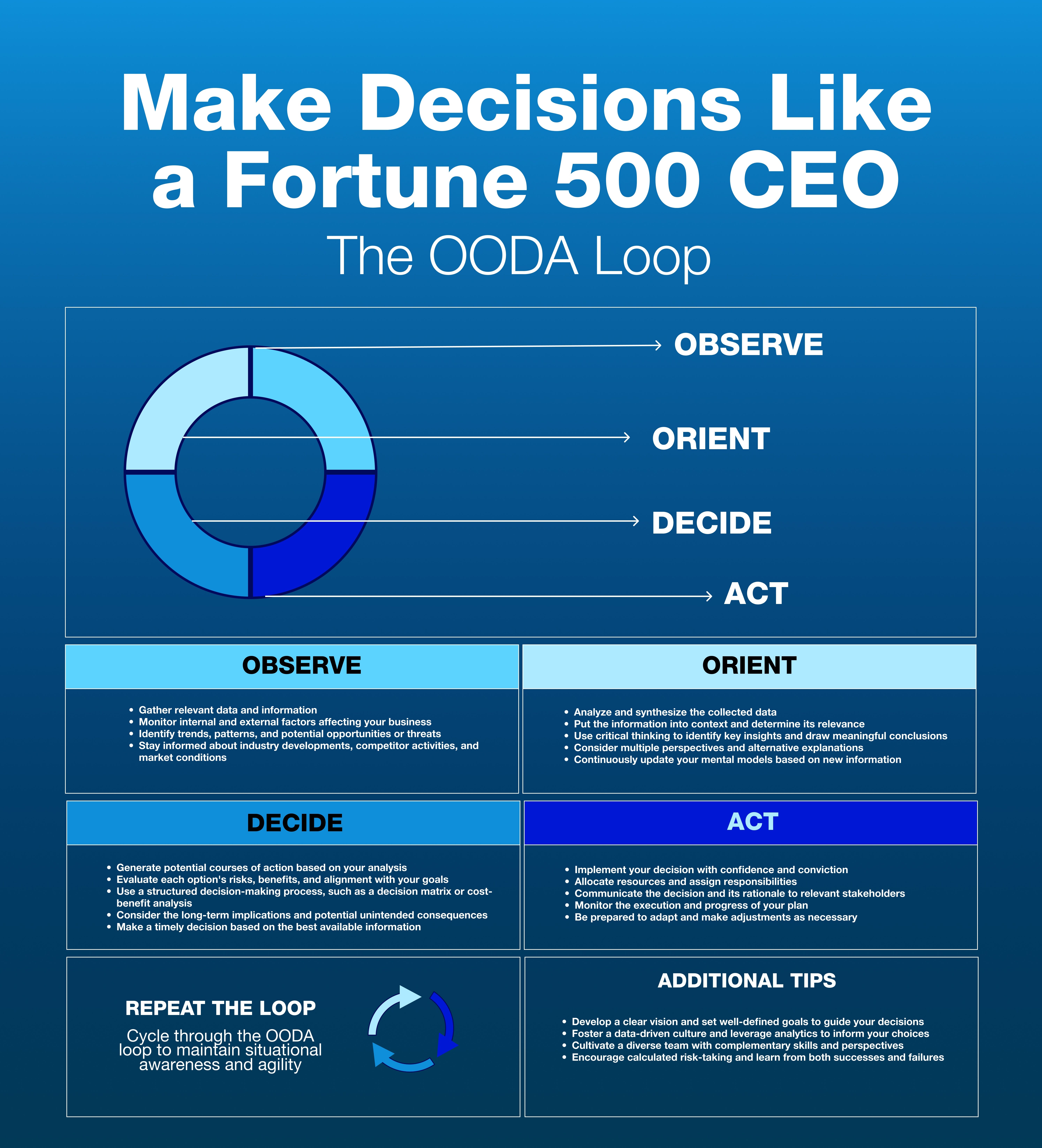
It breaks decisions into four continuous steps:
Observe
Orient
Decide
Act
The power isn’t in the steps themselves — it’s in the loop.
The goal is not to be right once, but to learn faster than everyone else.
1. Observe: See Reality as It Is
Observation is about gathering signals, not noise.
For founders, this means:
Customer behaviour (not opinions)
Market movement
Team performance
Financial data
Competitive actions
The biggest mistake here?
Confusing dashboards with insight.
Elite leaders look for patterns, not just metrics. They ask:
“What’s changing that wasn’t true before?”
2. Orient: Context Is Everything
Orientation is the most misunderstood — and most important — step.
This is where leaders:
Interpret what they’re seeing
Apply experience and mental models
Factor in culture, values, and strategy
Identify biases and assumptions
Two founders can observe the same data and reach opposite conclusions. Orientation explains why.
This is where leadership maturity shows up.
Founders who skip orientation jump straight to action — and repeat the same mistakes faster.
3. Decide: Commit, Don’t Drift
Decision-making isn’t about finding the perfect answer.
It’s about choosing a direction with intent.
Strong leaders:
Make decisions with incomplete data
Set clear ownership
Define success criteria
Accept trade-offs explicitly
Indecision is still a decision — just not a deliberate one.
The best founders don’t wait for certainty.
They decide, then design feedback loops to validate or correct.
4. Act: Speed Creates Learning
Action is where theory meets reality.
But action without reflection is chaos.
Action within the OODA Loop is different — it’s purposeful.
After acting, elite leaders immediately ask:
What happened?
What surprised us?
What did we learn?
What needs adjusting?
Then they loop back to observe again.
This is how momentum compounds.
Why Repeating the Loop Matters More Than Getting It “Right”
The OODA Loop rewards adaptability over accuracy.
In volatile environments — like startups — the winner isn’t the one with the best initial plan. It’s the one who:
Learns fastest
Updates beliefs quickly
Adjusts course without ego
This is why great CEOs appear decisive and flexible at the same time.
How Founders Actually Use the OODA Loop
In practice, the OODA Loop shows up everywhere:
Product decisions → observe usage, orient around strategy, decide roadmap, ship, repeat
Hiring → observe gaps, orient on stage needs, decide profile, hire, review
Fundraising → observe market appetite, orient on leverage, decide timing, act
Crisis response → observe facts, orient emotionally, decide calmly, act fast
It’s not a one-off tool.
It’s an operating rhythm.
Why Fortune 500 CEOs Love This Model
At scale, complexity kills intuition.
The OODA Loop:
Reduces cognitive overload
Prevents emotional decision-making
Creates shared decision language
Speeds up organisational learning
It allows leaders to move fast without being reckless — and to change course without losing credibility.
Common Founder Traps the OODA Loop Prevents
❌ Reacting emotionally
❌ Acting on stale assumptions
❌ Paralysis by analysis
❌ Overconfidence in past success
❌ Repeating the same mistakes
❌ Mistaking speed for progress
Founders who struggle with decision fatigue almost always lack a repeatable framework.
The Real Insight
Great decision-makers don’t eliminate uncertainty.
They build systems that thrive inside it.
The OODA Loop doesn’t promise perfect decisions — it promises better decisions faster, and the humility to update when reality disagrees.
In fast-moving companies, that’s the real advantage.
Final Thought
The difference between overwhelmed founders and elite CEOs isn’t intelligence.
It’s how they decide when it’s uncomfortable.
They don’t freeze.
They don’t thrash.
They don’t wait for certainty.
They observe, orient, decide, act — and loop faster than everyone else.
And over time, that rhythm compounds into clarity, confidence, and control.
-Chris Tottman
Reducing cognitive overload, in a maxed world, is a huge advantage
Cracking article that 👊