

Most founders use Claude the same way.
They open a new chat.
They paste in the deck. Then the metrics. Then three paragraphs explaining what the company does, for roughly the fortieth time.
They get a good answer, copy it into Notion, and close the tab.
Tomorrow, Claude has forgotten all of it.
The model is not the bottleneck. The copy and paste is.
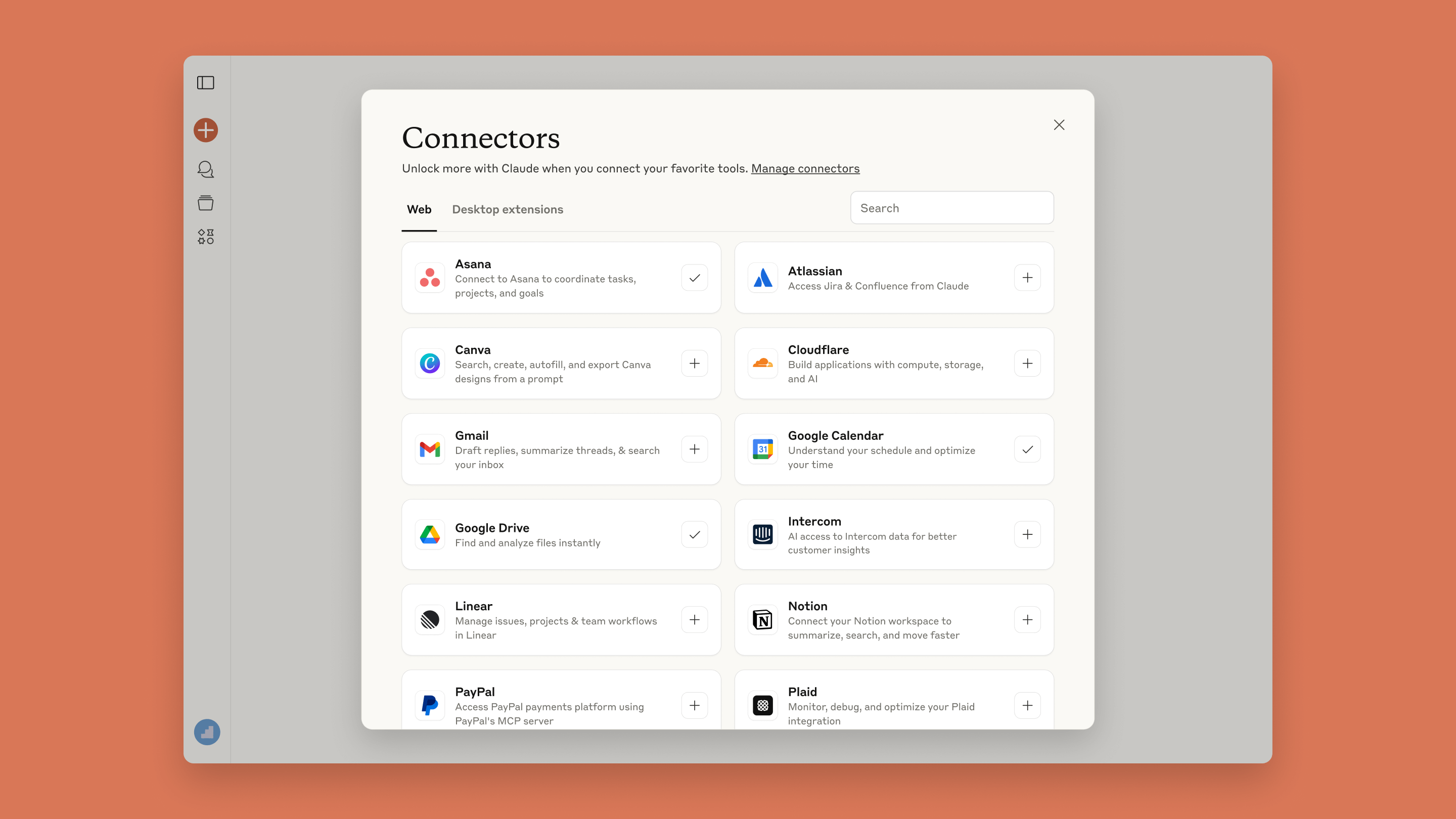
Claude can already search your Notion, read your Drive, draft from your inbox and check your calendar. It can now read your DocSend data room too.
Most founders have connected none of it.
So we connected all of it, and wrote down every step.
What you will be able to do by the end of this article
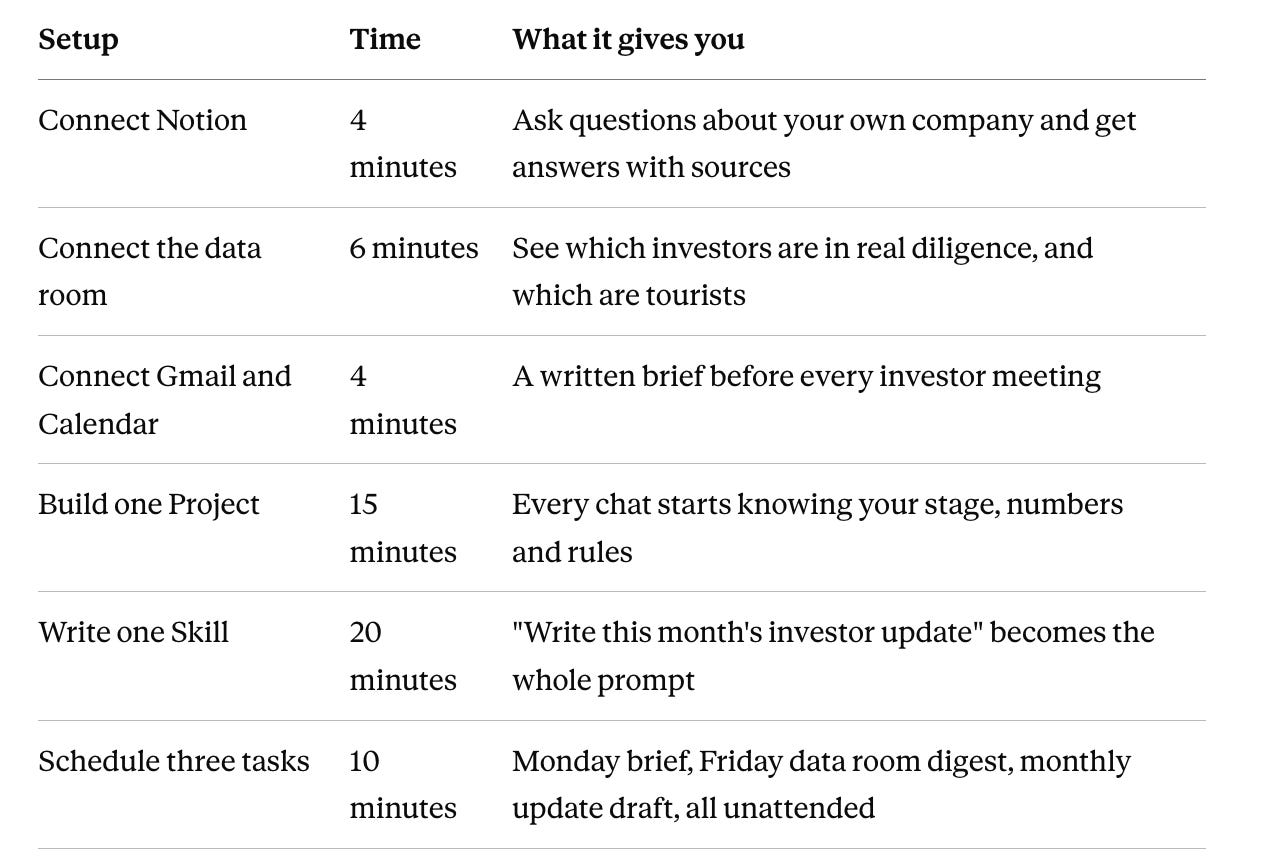
Total: about an hour of setup, spread over a week.
No code. No developer. No new subscription beyond the one you probably already pay for.
Want to get in front of 250k+ founders and investors?
For sponsorship opportunities across The Founders Corner newsletter and LinkedIn (160k followers), email: founderscornermedia@gmail.com
The Tax You Pay Before Claude Says a Word
In 2022, Harvard Business Review published a five week study of 137 people across three Fortune 500 companies.
The average person toggled between apps and websites nearly 1,200 times a day.
Each switch cost a little over two seconds of reorientation. Small on its own. Added up, it came to just under four hours a week.
Toggle tax = ~4 hours a week × 48 working weeks = ~190 hours a year
The researchers put it at five working weeks, or 9% of annual time at work.
The study measured employees at large companies, not founders. If your day has fewer tabs than theirs, we would like to meet you.
A founder’s toggling is worse in one specific way. The apps are not just different. The context is split across them.
The pipeline is in the CRM. The decision is in Slack. The numbers are in a Sheet. The investor’s last question is in Gmail. The only place they all meet is your head.
Every Claude chat that starts blank is one more toggle. You are the integration layer, and the integration layer does not scale.
Five Words, In Plain English
Before the setup, the vocabulary. This is the part nobody explains, and it is why most founders stall on step one.
Think of Claude as a very capable new hire who started this morning.
A connector is a login you hand them. Connect Notion and Claude can read your Notion. Connect Gmail and it can read and draft your email. You authorise it once, in the same way you would authorise any app, and Claude only ever sees what your own account can see.
MCP is the plug shape. It stands for Model Context Protocol, an open standard Anthropic published so any software company can build one connector that works with any AI tool. You will never need to know more than that, but you will see the acronym on setup pages, and now it will not throw you.
A Project is the induction pack. Standing instructions plus a few core documents, so every conversation inside it starts with your stage, your numbers and your rules already understood.
A Skill is a written procedure. A folder of instructions and examples that Claude loads only when the relevant task comes up. Your investor update format is a Skill. So is your board pack.
A scheduled task is the work that happens before you arrive. Claude runs a saved prompt daily or weekly, using your connectors, and leaves the output where you asked for it.
New hire, keys, induction, procedures, rota. Most founders hire the person and then never hand over any keys.
Why the Same Model Gets Smarter When You Stop Pasting
The best evidence on this comes from a field experiment with 758 consultants at Boston Consulting Group, run by researchers from Harvard Business School, Wharton, MIT Sloan and Warwick, and since published in Organization Science.
On tasks inside what they called AI’s “jagged frontier”, consultants using AI completed 12.2% more tasks, worked 25.1% faster, and produced work rated over 40% higher quality.
Then came the task outside the frontier.
It asked consultants to reach a business recommendation by combining spreadsheet data with interview notes, where the crucial detail was buried. The consultants using AI were 19 percentage points less likely to get the right answer.
Read that as a founder.
Board prep. Investor follow ups. “Why did churn spike in March?” Almost every task on your list is the second kind: numbers in one place, the explanation somewhere else, and the detail that matters buried in a thread.
Here is our read, and it is ours rather than the paper’s: a lot of what sits outside the frontier for a founder is not beyond Claude’s ability. It is beyond Claude’s access.
Connectors do not make the model cleverer. They move work across the line by handing Claude the context you would otherwise forget to paste.
Which raises the obvious objection. It is a good one.
The Case Against All of This, Taken Seriously
In July 2025, the research nonprofit METR ran a randomised controlled trial with 16 experienced open source developers across 246 real tasks.
With AI allowed, they took 19% longer.
The striking part was not the slowdown. It was that the developers expected AI to speed them up by 24%, and after the study still believed it had sped them up by 20%.
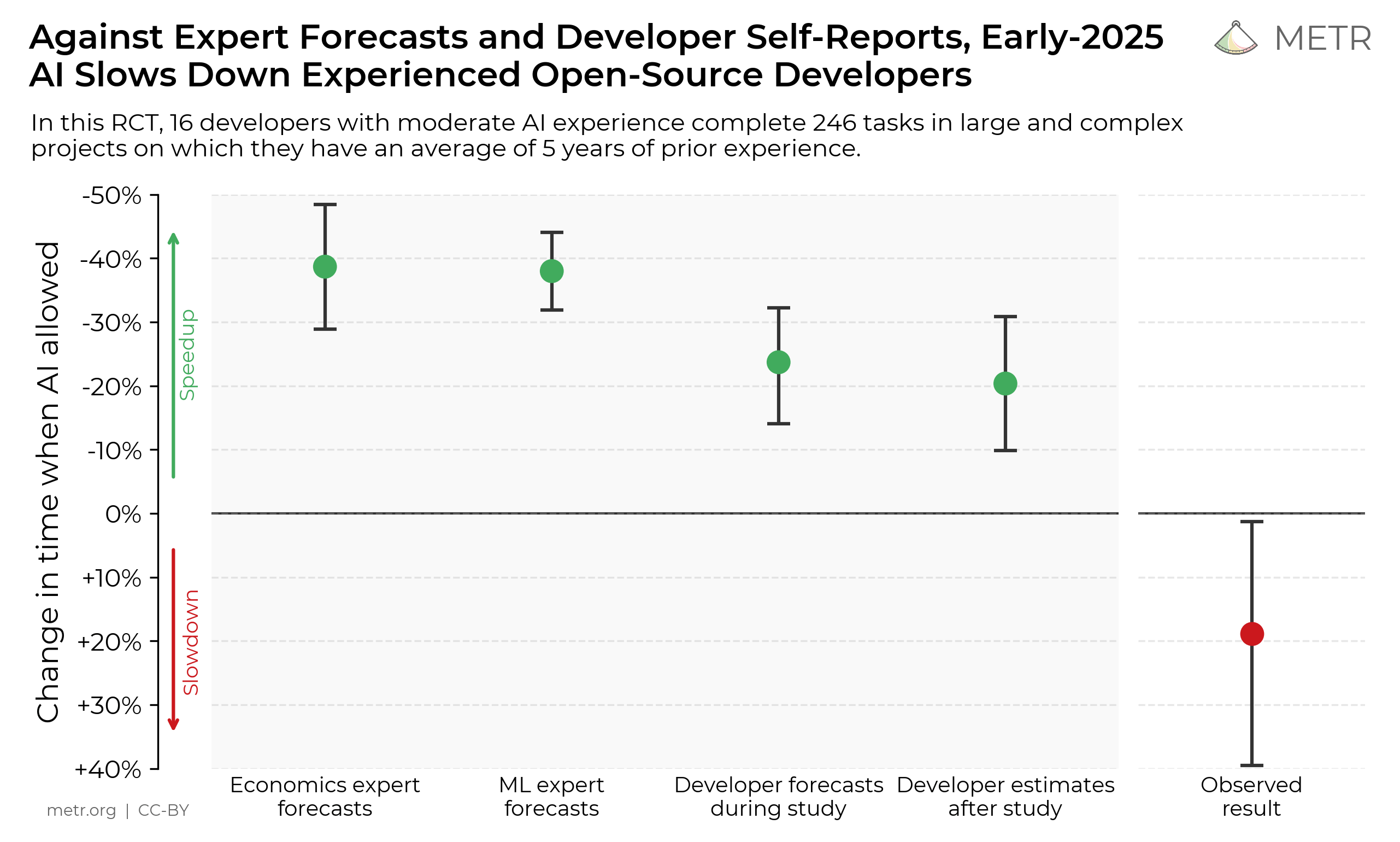
The sceptics deserve credit here. Feeling faster is not the same as being faster, and anyone selling you an AI setup should say so out loud.
But look at where METR thought the slowdown came from. They suggested AI may do comparatively worse in settings with very high quality bars and many implicit requirements that take humans a long time to learn.
Implicit requirements are just context nobody wrote down where the model could see it. Same lesson, different room.
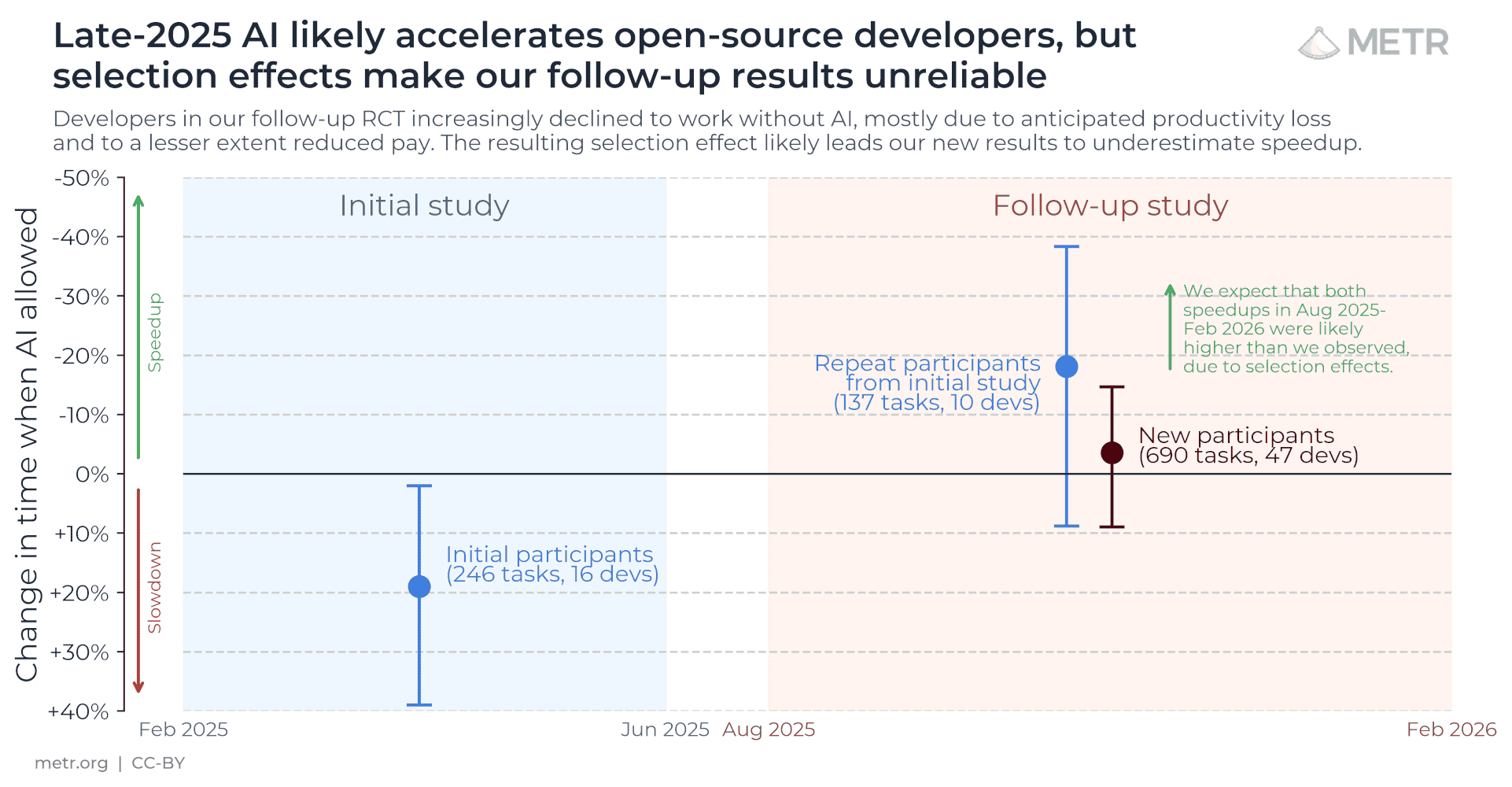
And the story did not end there. In February 2026, METR published an update on a second study with 57 developers and 800+ tasks.
For the developers who returned from the original study, the estimate had flipped to an 18% speedup. Newly recruited developers came in at 4%.
METR was careful to call this weak evidence, for a reason that tells its own story: between 30% and 50% of developers admitted they were holding back tasks because they did not want to do them without AI. Some refused to take part at all.
Founders, for what it is worth, got there first. Anthropic’s own Economic Index found startup work made up 32.9% of Claude Code conversations, against about 13% of ordinary Claude.ai chats. Its March 2026 report listed startup fundraising among the tasks most associated with Claude’s longest standing users.
The people who have used it longest are not using it less for raising money. They are using it more.
So: do not trust the feeling. Pick the tasks, connect the context, and time one normal week before the setup and one after.
Our Most-Read Articles Right Now
🔥 How to Build Your Fundraising Narrative with Claude The five-prompt playbook that turns your raw story into the argument that gets a term sheet.
🔥 I Asked Claude to Reject My Pitch Until It Couldn’t. Then I Raised. The adversarial system that finds your weak points before an investor does.
📋 The Claude Due Diligence Playbook That Gets You to Closing What happens after the meeting, when the term sheet arrives.
📋 The 6 Claude Prompts That Change How Investors See You The positioning layer that makes sure the right story lands.
📈 The Claude Prompt That Turns a Cold Email Into One a VC Actually Reads Personalised outreach that doesn’t read like a mail merge.
Build It In This Order, Not All At Once
Every setup that works has the same four layers, and they only work in sequence.
Layer 1: Memory. Who you are. A Project with standing instructions and your core documents.
Layer 2: Connectors. Where your company lives. Notion, Drive, Gmail, Calendar, Slack, the CRM, the data room.
Layer 3: Skills. How you do things. Your update format, your board pack, your objection handling, written down once.
Layer 4: Schedule. What happens without you. Saved prompts that run while you sleep.
The maths is simple:
Leverage = context Claude can reach × work Claude does without being asked
Most founders are running at 1 × 0. One layer, no schedule.
Investors are hitting the same wall from the other side. A partner at Airtree, one of Australia’s best known venture firms, told Anthropic their biggest operational problem was never access to information. It was that the information lived in too many tools.
Start with the connector holding your company’s written memory. For most startups, that is Notion.
Trick One: Give Claude Your Company’s Brain in Four Minutes
What this replaces: pasting your wiki into chats, hunting for the page where you wrote down the pricing decision, and answering diligence questions from memory.
What you need: a Notion workspace and a paid Claude plan. Nothing to install.
Notion runs its own official, hosted server, so this is four clicks and a sign in.
Step 1. In Claude, open Settings → Connectors. In the desktop app it sits under Customize → Connectors.
Step 2. Find Notion in the directory and click Connect.
Step 3. You land on Notion’s own authorisation page. Choose only the pages and databases Claude should see. Start narrow: wiki, metrics, meeting notes, investor pipeline. You can add more later in ten seconds.
Step 4. Approve, open a new chat, and check Notion is switched on in the tools menu for that conversation. Connectors are per chat, which is deliberate.
That is the whole install.
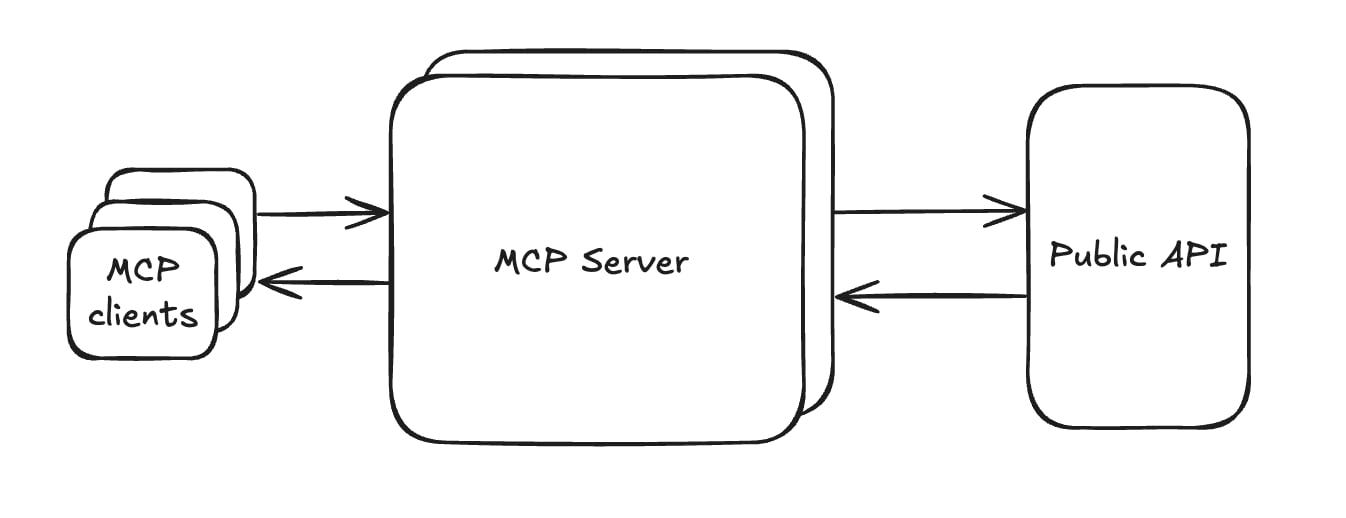
Claude can now search your workspace, read pages, query databases, and create or update content. Workspace owners can review and revoke every connection under Settings → Connections in Notion, which is the answer to the question your co-founder is about to ask.
Claude sees what your Notion login sees, and no more. One independent reviewer also found Notion search capped at 30 requests a minute: invisible in normal use, noticeable only if you ask it to crawl the entire workspace at once.
Test it works with one throwaway question: “What does our Notion say our ICP is, and which page says it?” If you get an answer with a page name attached, you are connected. If you get a general definition of ICP, the connector is off for that chat.
Now the three prompts worth running today. Copy them as they are.
Prompt 1: The Contradiction Finder
Search our Notion for every page that states our ICP, pricing, runway,
or hiring plan. List each claim with the page it's on and when that page
was last edited. Then show me every place where two pages disagree, and
which version is most recent. Don't change anything yet.
Why it matters: investors find these contradictions in diligence, usually in week three, usually in front of a partner. It is much cheaper to find them yourself on a Tuesday.
What a good answer looks like: a table of claims with page names and dates, then a short list of conflicts. If it returns confident prose with no page names, it is guessing from training data rather than reading your workspace. Ask it again and tell it to cite the page for every line.
Prompt 2: The Decision Log Rebuild
Read every page in [Meeting Notes] from the last 90 days. Extract each
decision we made: what was decided, who decided it, the reason given,
and anything we said we'd revisit. Create a new database called
"Decision Log" with those fields, add one row per decision, and link
each row back to its source page.
Why it matters: this is the first prompt where Claude writes rather than reads, and it builds an asset you have been meaning to keep for two years. Six months from now, when a new VP asks why you dropped the enterprise tier, the answer exists with a date on it.
Prompt 3: The Investor Update First Draft
Using the [Metrics] page and this month's entries in [Weekly Notes],
draft our monthly investor update: headline number, three wins, two
lowlights with what we're doing about each, and one specific ask. Under
300 words. If a figure isn't in Notion, write "NOT FOUND" instead of
estimating it.
Why it matters: the last line is the most important sentence in this article. A model with access and no rule about gaps will fill them. Tell it to flag gaps instead, and the draft becomes something you can trust enough to edit rather than rewrite.
Three prompts. Four minutes of setup. That is the free half of the job done, and most founders will already feel the difference by Friday.
“Claude doesn’t need to be smarter about your company. It needs to be allowed to read it.”
The Tool That Knows Who Is About to Invest
Now the one founders actually lose sleep over.
You send the data room link. DocSend pings you: someone has opened it.
Then you do what every founder does. You refresh the analytics page. You try to work out whether eleven minutes on the financial model means a partner is writing a memo, or an associate is killing time before lunch.
In July, a rival data room provider published a blog post arguing that DocSend had no public API, which made a connector for it “structurally impossible.”
Dropbox has since shipped one.
The DocSend server is in open beta for Advanced Data Rooms customers, and it connects to Claude in about six minutes. Once it is live, Claude can list your Spaces, read documents page by page, see who visited and exactly what each contact viewed, and search the activity log of a data room.
So the question you have been asking a dashboard, you can now ask in a sentence: who has been in the Series A room this week, and what did they look at?
But a list of visits is not an answer. The value is in the read. Which funds are in real diligence and which are tourists. Who forwarded your room to a partner. Which document nobody has opened. And what to send each firm before Friday.
That read is a prompt. So is everything that comes after it.
Below The Line
Know who is actually going to invest. The Investor Intent Read sorts every firm in your room into deep diligence, active, tourist or gone quiet, and tells you who to call first. With the reasoning behind each threshold, so you can tune it to your round.
Send each firm the email they are already asking for. The partner who spent twenty minutes in your model gets a different message from the fund that skimmed two slides. Neither ever knows you could see.
The six minute data room setup, including the admin toggle that silently kills the whole connection.
Never take an investor call cold again. One prompt. Four tools. A one screen brief before every meeting.
Nine brackets to fill in, once. After that, every chat knows your stage, your numbers, where everything lives, and the four things it must never do without asking you first.
“Write this month’s investor update.” Five words, because the format is now a Skill.
Three tasks that run while you sleep. Monday brief. Friday data room digest. Monthly update draft, waiting when you wake up.
What it costs per hour recovered, plan by plan. The security answers for when an investor asks what your AI can touch. And a thirty day rollout in twenty minute pieces.
One hour of setup. Then the raise runs on it.
Paid subscribers also get:
60+ additional tools across every stage of fundraising and company building: investor research, pitch deck screening, meeting prep, term sheet analysis, financial models, and the full investor database library.
Trick Two: The Data Room That Talks Back
What this replaces: refreshing an analytics dashboard, guessing what engagement means, and chasing all fifteen funds with the same email.