

👋 Hey, Chris here! Welcome to The Founders Corner. If you’ve been reading along, you’ll know I have very little patience for theory that doesn’t survive contact with a real buyer.
This series is a preview of a new book I’ve written with my partners Richard Blundell and Paul Watson — The Selling Software Algorithm: The Go-to-Market Navigation System for B2B Software Leaders.
It isn’t a strategy deck dressed up as a book. Between the three of us we’ve spent close to seven decades inside B2B software as founders, operators, investors and coaches — building companies, exiting some, and quietly breaking a few along the way, which is where most of the real learning lives. Through our work at Vencha we’ve now supported hundreds of founders trying to do the single hardest thing in software: turn a clever product into predictable commercial traction in a market that’s noisy, cautious, and more crowded than it has ever been.
One pattern shows up again and again. Companies rarely struggle because the product is bad. They struggle because they have no navigation system for going to market. This book is that system.
Over the last several weeks, we’ve built an Economic Buyer, a Perfect Customer Profile, three visceral pains, a Solution Slide, a Champion, a sales motion, named accounts, a homepage message, a content plan and an AI visibility audit.
This time, we bring all of it into one place.
Here’s the failure this final piece exists to prevent. A company does every step properly. The testing calls happen. The pains get ranked by the people who sign the cheque. The accounts get sorted, the homepage gets rewritten, the content gets mapped. Then each piece of work goes into its own folder, owned by whoever happened to run that workshop, and nobody ever puts them side by side. Six months later a new hire joins, asks what the company does and who it’s for, and gets four different answers from four different people. The work was done. It just never became one thing.
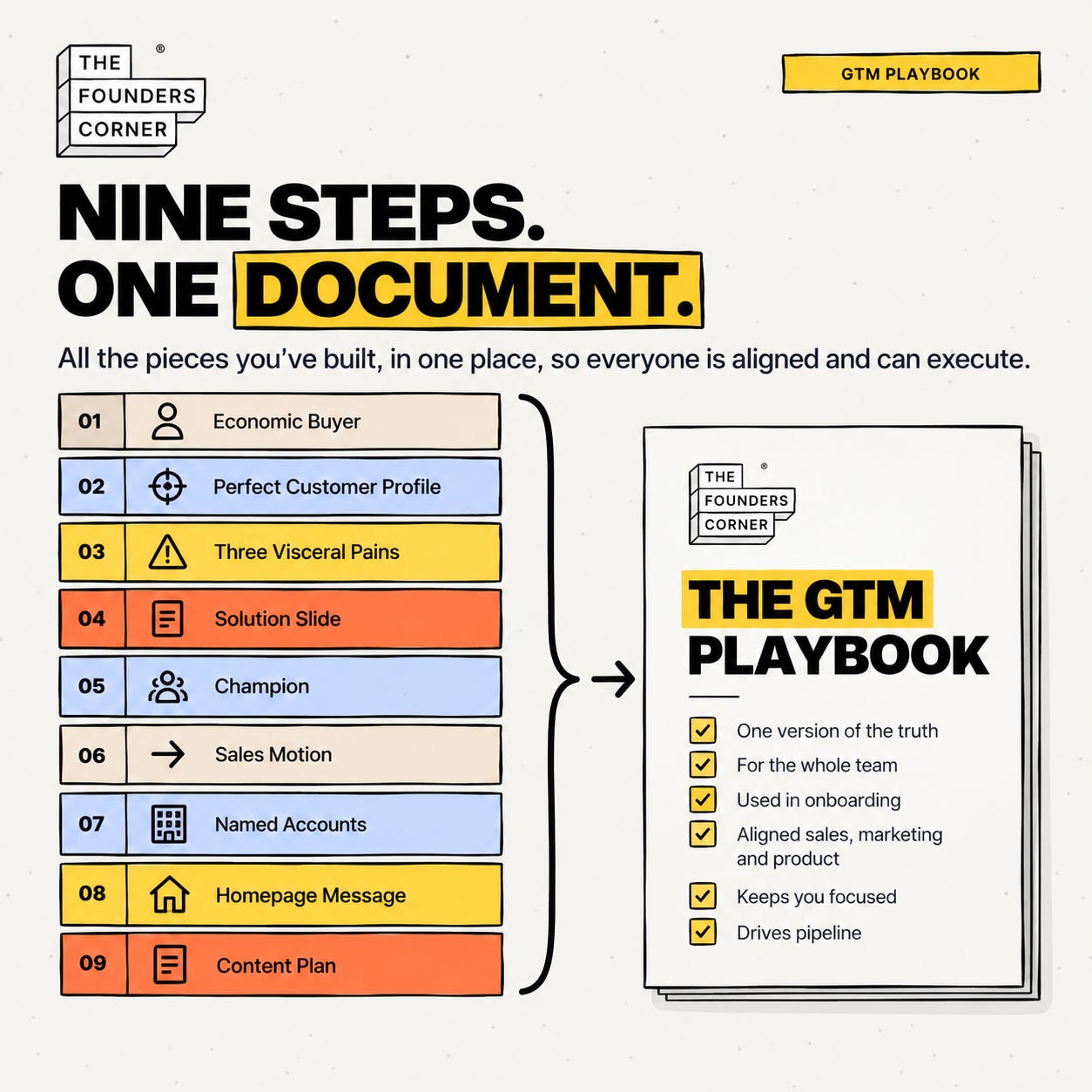
Table of Contents
A Simple Example: Three People, One Question
The Cost of Nine Tabs
Why the Founder Usually Is the Playbook
What a Real Playbook Contains
The Rule That Separates a Playbook From a Deck
Who This Document Is Actually For
What the Numbers Say About Day One
The Honest Case Against Playbooks
Why It Has to Be Reviewed, Not Just Filed
The Test of a Good Playbook
Where Your Nine Steps Become One Document
A Simple Example: Three People, One Question
Try this tomorrow. It takes about ten minutes and it’s slightly uncomfortable.
Pick three people in the business. One from sales, one from marketing, one from product. Separately, without warning, ask each of them the same question: who do we sell to, and why do they buy?
Write down what they say, word for word.
In most software companies I’ve watched run this, the answers overlap enough to sound like the same company and differ enough to cause real damage. Sales describes the buyer who said yes last quarter. Marketing describes the persona from the brand workshop. Product describes the user who files the most feature requests.
None of them is wrong, exactly. They’re each describing the part of the elephant they happen to be holding.
Now imagine a new hire asking those same three people that same question in their first week. That’s their onboarding.
The Cost of Nine Tabs
Every exercise in this series produces something real: a written sentence, a ranked list, a scored homepage, a set of named accounts with named people attached.
Left scattered across nine separate documents, though, that work quietly loses value every week.
A new sales hire reads the persona doc but never sees the pain ranking. A marketer writes content without checking the messaging scorecard. An SDR builds a prospecting list from an old filter because nobody told them the Focus zone changed. The algorithm sentence that was supposed to keep everyone saying the same thing ends up living in one founder’s head instead.
None of that is because the work was bad. It’s because the work was never assembled.
And assembly matters more than it sounds like it should, because each step only makes sense in the light of the others. A pain ranking without the Economic Buyer attached is just a list of complaints. A named account list without the pains is just a CRM export. A content plan without the stages is just a calendar. The value lives in the joins.
Why the Founder Usually Is the Playbook
There’s a reason this happens so reliably, and it isn’t laziness.
In the early days, the founder is the go-to-market system. They ran the testing calls. They heard the buyer hesitate before admitting the real problem. They know which deal was lost because the champion left and which was lost because the pain wasn’t sharp enough. All of that context lives in one place, and that place works perfectly well while the founder is on every call.
Then the company hires its second salesperson. Then its fourth. Then a marketing lead, then an agency. And every one of those people gets a verbal download of the market, delivered slightly differently each time, depending on what the founder was thinking about that week.
That’s not a playbook. That’s an oral tradition, and oral traditions drift.
The book is blunt about where the algorithm should live once you’ve earned it: not in a strategy folder nobody opens, but in the onboarding pack, in sales training, at the top of every marketing brief. The goal isn’t that the team has seen it. It’s that they can say it back to you.
Want to get in front of 250k+ founders and investors?
For sponsorship opportunities across The Founders Corner newsletter and LinkedIn (160k followers), email: founderscornermedia@gmail.com
What a Real Playbook Contains
A slide deck summarising the journey falls a long way short of what we mean here. A working GTM playbook carries the whole chain, in order:
The algorithm sentence, in full. Our software is perfect for [a clearly defined Economic Buyer] in [a tightly defined Perfect Customer Profile] who’s struggling with [the three most visceral pains our software solves]. Every bracket filled, no softening.
The Perfect Customer Profile across all four strands. Not “mid-market companies in financial services”. The boundaries that let a rep qualify an account in thirty seconds without asking anyone.
The three ranked pains, with their consequences. Symptom, consequence, and the personal stake for the person whose name goes on the purchase order.
Both personas. The Economic Buyer who signs, and the Champion who carries your case into rooms you’ll never be in.
The sales motion, and why it fits. Not just what the motion is, but the reasoning, so the next leader doesn’t rip it up on instinct.
The accounts, sorted into their zones. Focus, Research, Respond, Ignore. Including the Ignore list, which is the part most teams quietly skip.
The scored homepage message. The armour-piercing line, and the score that tells you whether it still passes the swap test.
The content pillars, mapped to stage. One pillar per pain, with Stages 3, 4 and 5 each getting the kind of piece they actually need.
That’s the document. Nothing in it is new. Everything in it is already somewhere in your business.
The Rule That Separates a Playbook From a Deck
One rule matters more than any formatting decision.
Everything in the playbook should trace back to an input someone on the team actually typed, not a paraphrase written for the deck.
This sounds pedantic. It isn’t.
The moment a pain gets rewritten to sound better in a summary, it stops being the buyer’s language and becomes yours. “Constant internal firefighting that’s burning out the team” becomes “operational efficiency challenges”. The first one makes a COO wince in recognition. The second one could sit on any software company’s website without anyone noticing.
Polish is how evidence turns back into opinion. A playbook that’s been tidied up for the board has usually been tidied out of usefulness for the sales floor.
So leave the rough edges in. Keep the buyer’s exact phrase. Keep the ranking even when it’s awkward. If a rep reads it and thinks “that’s exactly how they said it on the call”, the document is doing its job.
If you’re building right now, these five are worth your time
The AI Search Playbook That Gets Your Startup Recommended: three prompts that show whether a model puts you on the shortlist when a buyer describes their exact pain.
How to Turn Content Into Paying Customers: The 3-Pillar Playbook: three tested pains, three pillars, and the one question every topic has to pass before it gets written.
Would Anyone Notice If Your Competitor Stole Your Homepage?: seven seconds, one armour-piercing message, and the swap test most hero lines fail.
The 100 Accounts Your Sales Team Should Know by Name: how a filtered spreadsheet becomes 100 accounts and 300 named buyers your reps recognise on sight.
Why Most Founders Are Solving the Wrong Pain Entirely: ten pains go into the room, three come out, and only those three ever move a deal.
Who This Document Is Actually For
Picture a new sales hire’s first week.
The usual version: a laptop, a CRM login, a folder of onboarding docs of varying ages, a few recorded demos, and a founder’s verbal history of the market squeezed into a forty-minute slot on Wednesday afternoon. They spend the next month piecing together who the company actually sells to by listening to other people’s calls and guessing which version of the story is current.
The alternative: one document. Who we sell to, why it hurts them, how we talk about it, and who’s worth calling first.
That’s the test of a real playbook. It should be something a CRO could hand to a new joiner on day one and expect them to sound coherent on a call by day three.
Not expert. Not closing. Coherent. Able to describe the buyer’s world in the buyer’s words, name the three pains in the right order, and know which accounts to leave alone.
It isn’t only for sales, either. The same document briefs the agency, onboards the marketing lead, settles the product argument about which feature request actually matters, and gives a new board member the quickest possible read on whether the company knows who it’s for.
What the Numbers Say About Day One
The case for this isn’t just tidiness. Ramp time is expensive, and it’s getting more so.
The Bridge Group’s 2026 AE research, drawn from 158 B2B companies, puts average Account Executive ramp to full productivity at 6.2 months, the highest figure in the history of the study. Their own reading is that bigger deals and larger buying committees are stretching it out. For context, their earlier editions put it at 4.3 months in 2020, 5.3 in 2022 and 5.7 in 2024.
Half a year of salary before a new rep pulls full weight. Every week of that spent reconstructing the market from scraps is a week of ramp the company is paying for twice.
The broader onboarding picture isn’t encouraging either. Gallup has found that only 12% of employees strongly agree their organisation does a great job of onboarding, and that just 29% feel fully prepared and supported to excel in their role once onboarding is over.
Neither number isolates the effect of a written GTM playbook, and I wouldn’t claim one. What they show is the size of the gap a coherent first week could close.
A playbook won’t fix deal complexity. It won’t shrink a buying committee. What it can do is remove the part of ramp that has nothing to do with the market and everything to do with the company not having written itself down.
The Honest Case Against Playbooks
It would be odd to write this without giving the sceptics their due, because some of them are right.
Playbooks go stale. Plenty of companies have a beautifully formatted GTM document from two years ago that describes a market they no longer sell into. That’s worse than nothing, because new hires trust it.
Playbooks can replace judgement. A rep who’s been told exactly what to say can lose the habit of listening. The best salespeople I’ve worked with use a playbook as a floor, not a ceiling.
Very early companies are still finding out. If you’ve run four testing calls, not ten, the pains aren’t ranked yet. Writing them into a document can freeze a hypothesis before it’s earned the right to be treated as fact.
All three are fair. None of them is an argument for leaving the work scattered.
Staleness is a review problem, not a document problem. Over-scripting is a coaching problem. And if the evidence is still thin, the playbook should say so plainly, in the document, rather than letting everyone assume the founder’s latest guess is settled.
“A playbook isn’t a script for your team. It’s a record of what your buyers already told you, kept somewhere everyone can read it.”
Why It Has to Be Reviewed, Not Just Filed
A playbook that never gets revisited goes stale the moment the market moves.
Pain rankings shift as competitors enter. Personas age as your own product matures. A Focus account gets acquired and drops into Ignore. A homepage line that scored well a year ago starts appearing, almost word for word, on a competitor’s site.
The book makes the same point about the ICP Grid: revisit it quarterly, and watch how the points move. The playbook deserves the same rhythm.
The founders who get the most out of this treat it as a living document, reviewed every quarter alongside pipeline data, not a one-time deliverable filed after a workshop. Put the review in the calendar now. Give it an owner. Compare what the playbook says against what the last ninety days of deals actually showed, and change whichever one is wrong.
If the playbook and the pipeline disagree, the pipeline is usually telling the truth.
The Test of a Good Playbook
Here’s the simplest test I know.
Hand it to someone outside the founding team. Give them an hour. Then ask them to repeat the algorithm sentence back in their own words.
If they can, the playbook did its job.
If they can’t, something in it was still too vague to stick, and that’s worth fixing before it goes any further. Usually it’s one of three things: the Economic Buyer is described as a department rather than a person, the Perfect Customer Profile has no edges, or the pains are written in your language instead of theirs.
Run the same test on your next hire at the end of week one. Then again at the end of month one. The gap between those two answers tells you how much of your go-to-market is written down and how much is still being passed on by word of mouth.
Where Your Nine Steps Become One Document
This is exactly what unlocks once every step in the Builder has data: a single shareable Playbook, exportable as a PDF or as structured context ready to paste into a Claude or GPT project, so the whole team, and any AI tool they use, works from the same source of truth.
That last part is worth a moment. Your team is already asking AI tools to draft outbound, write blog posts and prep for calls. Every one of those prompts starts from whatever context the person happens to remember. Give the tool the playbook instead, and the drafts start from the buyer’s own words.
That’s nine weeks of this series distilled into nine steps and one document. If you’ve been building alongside us, you already have most of what belongs in yours.
The algorithm was always meant to be a compass rather than a slide. A compass only helps the person holding it, so hand it out.
-Chris Tottman
Most of this work already exists somewhere in your business. It’s just never been assembled into something a new hire could actually use.
The Selling Software Algorithm Builder Playbook pulls all nine steps into one shareable document the moment they’re complete.