

Two founders raise the same round.
Same sector. Same traction. Broadly the same deck.
One closes in eleven weeks. The other spends seven months “in conversations” and quietly gives up in the spring.
Here’s the part that surprises people. They both emailed roughly the same number of investors.
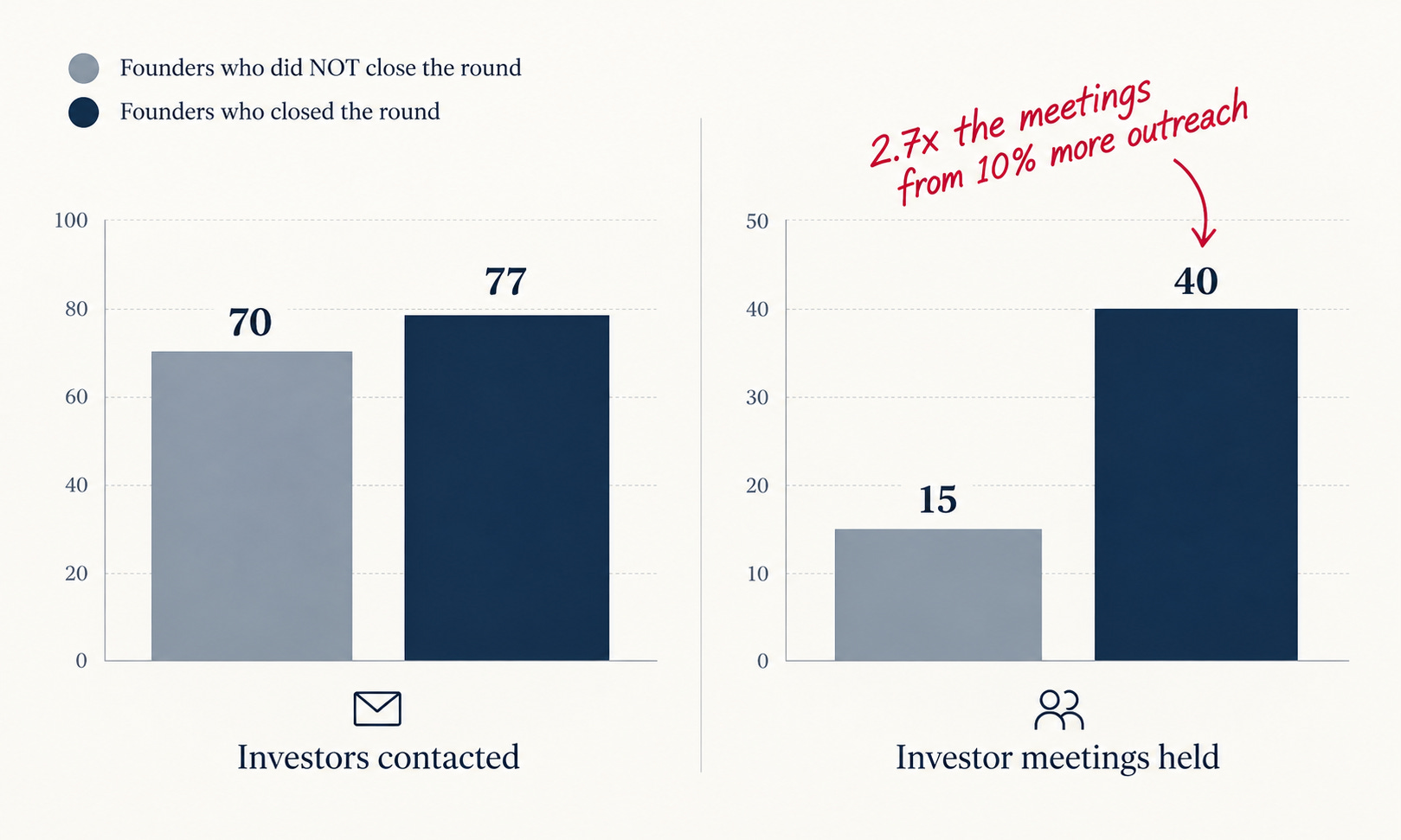
DocSend, working with Harvard Business School, has tracked this across hundreds of seed raises. Founders who closed their round contacted 77 investors on average and held 40 investor meetings. Founders who didn’t close contacted 70, barely fewer, and held 15.
Ten per cent more outreach. Nearly three times the meetings.
The second founder didn’t fail on volume. They failed on who was on the list.
That gap is what a badly built list does to you. Forty names harvested from three blog posts, most of them wrong on cheque size, wrong on stage, or no longer investing — and the emails go out anyway, because there’s nothing better to send them to.
The founders who convert aren’t emailing more people. They’re emailing correct people, chosen out of a pool of several hundred they’d already filtered.
You cannot filter down to the right thirty from a list of forty. That’s the whole problem, and it’s a sourcing problem long before it’s a pitching problem.
So we built the pool. 505 investors who fund companies at pre-seed and seed, across eight regions, each with stage, sector, cheque size, recent activity and a working link.
This article is how to filter it.
Want to get in front of 250k+ founders and investors?
For sponsorship opportunities across The Founders Corner newsletter and LinkedIn (160k followers), email: founderscornermedia@gmail.com
The Arithmetic Nobody Does Before They Start
Run the numbers on your own raise before you send a single email. It takes four minutes and it changes everything.
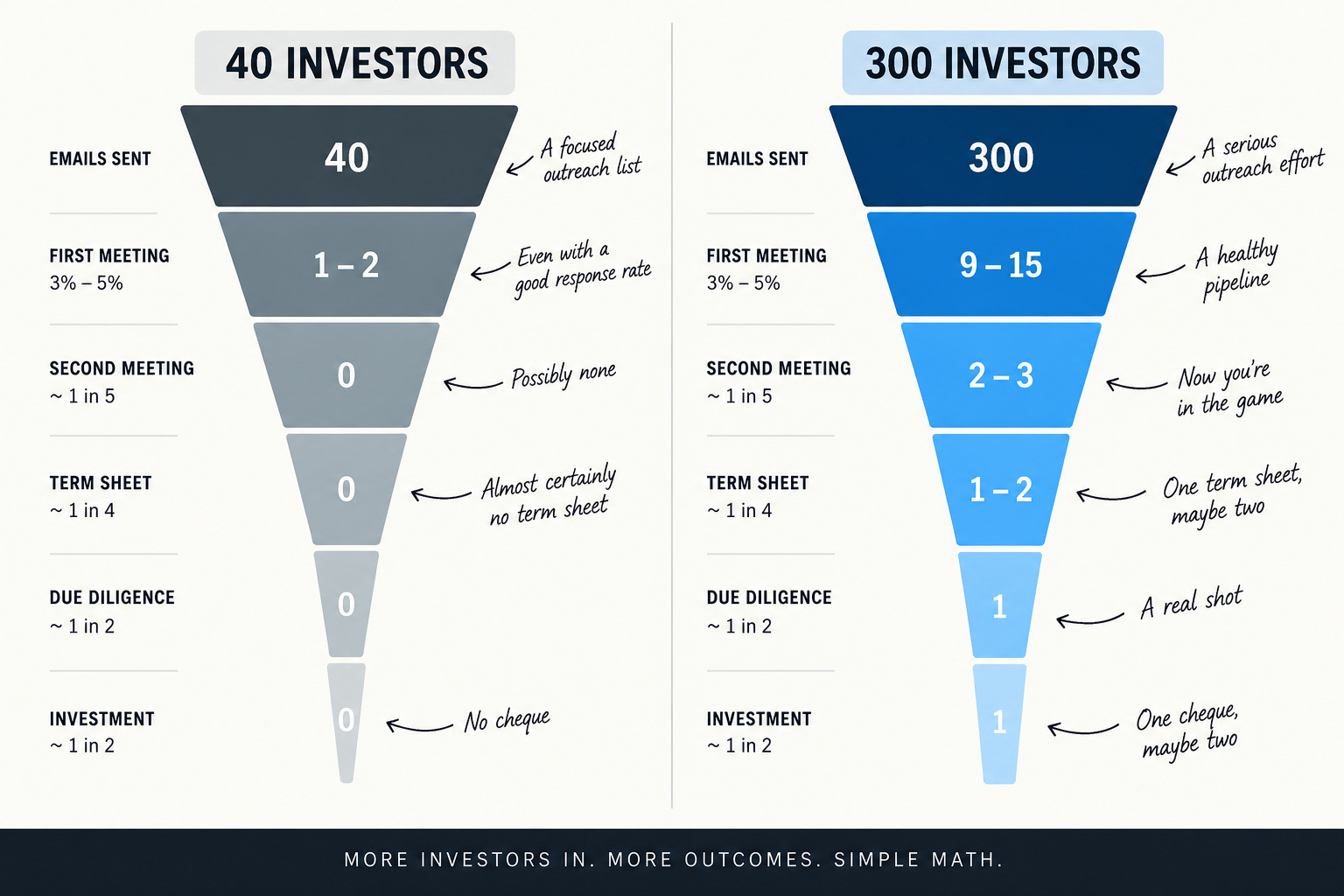
Take a reasonable conversion rate for a cold, well-targeted approach: 3% to 5% turn into a first meeting. Of those first meetings, maybe one in five goes to a second. Of second meetings, perhaps one in four produces a term sheet.
Now put 40 investors through it.
40 emails → 1 or 2 first meetings → possibly zero second meetings → almost certainly no term sheet.
That is not a failed raise. That is a raise that never statistically began.
Now put 300 through the same funnel.
300 emails → 9 to 15 first meetings → 2 to 3 second meetings → one term sheet, maybe two.
The founder who “got lucky” usually just ran a bigger top of funnel.
This is the least glamorous fact in early-stage fundraising. Nobody writes a LinkedIn post about volume. But the founder who closes is nearly always the one who spoke to 200 investors, not the one who wrote a better cold email to 30.
You cannot run those numbers without a list. And there is no free list of 300 well-targeted pre-seed and seed investors on the internet. That is the entire reason this file exists.
Segment Before You Send, or the Volume Works Against You
Volume without targeting is just spam, and spam burns a market you’ll need again in eighteen months.
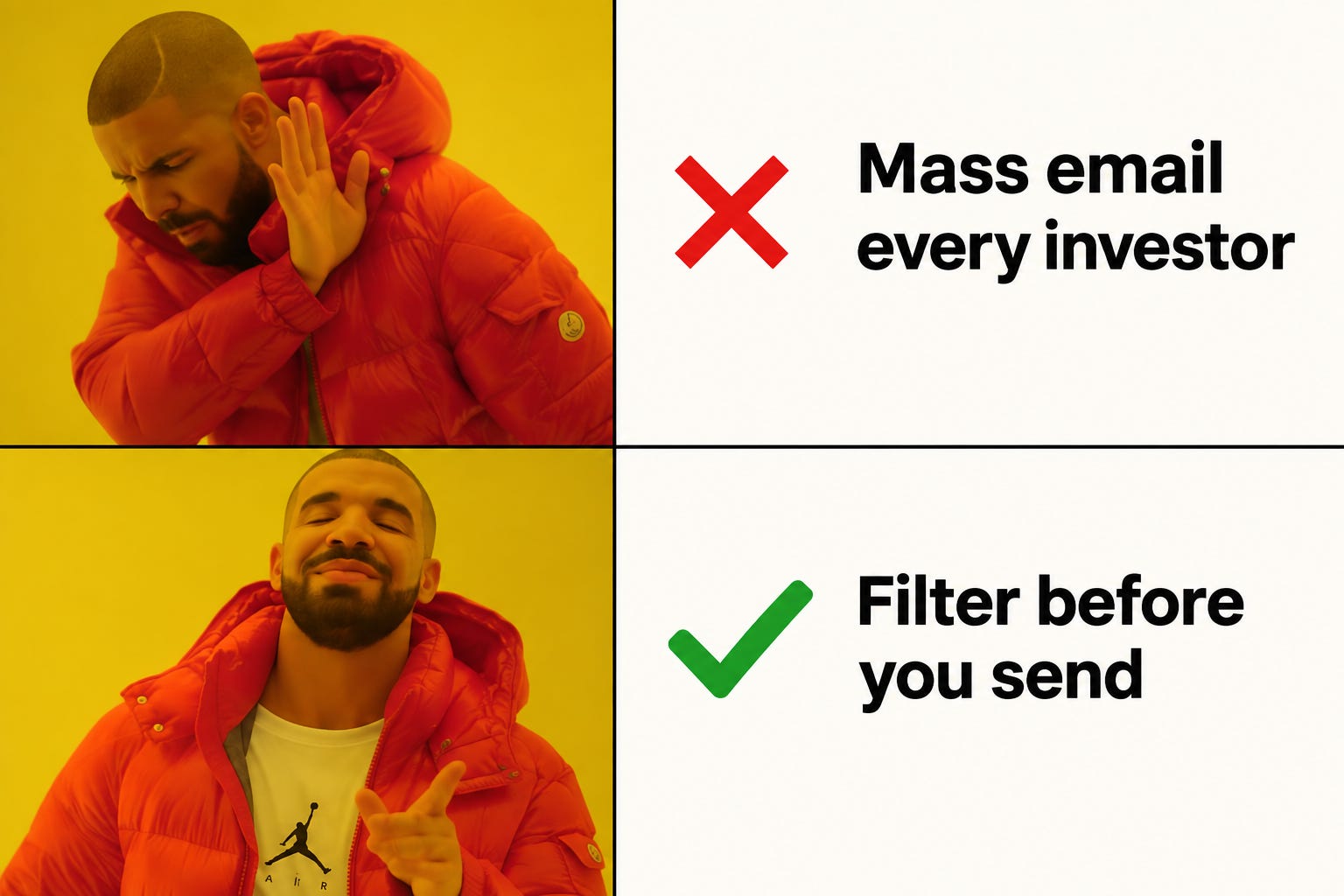
So the list gets cut four ways before anything goes out. In this order.
First, cheque size. This filter eliminates more wrong-fit investors in one pass than everything else combined, and almost nobody applies it first. Look at the actual spread among investors who all describe themselves as early-stage:
SBXi writes $10,000 to $100,000.
Kima Ventures in Paris writes €100,000 to €200,000.
Antler MENAP writes around $180,000 as a first cheque.
focal writes up to $1,000,000, often before you’ve incorporated.
2048 Ventures writes $500,000 to $3,000,000 and will lead the round.
A founder raising $150,000 and a founder raising $2m are both “raising pre-seed.” They share almost no investors. If you’re raising $150k, 2048 Ventures is a waste of a week. If you’re raising $2m, SBXi cannot fill your round even if they love you.
Second, stage. Pre-seed is first outside money — early product, little revenue. Seed is the round after, when something is working. Series A is a different sport entirely: real revenue, real growth rate, cheques of $5m and up, and a completely different decision process. Cut anyone whose centre of gravity isn’t your round.
Third, sector. Not for fit, but because your opening line changes. An investor who has backed three companies in your space needs one sentence of context. One who hasn’t needs four paragraphs, and won’t read them.
Fourth, geography. Which costs founders the most, in a way most of them never see.
The Same Company Is Priced Differently Depending on Who’s in the Round
Geography doesn’t just decide whether you close. It decides what you close at.
PitchBook’s Q2 2026 European VC Valuations Report, published in August, found the two markets moving in opposite directions. Median European deal value rose 25% year on year to €2.5m, while the median European pre-money valuation fell 5.4% to €7.5m. Over the same period, US deal sizes fell 13.5% and US valuations rose 45%.
Read that twice. European founders are raising more money at lower prices. American founders are raising less money at higher prices.
The standing gap shows up most clearly in what investors will accept as a valuation cap:
San Francisco Bay Area: pre-seed $8m–$15m, seed $15m–$25m.
London: pre-seed $4m–$9m, seed $9m–$19m.
Continental Europe: pre-seed $3m–$7m, seed $7m–$14m.
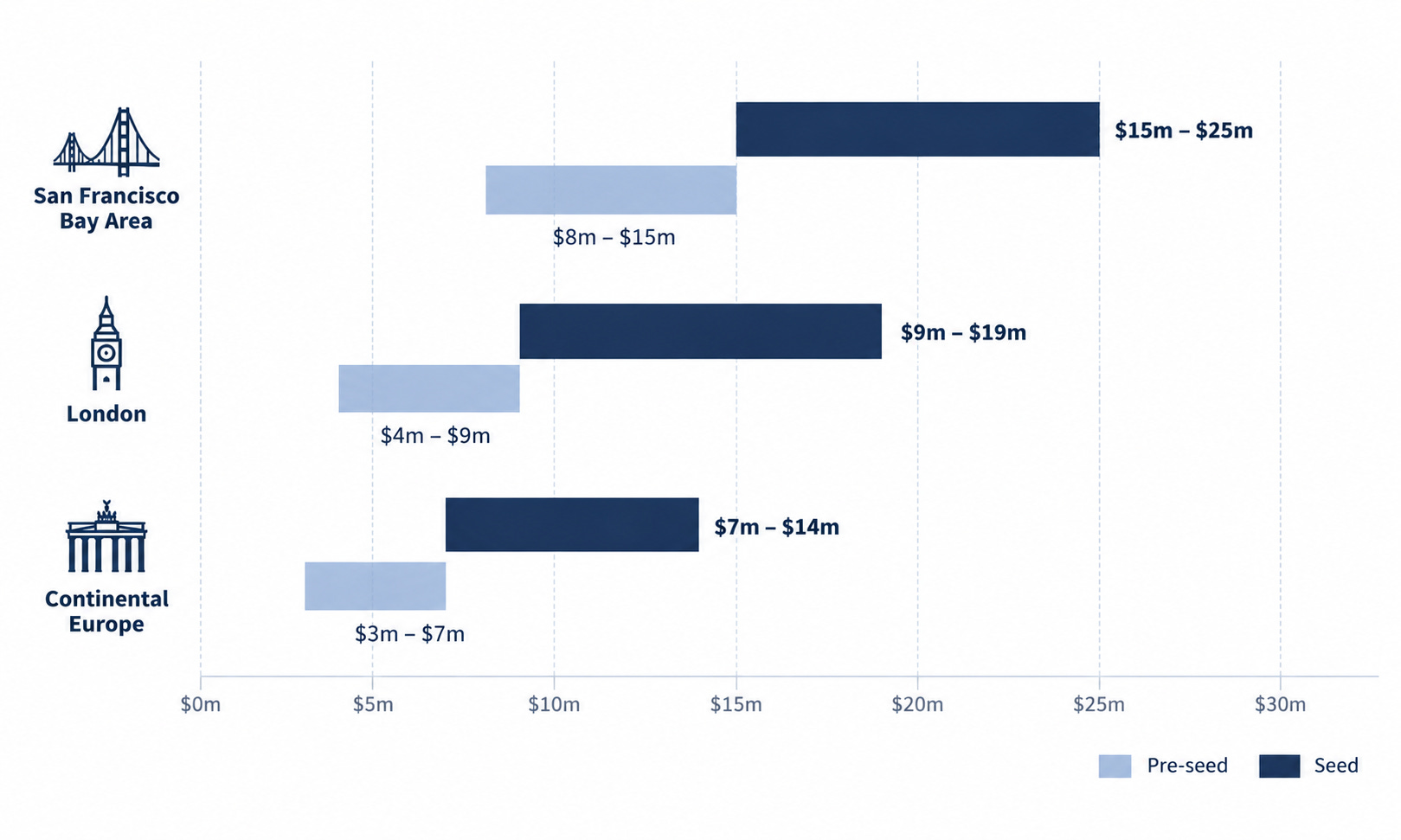
Same product, same traction, same month. A Bay Area company is routinely priced at double its Berlin equivalent, and roughly 33% above its London one at seed.
None of this is an argument to relocate. Most founders can’t, and the ones who do it for valuation reasons usually regret it.
It’s an argument about who is sitting on your cap table conversation. An American fund coming into a UK round tends to anchor on American comparables. A round filled entirely from your home market gets priced entirely at your home market’s median. The composition of your investor list is a pricing decision, not just a filling-the-round decision.
There’s depth at home too - the UK was Europe’s largest market in 2025 at $14bn, up 22% on the year, per Atomico. But depth and price are different things, and the founders who get both are the ones running a list that crosses the Atlantic.
290 of the 505 investors in this file are in the US, the UK and Europe. That’s a pipeline you can run across all three at once.
Our Most-Read Articles Right Now
🔥 How to Build Your Fundraising Narrative with Claude The five-prompt playbook that turns your raw story into the argument that gets a term sheet.
🔥 I Asked Claude to Reject My Pitch Until It Couldn’t. Then I Raised. The adversarial system that finds your weak points before an investor does.
📈 The Claude Prompt That Turns a Cold Email Into One a VC Actually Reads Personalised outreach at the volume this file makes possible.
📋 The 6 Claude Prompts That Change How Investors See You The positioning layer that makes sure the right story lands.
📋 The Claude Due Diligence Playbook That Gets You to Closing What happens after the meeting, and the term sheet arrives.
Sequence for Momentum, Not for Ego
Once the list is cut to your 200 or 300, the order you contact them in decides how the raise feels.
The instinct is to email your dream investors first. You get turned down while the pitch is still rough, and you’ve burned the names you most wanted.
Do it the other way round.
Wave one: the fast deciders. Some investors move in days. Kima Ventures does over 100 deals a year with decisions inside a week. Right Side Capital did 63 pre-seed deals in 2025. LvlUp Ventures did 92. These firms will tell you no quickly, which is the most valuable thing an investor can give you early. Ten rejections in a fortnight will teach you more about your pitch than three months of polite maybes.
Wave two: the strong-fit core. Sector match, cheque match, geography match. This is where your round actually gets filled. It should be the biggest wave by a distance.
Wave three: the dream names. Contacted only once waves one and two have sharpened the story and, ideally, produced a lead or some competitive tension. Investors respond to momentum, and momentum is manufactured in the sequencing.
Run each wave in blocks of roughly 40, a week apart. Track replies. Rewrite the email between waves based on what didn’t land.
That rhythm is impossible with a 40-name list. It’s straightforward with 505.
“A raise is not one conversation repeated 200 times. It’s three waves, each one better than the last, and you need the names to run them.”
Run It in Waves
If you take one operational thing from this issue, take this sequence:
Filter by cheque size. Cut to stage. Cut to sector. Then go wide on geography, not narrow.
Sequence into three waves. Fast deciders first, strong fit second, dream names last.
Send in blocks of 40, a week apart, rewriting between blocks.
Aim to contact 200 to 300 investors, not 40.
Every one of those steps needs the same input: a large, clean, properly segmented list of investors who genuinely fund companies at pre-seed and seed.
Building it yourself takes weeks. We’ve done it.
The file is waiting below.
The 505-Investor Pre-Seed and Seed Database
Every firm in this file invests at pre-seed or seed. No Series A funds padding the count. No growth funds with a token early-stage programme. No firms that have gone quiet.
What you’re downloading:
505 pre-seed and seed investors — United States (156), Europe (88), APAC (78), UK (46), LATAM (44), Middle East (42), Africa (37), Canada (14). Checked and deduplicated by hand.
Stage focus on every row, separated into pre-seed, seed and Series A, so your first filter takes thirty seconds.
Publicly stated cheque sizes — from SBXi’s $10,000 through to 2048 Ventures’ $3m leads — marked plainly where a firm doesn’t publish one, never guessed.
Deal counts and exit counts wherever public records allow, so you can sort by who is actually active rather than who is famous.
Dated activity notes: Oraseya’s 25 deals in 2025, LvlUp’s 92 pre-seed deals, VentureSouq’s $2m seed lead in January 2026, Launch Africa’s 15 closings in 2026.
Sector focus and named portfolio companies on every row, so your opening line can be about their thesis instead of your product.
A direct website link for all 505, with filters live on every column.
Three hours with this file replaces three weeks of research, and produces a pipeline large enough for the arithmetic at the top of this article to work in your favour.
Paid subscribers also get:
60+ additional tools across every stage of fundraising and company building: investor research, pitch deck screening, meeting prep, term sheet analysis, financial models, and the full investor database library.