

There’s a version of your raise happening right now that you can’t see.
It’s the one where every investor email gets drafted in eight seconds instead of forty minutes. Where your data room gets stress-tested before a VC associate ever opens it. Where your market slide gets rebuilt bottom-up, your metrics get pressure-checked against the benchmarks a partner will quote back at you, and your follow-up sequence writes itself the moment a meeting ends.
That version exists. Founders are running it. And the only thing separating them from the founder still hand-typing cold emails at 11pm isn’t budget, or connections, or a better idea.
It’s a prompt library.
Not a chatbot. A library. 40 specific, tested, role-loaded prompts that turn one tool into an entire fundraising function: a researcher, a copywriter, a financial analyst, and a brutally honest advisor who has read ten thousand decks and will tell you exactly where yours dies.
Here’s what almost nobody has figured out yet: the founders getting the most out of AI in a raise aren’t the ones with the cleverest single prompt. They’re the ones who stopped improvising. They built a library once, and now they run the same battle-tested prompts on every email, every deck revision, every investor meeting. The raise stops being a series of blank pages. It becomes a system.
Why “improve my pitch” produces garbage 🧠
Open Claude, paste your deck, type “how can I improve this?”, and watch it hand you a pile of encouraging, generic, useless feedback. Punchier headlines. Clearer value prop. Consider adding social proof.
You already knew all of that. It told you nothing.
The reason is simple, and once you see it you can’t unsee it: a vague prompt gets a vague role. When you don’t tell the model who it is, it defaults to Helpful Assistant - the personality trained to be encouraging and safe. Helpful Assistant is a terrible fundraising advisor. It wants you to feel good. A real advisor wants you to raise.
The entire craft of prompting for fundraising comes down to one move: stop asking for help, and start assigning a job.
Compare these two.
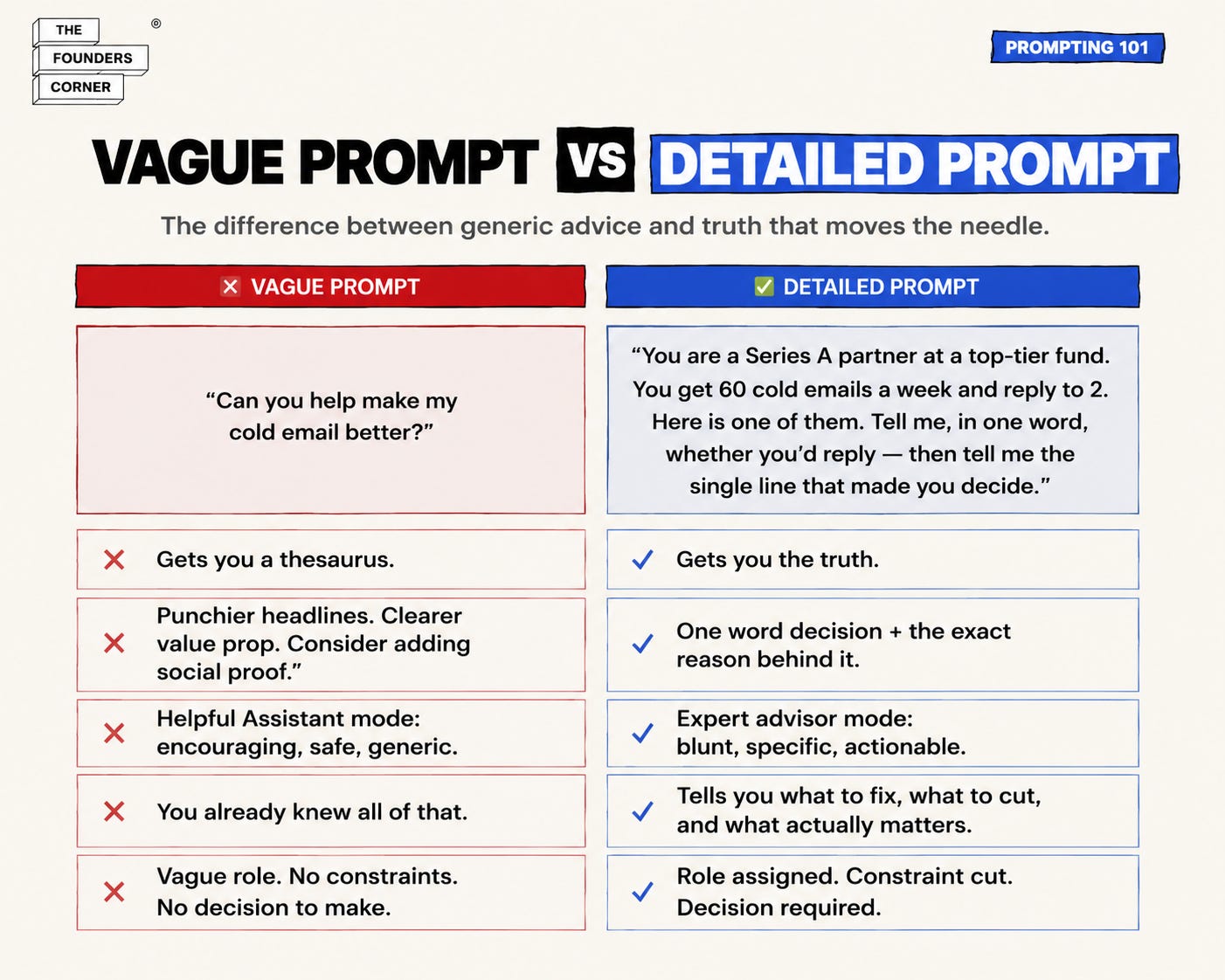
“Can you help make my cold email better?”
versus
“You are a Series A partner at a top-tier fund. You get 60 cold emails a week and reply to 2. Here is one of them. Tell me, in one word, whether you’d reply — then tell me the single line that made you decide.”
The first gets you a thesaurus. The second gets you the truth. Same model. Same email. The only variable that changed is that you gave it a role, a constraint, and a decision to make.
Every prompt in the library below is built on that principle. None of them ask for help. All of them assign a job.
What’s inside the full library 🗂️
40 prompts, organized by the stage of the raise where you’ll actually reach for them:
▫️ Narrative & positioning (6 prompts) - the prompts that turn “what we do” into a story a partner repeats to their committee
▫️ The deck (6 prompts) - slide-by-slide teardown prompts, including the market-slide rebuild and the traction-slide pressure test
▫️ Investor research (6 prompts) - how to profile a fund’s real thesis from its last 12 months of deals, not its website
▫️ Cold outreach (6 prompts) - the role-loaded email prompts, the subject-line generator, and the warm-intro request that people actually forward
▫️ Meeting prep (6 prompts) - the objection simulator that plays the specific partner you’re about to meet
▫️ The follow-up (5 prompts) - the post-meeting sequence that writes itself while the conversation is still fresh
▫️ Diligence & the data room (5 prompts) - the prompts that find the hole in your data room before an investor does
Below, four of them are fully written out and ready to paste right now - one from the deck, one from investor research, one from outreach, one from meeting prep. They’re the four we’d hand a founder on day one. The other 36, organized into the same seven categories, are yours as a downloadable Word document the moment you subscribe.
🟦 Prompt 1: The Rejection Simulator
Before you polish anything, you need to know how it dies. Most founders never get this - investors pass with a polite “not the right fit for us right now,” and the real reason stays buried. This prompt digs it out.
💬 Paste into Claude (new conversation, full pitch pasted in):
You are a skeptical Series A partner at a top-tier venture fund. You
pass on 98% of what you see, and you pride yourself on spotting the
fatal flaw fast. You are not here to be encouraging.

Here is a founder's pitch: [PASTE YOUR ONE-PAGER OR DECK TEXT]

Do this:
1. Write the actual internal note you'd send your partners explaining
   why you're passing. Be specific and unsparing. Name the real reason,
   not the polite one.
2. Identify the single weakest claim in the pitch — the one you'd poke
   first in a meeting to watch the founder squirm.
3. Tell me what would have to be true for you to change your mind and
   take a second meeting.

Do not soften anything. I need the version of this you'd say about me
when I'm not in the room.
⚡ Why this works: “Review my pitch” gets you a critique you’ll ignore. “Write the note you’d send your partners” gets you the sentence that’s actually killing your raise; the one no investor will ever say to your face.
🟦 Prompt 2: The Fund Thesis Decoder
A fund’s website tells you what it says it invests in. Its last twelve months of deals tell you what it actually invests in. Those are rarely the same thing, and the gap is where most cold outreach goes to die.
💬 Paste into Claude:
You are an analyst who profiles venture funds for founders deciding
who to approach. I'm considering reaching out to [FUND NAME].

Here is what I know about their recent activity: [PASTE 8-12 OF THEIR
RECENT INVESTMENTS — company names, stages, sectors, check sizes if
known. Pull these from their portfolio page or recent announcements.]

Analyze this and tell me:
1. What is this fund's REAL thesis, based on where the money actually
   goes — not their stated mandate?
2. What stage and check size are they most active at right now?
3. Based on my company [ONE-LINE DESCRIPTION], am I a genuine fit, a
   stretch, or a waste of both our time? Be honest — a "no" here saves
   me three weeks.
4. If I'm a fit, what specific portfolio company would make the
   strongest comparison in my outreach, and why?
💡 Run this before every cold email, not after. Ten minutes of thesis-decoding beats a hundred generic emails. The founders who get replies aren’t emailing more investors - they’re emailing the right ones with a reason.
If you found this useful, these are five more from the archive worth your time:
The Claude Guide Every Founder Should Run Before Fundraising - your deck isn’t read by a partner first anymore. It’s read by a model. Here’s how to pass the screen before a human ever sees it.
The 6 Claude Prompts That Change What You Walk Into the Room With - the meeting system that gets you prepared for the investor, not just the pitch.
The Claude Prompt That Turns a Cold Email Into One a VC Actually Reads - cold emails convert at 3%. Here’s the five-prompt system that beats it.
The Two-Minute Investor Briefing Every Founder Should Be Running - the Claude agent that turns a fund and partner name into a full investor briefing before every meeting.
I Asked Claude to Reject My Pitch Until It Couldn’t. Then I Raised. - the adversarial system that finds every weak point in your pitch before an investor does.
How to Build Your Fundraising Narrative with Claude - the five-prompt sequence that turns your raw story into the argument that actually closes rounds.
🟦 Prompt 3: The Cold Email That Earns a Reply
Now you know the fund is a fit. Most founders blow it here by writing an email about themselves. The email that gets replies is about the investor - specifically, about why this fund, this partner, this week.
💬 Paste into Claude:
You are a founder who consistently gets 30%+ reply rates on cold
investor emails. Your emails are short, specific, and impossible to
confuse with a template.

Write a cold email to [PARTNER NAME] at [FUND].

Context you'll use:
- What we do, in plain terms: [ONE LINE]
- The single most impressive, verifiable traction fact we have: [FACT]
- The specific reason THIS fund fits: [FROM YOUR THESIS DECODE]
- Any real connection or trigger: [shared portfolio co, recent post
  they wrote, a mutual contact — or write "none" and don't fake one]

Rules:
- Under 120 words. A partner reads it on their phone.
- Lead with the one fact that makes them curious, not with "I'm the
  founder of..."
- One clear ask: a 20-minute call. No calendar links in a cold email.
- No adjectives doing work a number should do. "Growing fast" is banned.
  Give the number or cut the claim.
- It should sound like a person who has something, not a person who
  needs something.

Give me three versions with different opening lines.
⚡ The tell: if your cold email would still make sense sent to a different fund with the name swapped out, it’s not outreach - it’s spam with better grammar. This prompt forces specificity the copy-paste crowd can’t fake.
🟦 Prompt 4: The Objection Simulator
You’ve got the meeting. Now the raise is won or lost on how you handle the three questions you’re secretly hoping they won’t ask. This prompt makes you rehearse them until they’re boring.
💬 Paste into Claude:
You are the partner I'm meeting on [DATE] at [FUND]. Based on this
fund's typical concerns at [STAGE], you are going to interrogate my
business.

Here's my pitch: [PASTE DECK OR ONE-PAGER]

Run a mock meeting. Ask me the six hardest questions this specific
partner would actually ask — the ones aimed at my weakest points, not
softballs. Ask them ONE AT A TIME and wait for my answer before the
next. After each of my answers:
- Rate it: convincing / shaky / disqualifying
- Tell me what a sharp partner would think but not say out loud
- Then ask your follow-up, the way they'd actually push

Start with your hardest question. Don't warn me. Go.
💡 Do this the night before, out loud. The founders who look calm in the room aren’t calm - they’ve just already had the conversation. The first time you hear your weakest answer should never be in front of the person writing the check.
🔒 This is where the library becomes a system
Four prompts will sharpen your next email and survive your next meeting. That’s real - use them today.
But four prompts is not a raise. A raise is dozens of these moments, back to back, for weeks, and the founders who stay sane are the ones who stopped improvising each one. They run the same library every time.
Here’s what’s behind the paywall:
✅ A downloadable Word document with the remaining 36 prompts - organized into the same seven categories, each one role-loaded, fill-in-the-bracket ready, and tested on live raises, not invented for a blog post. Keep the file. Run it on every round you’ll ever raise.
Inside that document, a few you’ll reach for immediately:
▫️ The Market Slide Rebuild - turns a sourceless “$14B TAM” into the bottom-up version a partner won’t discount on sight.
▫️ The Traction Pressure Test - finds the number in your deck an investor will use to disqualify you, before they find it themselves.
▫️ The “Why Now” Defense - separates a real timing thesis from a market-trend argument any competitor could also claim.
▫️ The Data Room Gap Finder - hands you the exact list of missing documents a diligence team will ask for, in the order they’ll ask.
▫️ The Closing Checklist Generator - the sequence and tracker for the gap between a verbal yes and a wired check, where deals quietly die.
Plus full access to the entire Founders Corner archive - every prompt, framework, and teardown we’ve published on getting a round closed.
Start your 7-day free trial → download the full 40-prompt library. Cancel anytime.
The Claude Fundraising Prompt Library
Download the rest of my prompts below: