

Most founders build their investor list the same way.
They Google “top seed VCs 2026.”
They copy the cap tables of three companies they admire.
They find a spreadsheet from 2023 on someone’s Substack.
The result is forty famous funds, most of them in San Francisco or London, and no idea which of them would ever back a company like theirs.
Then they send the same email to all forty and wait.
“Not our stage.” “We don’t invest in your market.” Mostly, nothing.
The problem isn’t the pitch. The problem is the list.
This database fixes that.
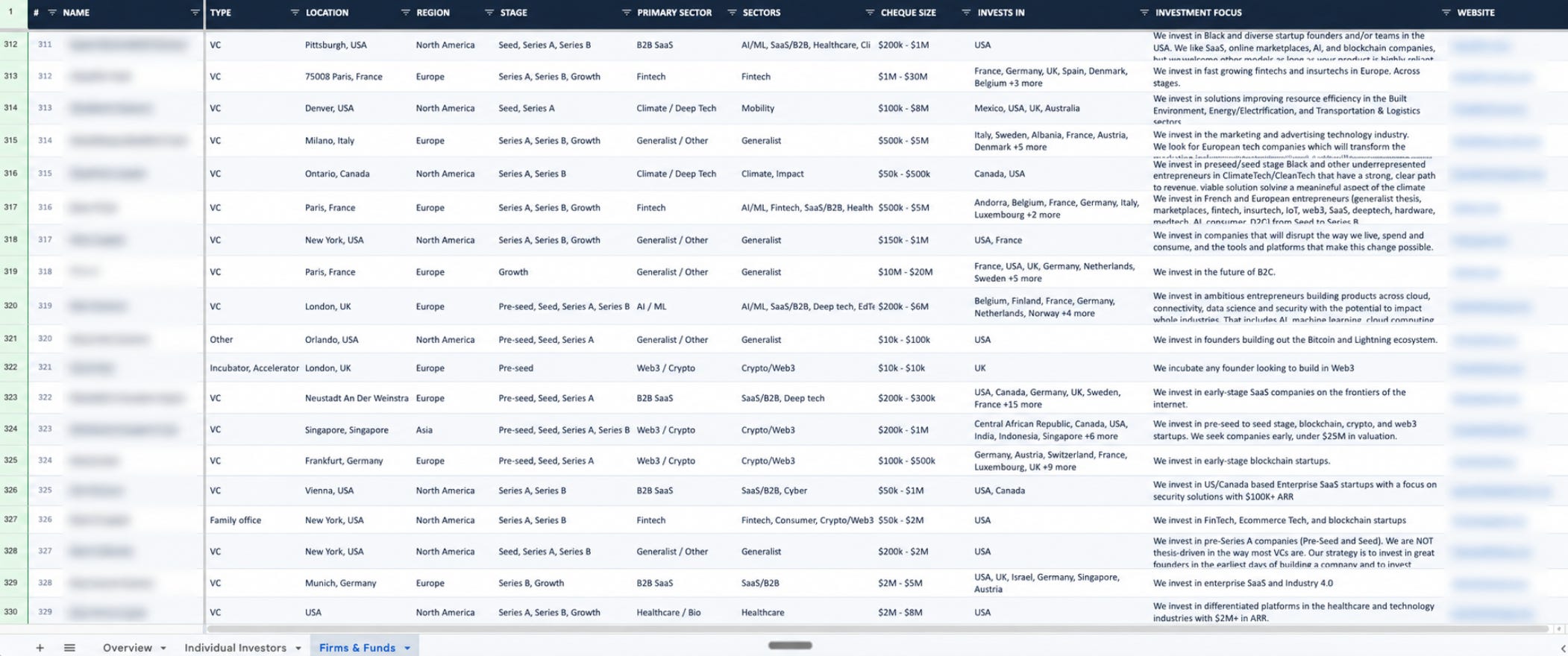
3,242 investors in one file. 992 named angels, solo GPs and partners who invest personally. 2,250 VC firms, corporate VCs, family offices, angel networks, accelerators and startup studios. Where each one is based, and where each one actually invests.
Filterable by region, stage, sector and cheque size. Ready to plug into your outreach today.
Want to get in front of 250k+ founders and investors?
For sponsorship opportunities across The Founders Corner newsletter and LinkedIn (160k followers), email: founderscornermedia@gmail.com
Why the Usual Investor List Doesn’t Work
Most lists are organised by where investors sit.
The money is organised by where it goes.
Those are not the same map. Across the database:
UK. 220 firms list a UK head office. 594 name the UK as a market they invest in.
Germany. 114 based there. 482 invest there.
Canada. 55 based there. 394 invest there.
Brazil. 10 based there. 124 invest there.
Nigeria. 5 based there. 49 invest there.
Kenya. 4 based there. 45 invest there.
And those are floors. 790 firms invest in so many countries that their entry names the first six and counts the rest.
A founder in London who searches for "UK VCs" finds the same familiar names everyone else is emailing. But 427 firms outside the UK name it as a market, 176 of them in the US. New York, San Francisco, Paris and Amsterdam are all writing cheques into British companies.
“Location” tells you where the partner has lunch. “Invests In” tells you where the money goes.
That one column is the reason this database exists.
What Each Entry Includes
Every row gives you up to nine things:
1. Name and type. VC, corporate VC, family office, angel network, accelerator, startup studio, or a named angel, solo GP or partner.
2. Firm or known for. For every named individual, the fund or company behind the name.
3. Location and region. Where they’re based, grouped into seven regions.
4. Stage. Pre-seed, seed, Series A, Series B, growth and pre-IPO.
5. Primary sector and sector tags. One headline sector for a clean filter, plus every sector they back, across 17 tags from AI and fintech to climate and healthcare.
6. Cheque size. The range they actually write. The fastest way to know whether they can lead your round.
7. Invests In. Where they actually deploy. The most important field in the file.
8. Investment focus. The fund’s thesis in its own words. This is where the real disqualifiers hide: target cheque, valuation band, revenue floor, the sectors they quietly won’t touch.
9. Website. One click to the investor’s own site.
A Taste of What’s Inside
Seven entries from across the database, and what each one tells you before you ever send an email.
Point Nine Capital
VC · Berlin · Seed to Series A · €0.5M to €3M · 29 countries
B2B SaaS and B2B marketplaces at seed. The detail most founders miss: raise your seed from Point Nine and it commits to participating in your Series A. That changes how you sequence your whole raise.
Hustle Fund
VC · Seed to Series A · $25k first cheque · USA, Canada, Indonesia, Vietnam
A generalist that starts with a fast-decision $25,000 cheque and works with you on growth. If there’s a fit both ways, it asks to put $250,000 to $750,000 into your next round. The right first call if you need an early yes to build momentum.
Precursor Ventures
VC · San Francisco · Seed to Series A · $100k to $500k · USA, Canada, Mexico, Kenya, Nigeria, UAE
Backs people over product, in hardware and software, at the earliest stage of a company’s life. A Bay Area fund that names Kenya and Nigeria as markets, which is exactly what a “Top Silicon Valley VCs” list won’t tell you.
Deutsche Telekom hubraum Fund
Corporate VC · Berlin · Seed to Series A · $50k to $350k · 69 countries
One of Europe’s largest telecoms groups, writing seed cheques from $50,000 into AI, 5G, IoT and connected work. It backs companies it sees as future strategic partners, which means the cheque can come with a customer attached.
Chanzo Capital
VC · Port Louis · Pre-seed to Series B · $25k to $250k · Kenya, Côte d’Ivoire, Nigeria, Ghana, South Africa
Invests only in the five markets it calls the KINGS of Africa’s digital economy, across fintech, edtech, agtech, healthtech and cleantech. A Lagos founder searching locally would never find it.
Reshma Sohoni, Seedcamp
Individual investor · London · Pre-seed to Seed · Generalist
Notable investments on file: Revolut and UiPath. One of 992 named investors in the Individual Investors sheet, alongside 14 partners at Andreessen Horowitz, 14 at Sequoia and 12 at Accel. A firm never reads your email. A person does.
Six entries. 3,236 more, across every stage, 17 sectors, and investment markets in more than 150 countries and territories.
The full database is available to Premium subscribers.
Start your 7-day free trial → Cancel anytime.
The Breakdown
By type. 1,631 VC firms. 992 named individuals, including 606 partners and 354 angels. 139 corporate VCs. 133 angel networks. 115 accelerators and incubators. 96 family offices. 43 startup studios.
By region. North America 1,382. Europe 1,139. Asia 276. Middle East 129. Latin America 66. Oceania 52. Africa 40.
By sector. B2B SaaS is the deepest pool, with 676 firms tagging it. Then deep tech with 501, healthcare with 479, fintech with 468 and climate with 279. AI is tagged by 265 firms and 112 individual investors. A third of firms are generalists, which means they’ll look at almost anything good.
Read the regional numbers alongside the Invests In column, not instead of it. Africa has 40 investors based there. 122 firms name an African market. That gap is the opportunity, and it’s the same story in Latin America, the Middle East and Southeast Asia.
What 885 VCs Said About Where Their Deals Come From
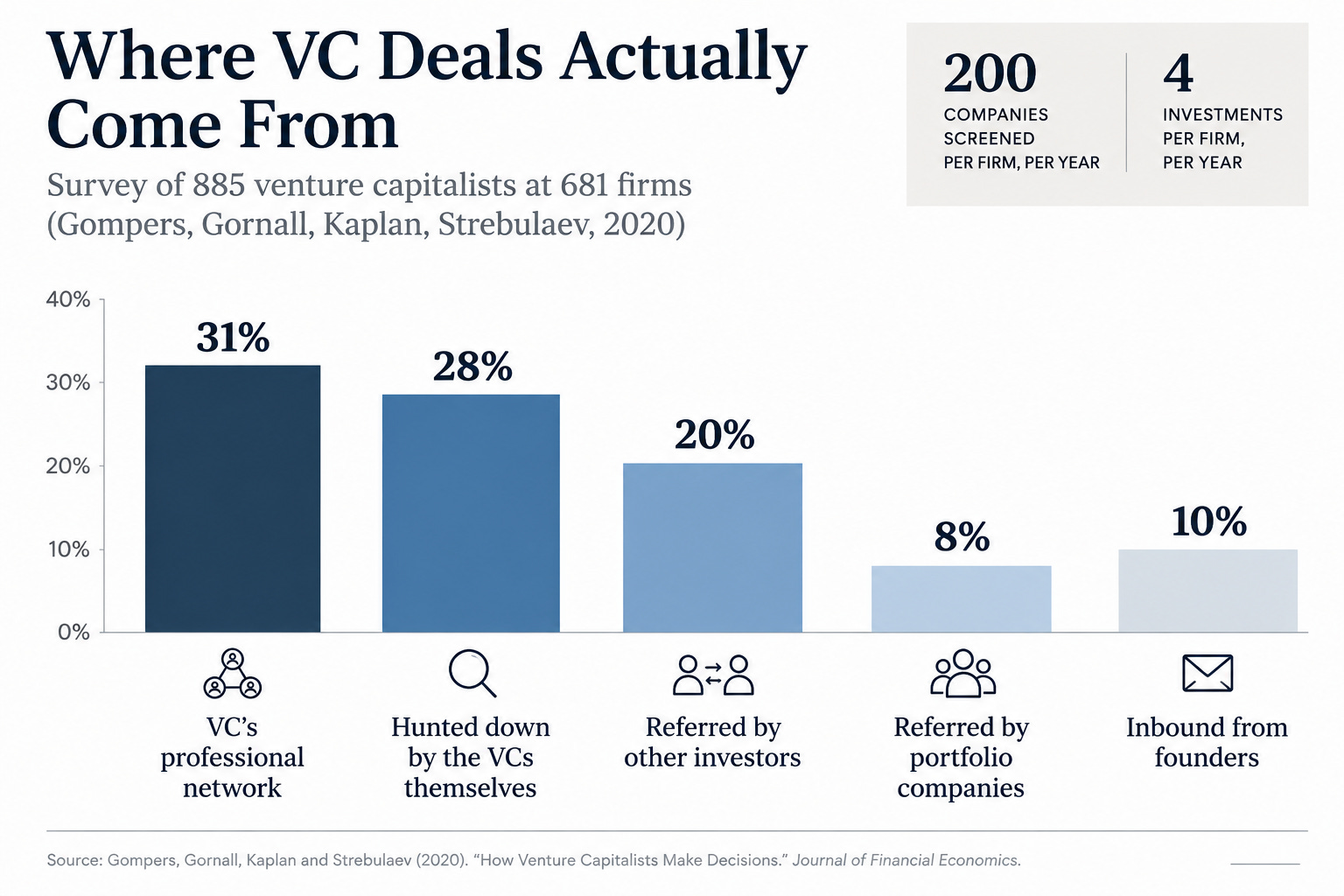
Paul Gompers (Harvard), Will Gornall (UBC), Steven Kaplan (Chicago Booth) and Ilya Strebulaev (Stanford) did something unusual. They asked. Their survey of 885 venture capitalists at 681 firms was published in the Journal of Financial Economics in 2020.
The average firm screened 200 companies a year and invested in four.
And the sourcing breakdown should change how you use any list:
31% came through the VC’s professional network.
28% were hunted down by the VCs themselves.
20% were referred by other investors.
8% were referred by portfolio companies.
10% came inbound from founders.
One deal in ten arrived the way most founders try to raise.
The same survey found 62% of firms specialise by stage, 61% by industry and 50% by geography. Pitch outside those lines and you are filtered out before anyone reads about your team.
The market since has only raised the stakes. The NVCA’s 2026 Yearbook, built on PitchBook data, recorded the number of US VC firms falling for the first time ever, from 3,054 to 2,984, and first-time funds dropping to 101 in 2025, the lowest since 2007.
Fewer buyers. Less room for a wasted first impression.
The job of an investor database isn’t to help you email more people. It’s to tell you who to get introduced to.
That’s why 992 of the entries are people, not logos.
Our Most-Read Articles Right Now
The Pitch Deck Playbook Investors spend 3 minutes and 44 seconds on your deck. Here’s the 11-slide rubric they score it against.
The Claude prompt that turns a cold email into one a VC actually reads Once the list is right, this is the email that goes to it.
The Number That Kills More Fundraises Than Any Bad Idea Why your market size slide quietly decides whether you get a second meeting.
The Due Diligence Playbook: What VCs Actually Analyse Before They Invest The stress test that starts long before the term sheet lands.
The Way VCs Actually Calculate Your Valuation (But Never Say Out Loud) The quiet maths that decides your price before the meeting even starts.
What This Replaces
Building this yourself looks like this.
Googling fund names. Paying for a data platform. Checking whether a partner still writes early cheques. Working out whether a Berlin fund invests in Nairobi. Copying everything into a spreadsheet that’s out of date by the time you send the first email.
Weeks of work before you’ve sent a single email.
This database skips all of that. 3,242 investors, already in one file, already filterable, with where they invest, the cheque they write and what they say they want sitting in the same row.
Open it, filter to your stage and market, and you have a working investor list before lunch.
One Rule Before You Approach Anyone
Read the Investment Focus cell first. Every time.
It takes thirty seconds. It tells you the target cheque, the valuation band, the traction bar, the markets. And it gives you the opening line of your email, because the best outreach starts with the investor’s own thesis and explains why your company is the proof of it.
“Nobody raises from 3,242 investors. You raise from the hundred or so who could actually say yes. The whole job is finding out which hundred are yours.”
Before You Send a Single Email
Most founders raise badly because they list badly.
They target the forty funds everyone else targets.
They search by where investors sit instead of where they invest.
They lose weeks to Googling, Crunchbase and cross-referencing.
They pour cold email into the channel that produced one deal in ten.
The list is now fixed. The rest is preparation.
Before you reach out to anyone in this file, have your fundraising narrative straight, your pitch stress-tested, your cold email rewritten around the investor’s thesis, and your first meeting prepped.
The file is waiting for you below.
The Full 3,242-Investor Database
The complete workbook is available below for Premium subscribers.
Here is exactly what you’re downloading:
Individual Investors sheet. 992 named angels, solo GPs and partners who invest personally, including partners at Andreessen Horowitz, Sequoia, Accel, Index, Atomico, Balderton and Benchmark. Type, firm, location, region, stage and sectors.
Firms & Funds sheet. 2,250 institutions, including 1,631 VCs, 139 corporate VCs, 133 angel networks, 115 accelerators and incubators, 96 family offices and 43 startup studios. Cheque size on 2,229 of them, investment focus in the fund’s own words on 2,245, and a website on 2,242
Invests In column. Where each investor actually deploys, not where it’s headquartered, across more than 150 countries and territories
One-click filters on every column. Region, stage, primary sector, 17 sector tags and cheque size
Overview sheet. A one-page guide to every column and how to use it
Add three columns for status, intro path and notes, and it becomes your fundraising CRM from the first email to the final close.
Unlock it today and get everything inside The Founders Corner:
▫️ This database of 3,242 investors across every stage and region
▫️ The Funding Milestone Navigator: stage-by-stage expectations, so you know exactly what investors want to see before you raise
▫️ The 30 Second Pitch Test: the fast filter that shows whether an investor grasps your business before they’ve even blinked
▫️ 60+ tools across fundraising and company building: investor research, pitch deck screening, meeting prep, term sheet analysis and financial models