

👋 Hey, Chris here! Welcome to BrainDumps—a weekly series from The Founders Corner. If you’ve been reading along, you know this series is a preview of a bigger project. Well, it’s finally here: The Big Book of BrainDumps is out now!
It isn’t a theory book—it’s the founder’s field manual. Inside, you’ll find 70 powerful frameworks distilled from 30+ years scaling software companies to hundreds of millions in ARR, 20+ years investing in 500+ B2B tech startups, and over $1B of shareholder value created. From raising capital to hiring your first VP of Sales, this book turns scars and successes into practical playbooks you’ll return to again and again. I expect most copies will become well-worn, scribbled on, and dog-eared—because it works.
If there is one leadership skill that quietly separates high performers from overwhelmed operators, it is prioritisation.
Strategy matters. Vision matters. Talent matters. But without the ability to decide what truly deserves attention — and what does not — even the best teams drift into reactive busyness. Over time, that busyness becomes cultural. Slack fills with urgency. Calendars fill with noise. Roadmaps fill with “almost important” initiatives.
The uncomfortable truth? Most businesses do not have a productivity problem. They have a prioritisation problem.
Over the years, we have learned the hard way that disciplined prioritisation stacks the odds in your favour as a leader. Knowing what to tackle immediately, what to schedule deliberately, what to delegate confidently, and what to eliminate entirely can mean the difference between scaling efficiently and constantly firefighting.
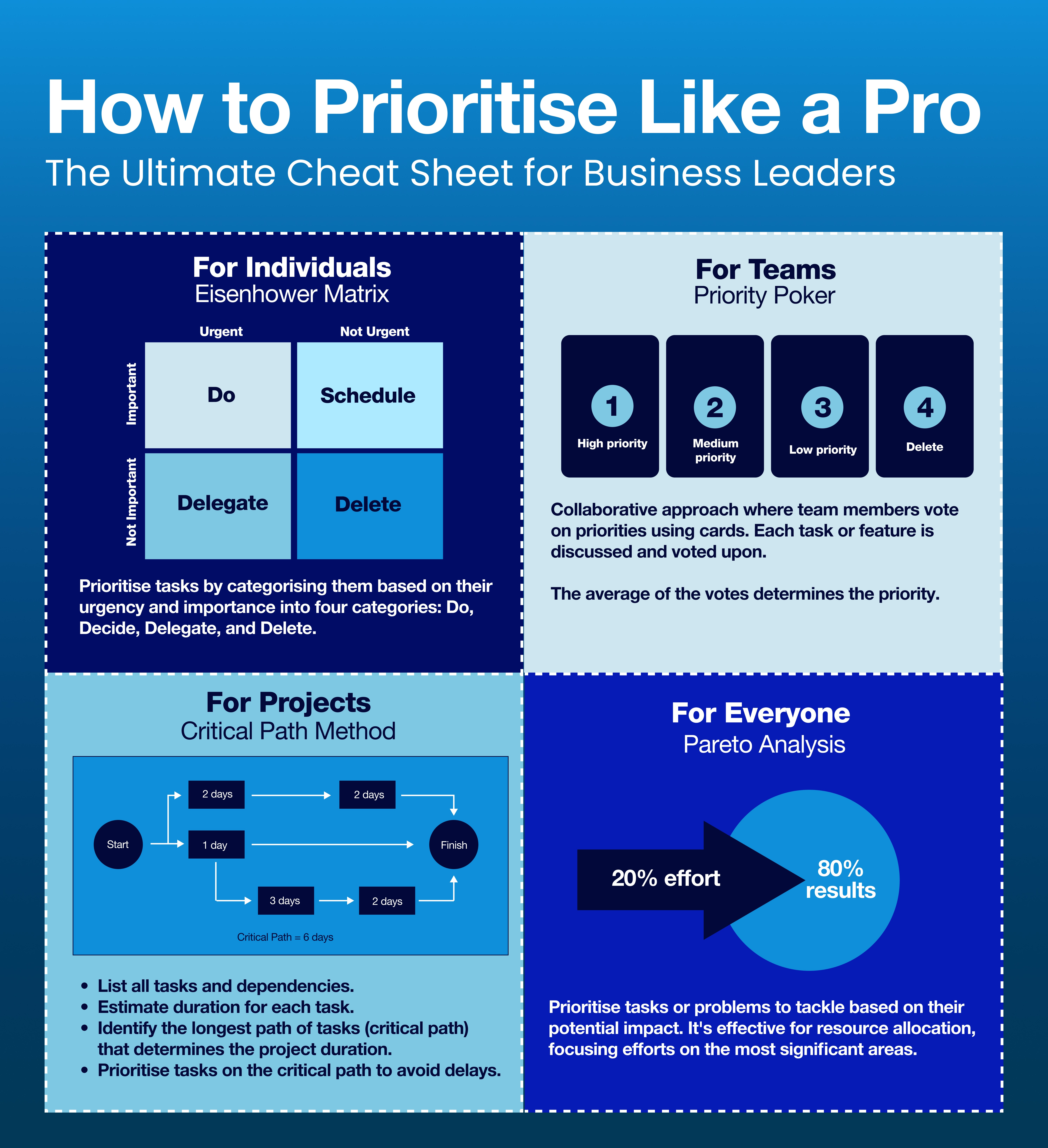
The BrainDump above captures four practical frameworks that apply at different levels of leadership: individual focus, team alignment, project execution, and company-wide impact. Each one solves a different flavour of the same problem — deciding what matters most.
Let’s unpack them in a way you can actually apply.
Table of Contents
The Eisenhower Matrix — Stop Confusing Urgency with Importance
Priority Poker — Alignment Beats Assumption
The Critical Path Method — Protect the Timeline by Identifying What Truly Drives It
Pareto Analysis — Focus on the 20% That Drives 80% of Results
Discipline Is the Multiplier
From Chaos to Clarity
Closing Thoughts
1. For Individuals: The Eisenhower Matrix
Stop Confusing Urgency with Importance
The Eisenhower Matrix is deceptively simple and incredibly powerful. It forces you to categorise tasks along two axes: urgent and important. That clarity alone exposes how much of your time is spent reacting rather than leading.
When you map your workload visually, four categories emerge.
Tasks that are both urgent and important demand immediate action. These are the fires that genuinely need putting out — critical customer escalations, funding deadlines, legal issues, board preparation. They belong in the “Do” quadrant.
Important but not urgent tasks are where long-term success is built. Strategic planning, hiring thoughtfully, product innovation, leadership development. These belong in the “Schedule” quadrant. The discipline here is protecting time before urgency hijacks it.
Urgent but not important tasks should be delegated wherever possible. These are often operational interruptions that feel pressing but do not require your leadership bandwidth.
And finally, tasks that are neither urgent nor important should be deleted. Not postponed. Deleted.
What this matrix does brilliantly is expose the illusion of productivity. Many leaders spend disproportionate time in the urgent-but-not-important quadrant, mistaking activity for progress. The matrix forces you to be honest about whether you are leading or simply reacting.
Used consistently, it transforms how you spend your day — and ultimately how your business performs.
2. For Teams: Priority Poker
Alignment Beats Assumption
Individual clarity is one thing. Team alignment is another entirely.
One of the most common causes of execution friction is silent disagreement about what matters most. Everyone nods in meetings, yet priorities subtly diverge across functions. Engineering thinks Feature A is critical. Sales pushes for Feature B. Marketing campaigns for Initiative C.
Priority Poker introduces structured alignment.
Each team member privately assigns a priority score to tasks, features, or initiatives. The scores are revealed simultaneously, and differences spark discussion. Rather than the loudest voice dominating, the process creates equal input and surfaces hidden perspectives.
The average score determines the ranking, but the real value lies in the conversation.
Why did one person rate it a four while another gave it a two? What assumptions are being made? What risks are being overlooked?
The method fosters debate without ego and builds buy-in because everyone has participated in the decision. When a team collectively sets priorities, execution accelerates. Alignment reduces friction. Accountability increases.
Prioritisation, at its best, is a shared understanding — not a top-down directive.
3. For Projects: The Critical Path Method
Protect the Timeline by Identifying What Truly Drives It
When managing complex projects, intuition is not enough. Dependencies create hidden bottlenecks, and delays compound silently.
The Critical Path Method forces you to map every task, identify dependencies, estimate durations, and determine the longest sequence of dependent activities — the critical path.
This path determines the project’s overall timeline. Any delay along it delays the entire initiative.
Leaders who understand their critical path can allocate resources intelligently. Instead of spreading effort evenly across all tasks, they concentrate attention where slippage would be most damaging.
It also sharpens decision-making. If a non-critical task slips, you may absorb the delay. If a critical-path task slips, you intervene immediately.
In scaling businesses, where multiple projects compete for resources, clarity on critical paths prevents cascading delays and protects delivery credibility.
Execution excellence is rarely about doing more. It is about protecting what matters most to completion.
4. For the Organisation: Pareto Analysis
Focus on the 20% That Drives 80% of Results
At a macro level, the Pareto Principle — often referred to as the 80/20 rule — provides a brutally effective lens for company-wide prioritisation.
In most businesses, a minority of efforts generate the majority of outcomes. Twenty percent of customers drive eighty percent of revenue. A handful of product features drive most engagement. A small number of initiatives generate the bulk of growth.
The discipline lies in identifying that vital minority.
Pareto Analysis asks uncomfortable questions. Which products truly drive profitability? Which sales channels genuinely convert? Which customers create disproportionate complexity relative to value?
By doubling down on the high-impact 20% and deprioritising the rest, organisations avoid dilution of effort. Resources concentrate where they create leverage. Strategy becomes sharper. Margins often improve.
The challenge is emotional as much as analytical. Leaders must be willing to let go of initiatives that feel important but do not meaningfully move the needle.
Focus is a strategic act of elimination.
Discipline Is the Multiplier
Frameworks alone do not create efficiency. Discipline does.
For individuals, discipline means resisting the dopamine hit of urgent but low-impact tasks. It means scheduling strategic thinking before crisis thinking consumes the week.
For teams, discipline means committing to alignment rather than reverting to informal prioritisation by politics.
For projects, it means rigorously mapping dependencies instead of hoping timelines hold.
For organisations, it means making bold trade-offs rather than hedging bets across too many initiatives.
Prioritisation is not about doing everything well. It is about doing the right things exceptionally well.
From Chaos to Clarity
Every scaling business eventually hits the same ceiling: too many opportunities, too few resources, too little time.
The leaders who break through are not those who work longer hours. They are those who decide better.
They separate urgency from importance.
They align teams around shared priorities.
They protect critical paths.
They double down on high-leverage initiatives.
When prioritisation becomes cultural, momentum compounds. Execution sharpens. Energy focuses. Results accelerate.
Operational efficiency is not built on busyness. It is built on clarity.
And clarity begins with deciding what truly deserves your attention.
Closing Thoughts
The hardest part of prioritisation isn't the framework. It's the discipline to say no to things that feel important but aren't. Most leaders know what matters. The ones who scale are the ones who act on it — consistently, uncomfortably, and without apology. Frameworks give you the lens. But the real competitive advantage is the courage to use it when the pressure is on, the calendar is full, and everyone is asking for everything at once. That's when prioritisation stops being a productivity tool and starts being a leadership statement.
-Chris Tottman
What makes this hard is that urgent work often feels responsible.
BUT there is a point where being helpful starts getting in the way of being effective.
That is usually where urgency has taken over and delegation has fallen behind.
Important work often looks quieter than urgent work, but it tends to matter more.
If you keep holding on to work that no longer needs you, you leave no room for the work that does.
We have to keep relearning that.
I wrote about that here too: https://millennialmasters.net/p/power-of-saying-no-delegation
Chris, I like the core diagnosis here: most founders do not need more hours, they need a better “decision machine.”
One question I am curious about, and I think it is the real failure mode in the wild. How do you keep these frameworks from turning into a weekly prioritization theater where everything still gets labeled important?
More specifically: what is your simplest forcing function for “stop doing” at the company level? Do you cap active bets (WIP limits), require a trade (one in, one out), or run a kill list review with explicit owner, date, and decision criteria?
If you have a quick example of a hard “no” that improved outcomes, I would love to see it.