

Let me show you something.
Two companies. Same private markets. Same era.
Company A: $157B valuation. Raised $6.6B in a single round in late 2024. CEO on the cover of every major publication. Projected cash burn through 2029: $112 billion.
Company B: $39B valuation. Last significant raise was years ago. Most people outside the design industry couldn’t name its CEO. It has been profitable for years. 170 million users. Generates more cash than it spends, every quarter, without asking anyone’s permission.
Company A is OpenAI.
Company B is Canva.
Which one has power? Not headlines. Not hype. Not narrative momentum. Power. The kind where you decide your own fate.
Most founders can’t answer that question cleanly.
Because for a decade, we’ve been trained to chase one number: valuation.
A $1B valuation made you a unicorn.
$10B made you elite.
$100B made you untouchable.
But valuation is a story.
Two people negotiate it in a room. It moves with sentiment, with comparable transactions, with the mood of a single lead investor. It can collapse in a quarter.
Cash doesn’t negotiate. It just is.
Brought to you by Deel: $1,000,000 for a 5-minute application.
Most founders spend months trying to get in front of the right investor.
This changes that.
Deel just launched The Pitch, presented by J.P. Morgan - a global startup tournament deploying $15M+ into early-stage companies.
Up to 100 regional winners receive $50K.
From there, 10 founders move on globally.
Each receives a $1M SAFE.
No warm intros.
No gatekeepers.
Just product, team, and ambition.
The application takes minutes.
The upside is asymmetric.
Apply here.
What We’re Calling a Balance Sheet Unicorn
A Balance Sheet Unicorn (BSU) is a privately held company with $1B+ in net cash.
Not committed capital.
Not a funding round in progress.
Not equity locked in a cap table.
Real cash. Available. Unconditional.
The kind that lets you:
Acquire competitors when markets turn and everyone else is retrenching
Pay talent without promising a liquidity event that may never come
Ignore the IPO window entirely - because you don’t need it
Say no to a bad term sheet, because you have the leverage to wait
We’ve been tracking valuations for a decade.
Nobody has been tracking this.
The Numbers That Prove the Gap Is Real
This isn’t theory. The data is striking.
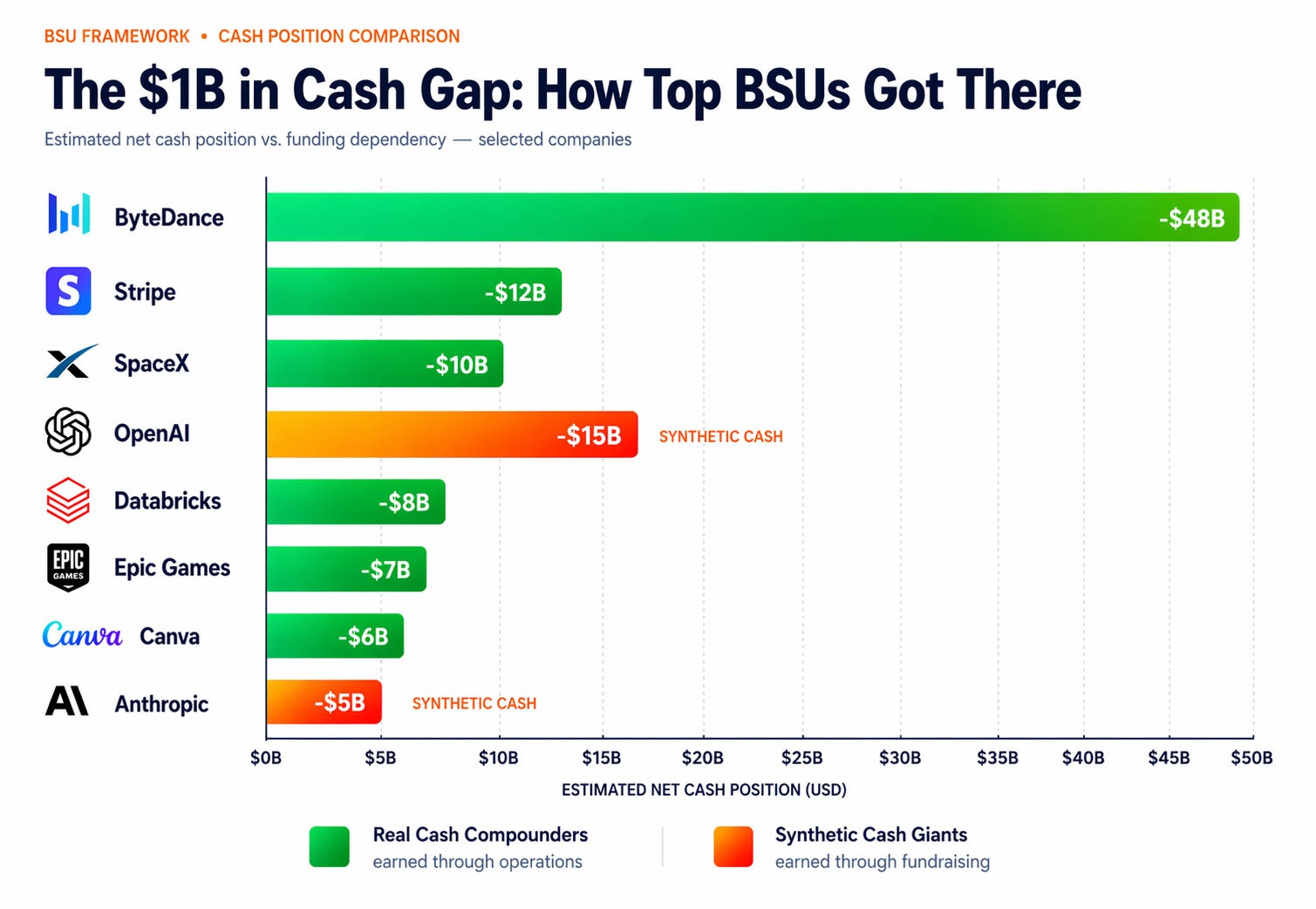
ByteDance reached approximately $50 billion in net profit in 2025 on revenues of around $186 billion. Its annual profit is now approaching Meta’s. From a standing start as a content app, it has built one of the most cash-generative businesses in the history of private markets.
Stripe processed $1.9 trillion in total payment volume in 2025 — equivalent to 1.6% of global GDP. Up 34% year-on-year. The Collisons raise capital occasionally. Not because they need it. Because they choose to.
OpenAI confirmed $20B+ in annualised revenue for 2025 — a 3x increase on 2024’s $6 billion. It then raised $122 billion in its latest round at an $852 billion valuation and is now generating $2 billion in revenue per month. Projected cash burn: $9 billion in 2025, $17 billion in 2026. No path to cash-flow positive until 2030. The fundraising machine is extraordinary. The dependency is structural.
These three companies tell the whole story of the BSU divide.
The Leaderboard: Who Has Crossed the Threshold
Cash position is invisible in private markets. Nobody publishes a balance sheet.
So we built a way to reverse-engineer it.
The BSU Score (0–100) estimates a private company’s likely net cash from six observable signals:
Cash = Capital Raised + Cumulative Profits — Burn — Liquidity Leakage
Here’s who scores highest and why it matters.
Tier 1: Liquidity Engines (Score 80–100)
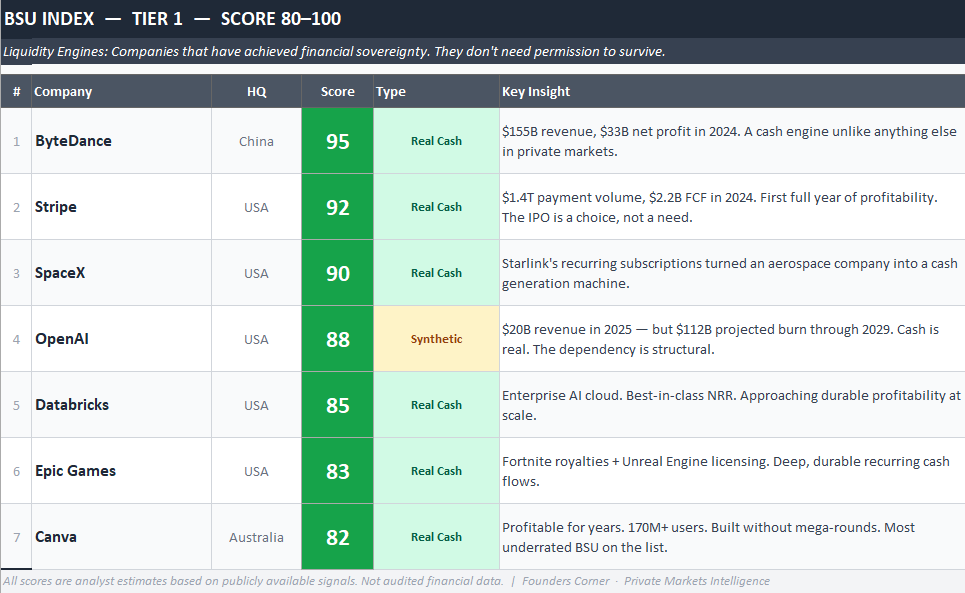
ByteDance (95) is in a category of its own. $50B in net profit last year. TikTok internationally, Douyin domestically. The flywheel is self-sustaining in a way almost no private company has ever achieved.
Stripe (92) is what “capital-light” looks like when executed at scale. No inventory, no hardware, no physical infrastructure. Just margin compounding on every transaction through its API. The IPO is a choice, not a need.
SpaceX (90) used to be entirely dependent on NASA contracts. Then Starlink’s recurring subscriptions kicked in and SpaceX became a cash machine that happens to also build rockets. Musk’s refusal to take it public now looks rational.
OpenAI (88) scores here not because it’s operationally self-sustaining, it isn’t, but because the sheer scale of its fundraising creates a genuinely large cash balance. The mechanism behind the score is entirely different from the others. We’ll come back to this.
Canva (82) is the most underestimated company on this list. Built in Sydney. Profitable for years. No mega-round. 170 million users. Most people in venture can’t name its CEO. That’s the point.
Tier 2: One Constraint Away (Score 65–79)
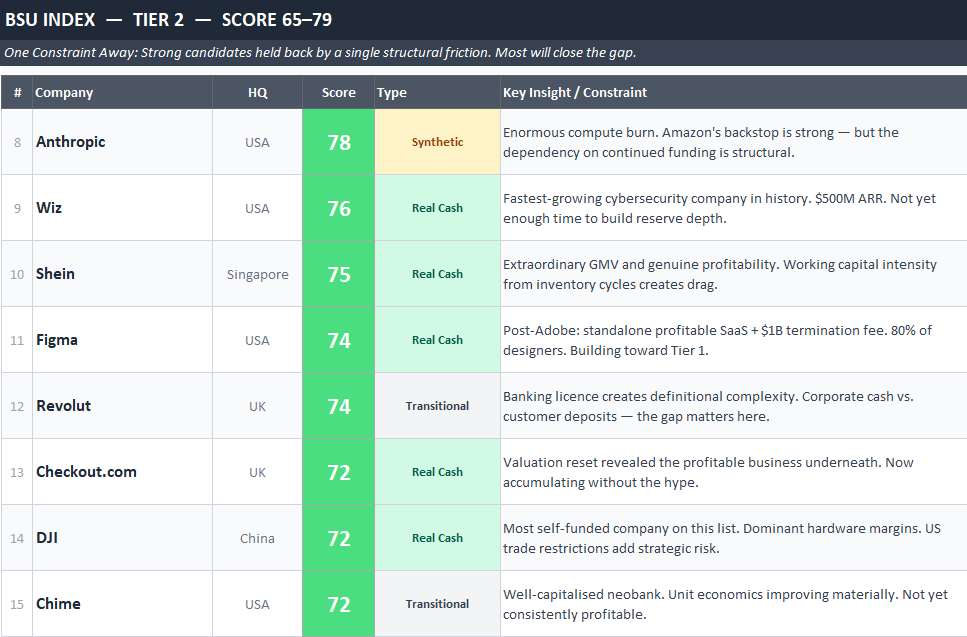
Anthropic (78) almost certainly has $1B+ right now. But the compute burn is extraordinary, and the position is entirely dependent on continued Amazon backing. The constraint isn’t access to money. It’s whether frontier AI economics ever become self-sustaining.
Wiz (76) is the name most founders haven’t heard of. Fastest-growing enterprise cybersecurity company in history. $500M ARR. Exceptional margins. It just hasn’t been generating cash long enough to build the reserve depth Tier 1 requires. Watch it.
Figma (74) is a story about a failed acquisition that created something better. Adobe’s $20B deal collapsed. Figma received a $1B termination fee — on top of an already profitable business used by 80% of the world’s product designers. Post-deal, it’s cleaner and more independent than it would ever have been inside Adobe.
Revolut (74) comes with a footnote that matters. Cash in a regulated banking context isn’t the same as corporate cash. Customer deposits are liabilities. Strip those out, and the real position is meaningfully smaller than the headline suggests.
Tier 3: Touched the Threshold (Score 50–64)
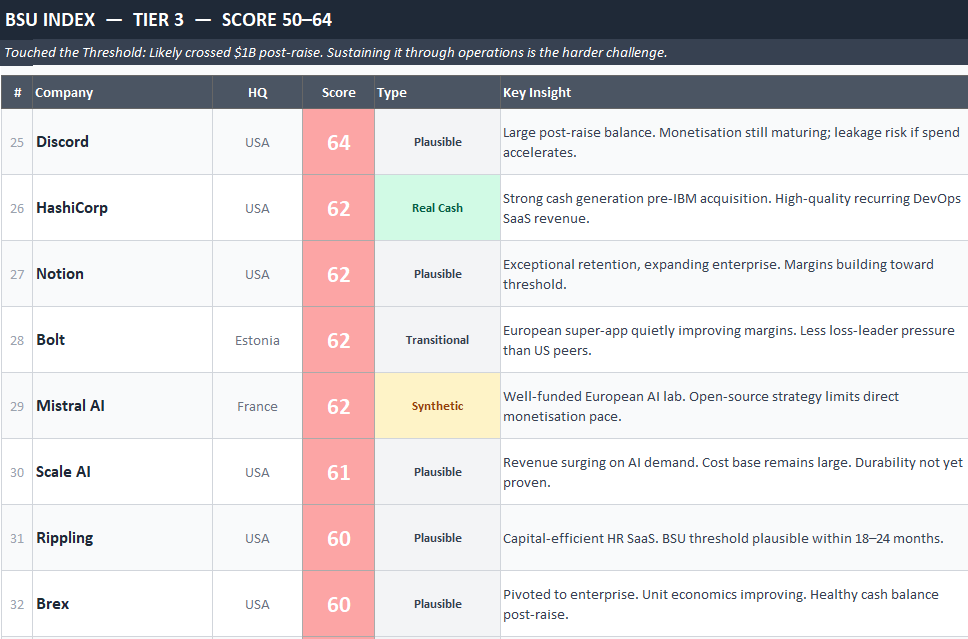
The Tier 3 companies aren’t failures. Many are exceptional businesses. What they share is that their cash position is volatile — tied to raise timing, burn reduction pace, and how quickly revenue converts to retained cash.
Rippling (60) is the most interesting here. Capital-efficient HR SaaS. Building the right way. BSU threshold plausible within 18–24 months if the trajectory holds.
The Split Nobody Talks About
Here’s the thing nobody in private markets will say plainly: not all Balance Sheet Unicorns are the same kind of company.
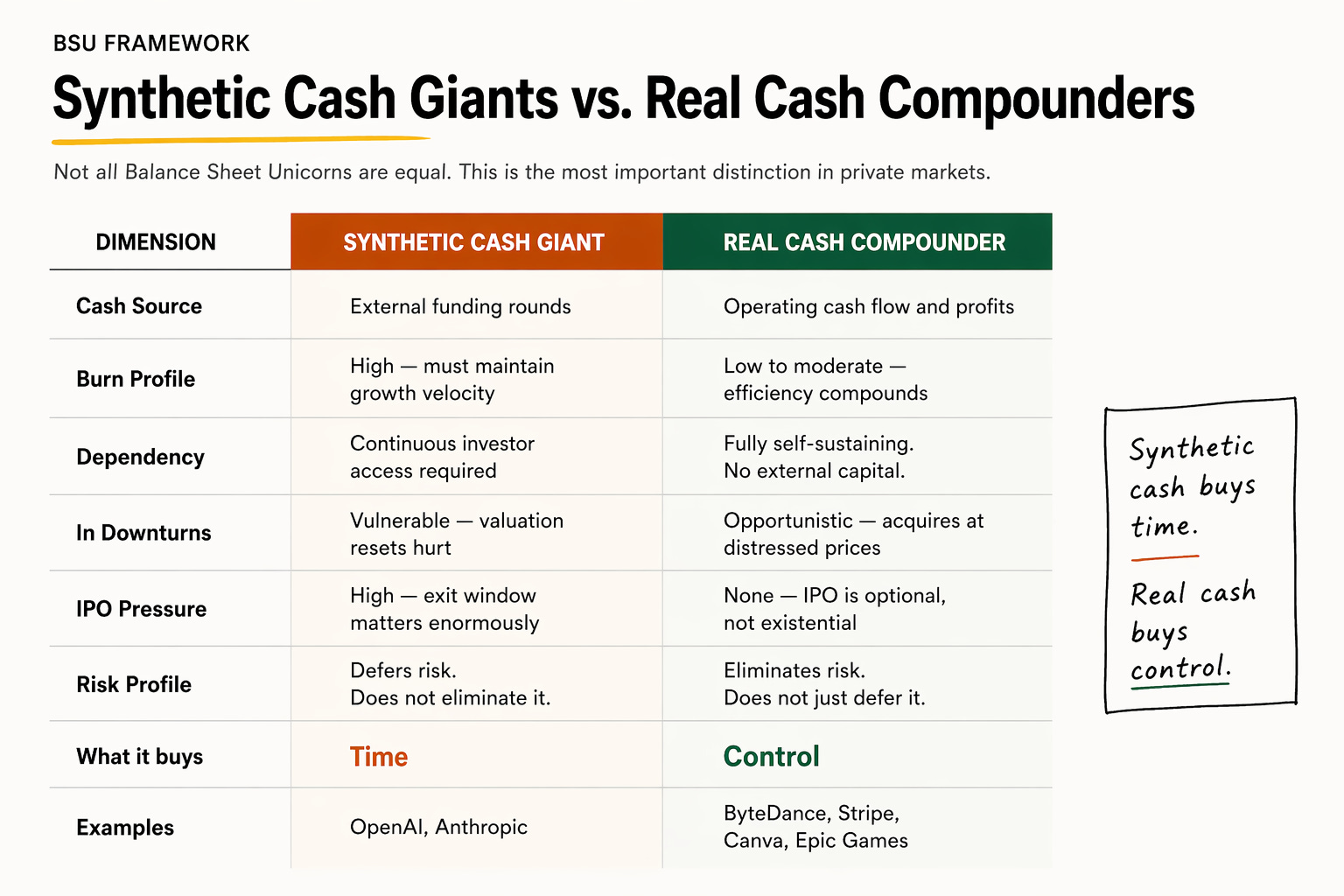
Once you map the full field, a deeper divide appears, one that matters more than any individual ranking.
Synthetic Cash Giants
OpenAI. Anthropic.
Their cash comes from investors. Remove the fundraising, stop the capital inflows, and the position collapses. The balance sheet is real, but the dependency is structural. Synthetic cash buys time.
Real Cash Compounders
ByteDance. Stripe. Canva. Epic Games.
Their cash comes from operations. Margins are high, surplus builds, and in downturns they get stronger, not weaker. When others are cutting, they’re buying. Real cash buys control.
The rule is simple: synthetic cash buys time, real cash buys control. One delays the reckoning. The other removes it.
The Geography of Power
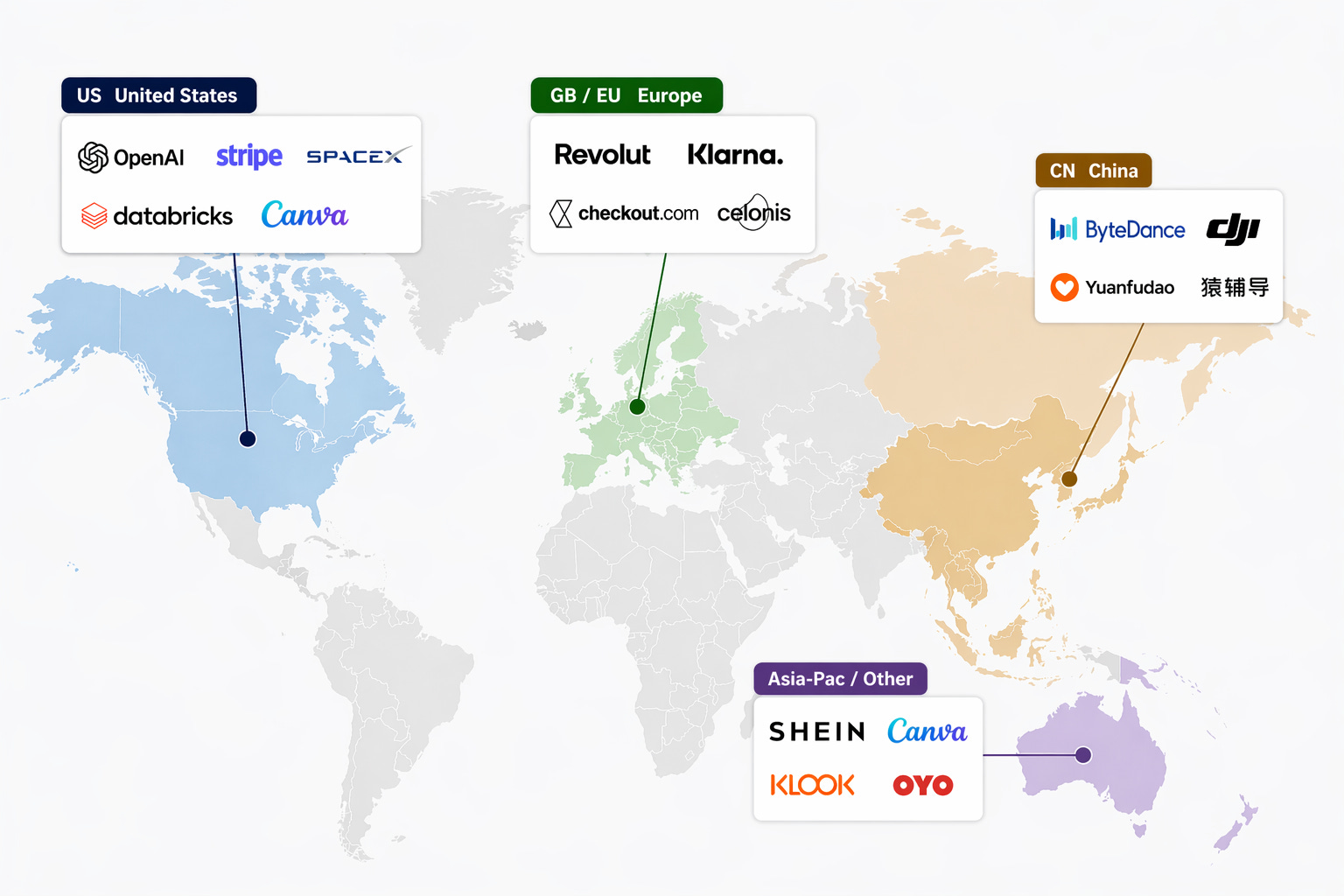
The distribution isn’t random. It maps onto structural differences in capital formation.
USA produces both archetypes at scale simultaneously — something no other market does.
China produces almost exclusively Real Cash Compounders. ByteDance, DJI, and Yuanfudao reached their positions through operational profitability, not funding. DJI never took significant outside capital. It just built dominant hardware margins and held them.
European fintech looks strong until you look closely. The definitional complexity of ‘cash’ in regulated banking keeps Revolut and Klarna out of Tier 1, regardless of their revenue scale.
Canva deserves a special mention. Australian. Not backed by the biggest VCs. Not building AI or payments infrastructure. A design tool. Quietly sovereign.
What This Means for You
Most founders ask: “What’s my valuation at the next round?”
That’s the wrong question.
It optimises for a number that two people negotiate based on conditions outside your control.
The right question is: “How do I build a company that generates more cash than it consumes?”
Not eventually. Not after the next round. As an architectural feature of the business model from day one.
ByteDance doesn’t need a favourable IPO window.
Stripe isn’t waiting for interest rates to fall.
Canva’s next move doesn’t require a new investor’s approval.
That is what financial sovereignty looks like.
And the founders who build it — quietly, without fanfare — are the ones who will define the next decade of private markets.
🔒 Want To Run This On Your Own Business? Here’s How.
The framework that scored every company on this list is behind the paywall — along with two resources you can use immediately.
The BSU Score Calculator. Live Excel. Enter any company across the six signals. BSU Score and tier update automatically. Run it on a competitor, a partnership target, or your own business. Takes under five minutes.
The full BSU Scoring Methodology. Every signal explained, every scoring band defined. Understand exactly how every number on this list was reached.
The Full BSU Tier List — all 50 companies, continuously updated. Every company scored and annotated. The living reference document we update as positions change.
Have the conversation most founders avoid. Enter your own numbers honestly. The output tells you whether you’re building toward sovereignty or toward dependency. That’s what this is really for.
Two resources. Immediately actionable.