

A founder I sat on the board of once sent me a 40-slide deck the night before a board meeting. Full P&L. Every KPI. Three appendices. I read maybe six slides. Most of the other directors read fewer.
The meeting itself was worse. He talked for fifty minutes out of sixty. We left without making a single decision. He thought the meeting had gone well because nobody had pushed back. I left thinking we had just lost an hour we did not have.
Nobody tells founders that closing the round is the easy part. The hard part starts in the boardroom three months later, when you go from being the only person making decisions to being one voice in a room that includes people who have a legal right to remove you.
Most founders have never run a meeting like this before. They learn by getting it wrong in front of the people who decide their future raises, their exit timing, and in extreme cases, their job.
Why Board Meetings Go Wrong From the First One
The mistakes are almost always the same three.
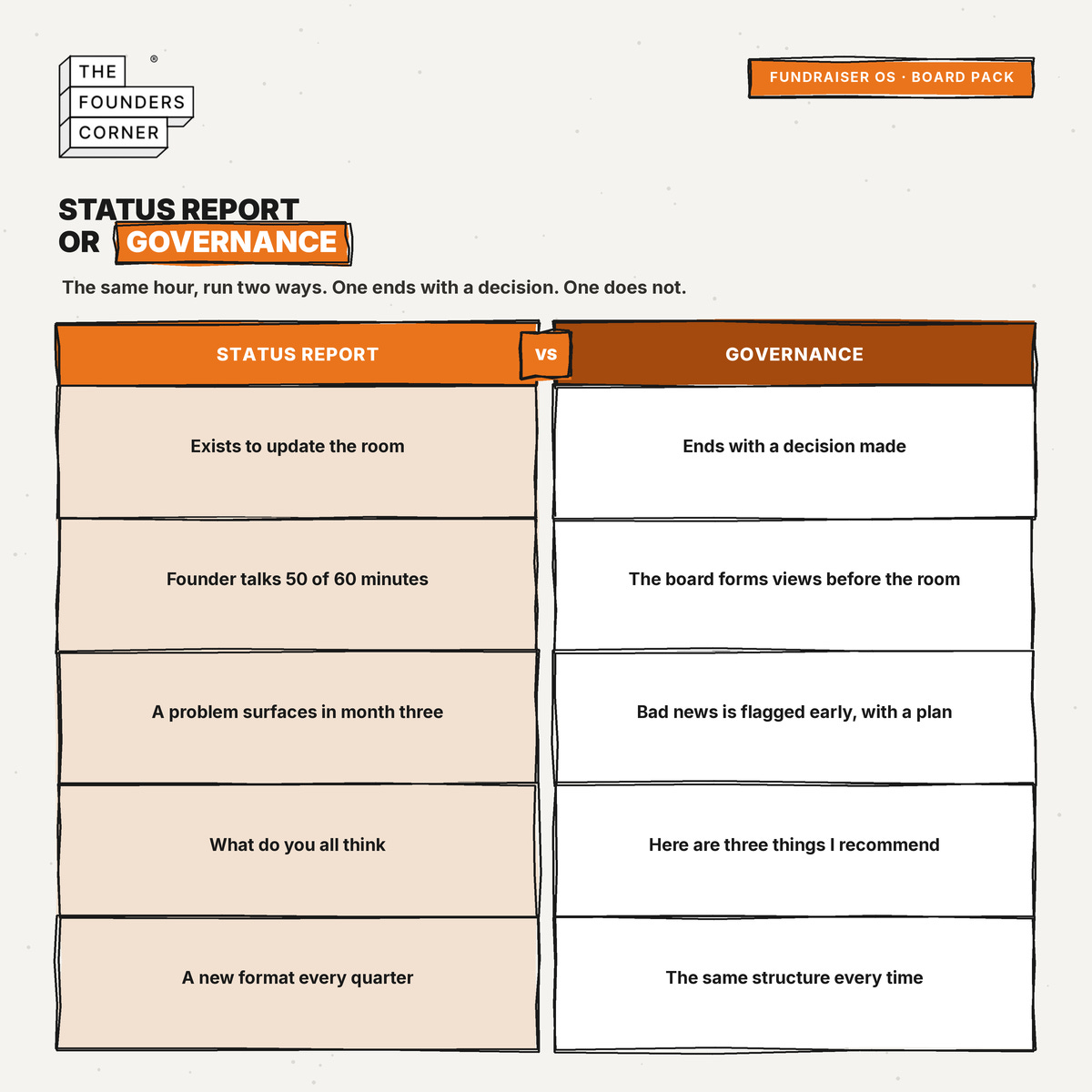
Too much information, badly organised. Founders either over-prepare with a deck nobody reads in full, or under-prepare with no structure at all. Both produce the same outcome: directors who are reacting to information for the first time in the room, instead of arriving with views already formed.
No decisions on the agenda. A board meeting that exists to update people is a status report, not governance. If the meeting does not end with at least one decision made, you have wasted the most expensive hour on your calendar. Board members are paid in equity and reputation to make decisions, not to be informed.
No consistency between meetings. The founders who struggle most send a different format every quarter. A new structure, a new set of metrics, a new layout. Every meeting becomes a fresh cognitive load for the board instead of a continuation of a story they already understand.
What a Board Actually Wants From You
I have sat on dozens of boards. The founders I trust most share a specific pattern, and it has nothing to do with how good their numbers are.
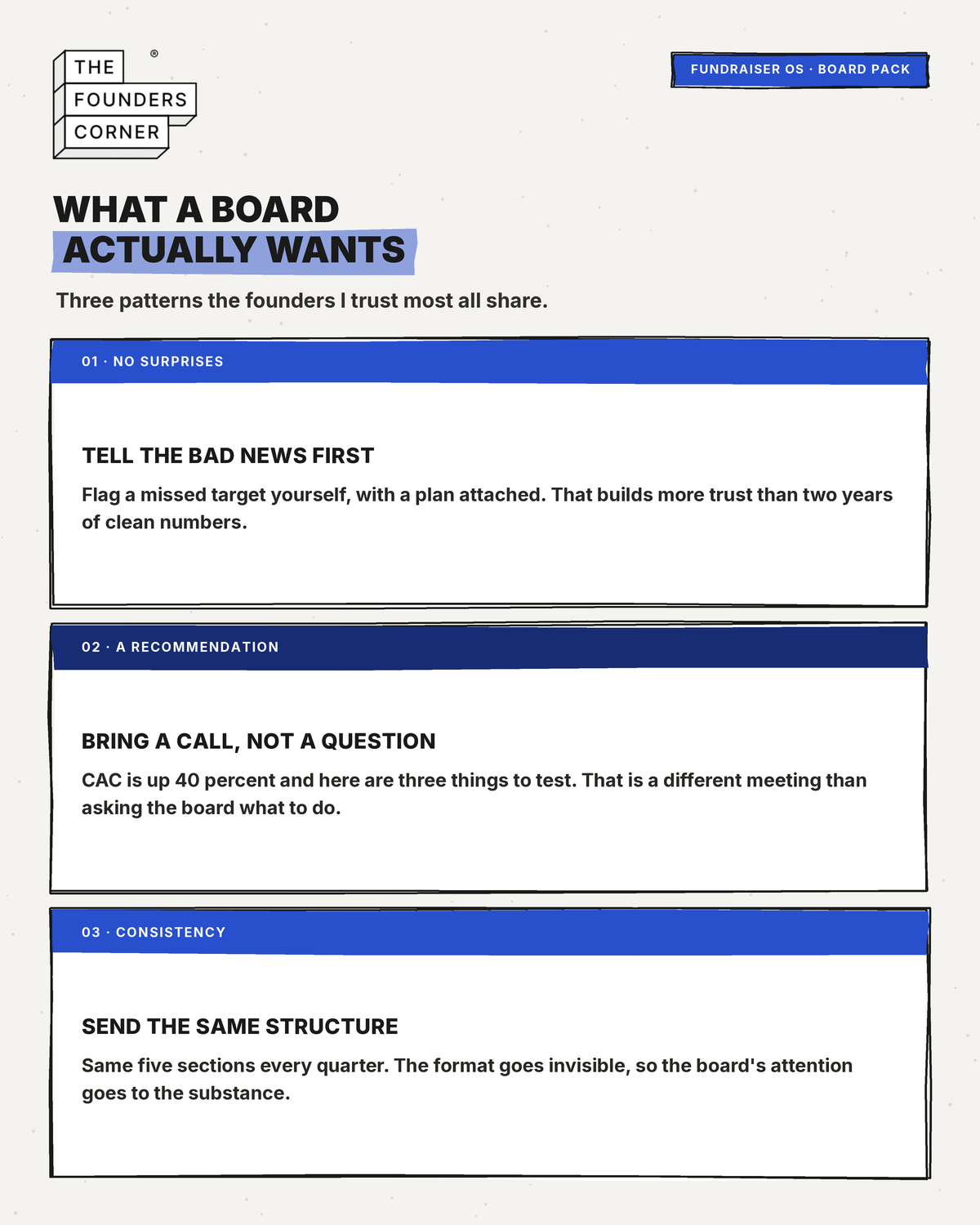
They tell me the bad news before I find it myself. A founder who flags a missed target proactively, with a plan attached, builds more trust in five minutes than a founder who hits every number for two years and then surprises me with a problem in month three. Directors do not expect perfection. They expect to never be surprised.
They come with a recommendation, not just a problem. “Our CAC has gone up 40 percent and here are the three things I think we should test” is a completely different meeting than “our CAC has gone up 40 percent, what do you all think.” The first signals a founder who is in control. The second signals a founder asking the board to run the company for them.
They send the same structure every time. The board packs that work are boringly consistent. Same five sections. Same metrics tracked over time. The format becomes invisible, which means the board’s attention goes entirely to the substance rather than to figuring out where to find the number they are looking for.
If you are building your board relationships or preparing for your first board meeting, these are the articles that will do the most work alongside this one.
→ Stop Sending Boring Investor Updates - Do This Instead - the monthly update format that keeps investors engaged between meetings
→ The Secret to Raising Once and Never Chasing Again - how to keep investors close so your next round starts before you need it
→ The Due Diligence Playbook - what VCs actually analyse before they invest, and what that tells you about what they will scrutinise after
The free section above gives you the principles. The paid section below gives you the asset itself - a complete Word board pack template, built around the five-section structure described above, ready to fill in before your next board meeting.
✅ The Board Pack Template (Word) - a ready-to-use document with the one-page summary, the metrics tracker, the decision pages, the risks and asks section, and the appendix structure already built, so you are filling in a framework rather than designing one from scratch
✅ Pre-filled decision page format - a repeatable layout for presenting any decision to your board: the decision itself, your recommendation, your reasoning, and the alternative you considered and rejected
✅ The metrics tracker page - a consistent table structure for the five to seven metrics that should appear in every board pack, formatted to show trend over time rather than a single snapshot
✅ Section guidance notes - short prompts embedded in the template itself, reminding you what belongs in each section and what should be moved to the appendix instead
This is what a paid subscription to The Founders Corner gets you every week.
Not frameworks to screenshot and store. 50+ tools you open, use, and walk away from with something concrete, built for the decisions founders are actually making.
The Board Pack Template is available exclusively to premium subscribers of The Founders Corner.
What Is Actually in the Template
The document is built around the structure that follows. It is not a slide deck. It is a Word document - the format most directors find easiest to read on a phone, a laptop, or printed before a flight.
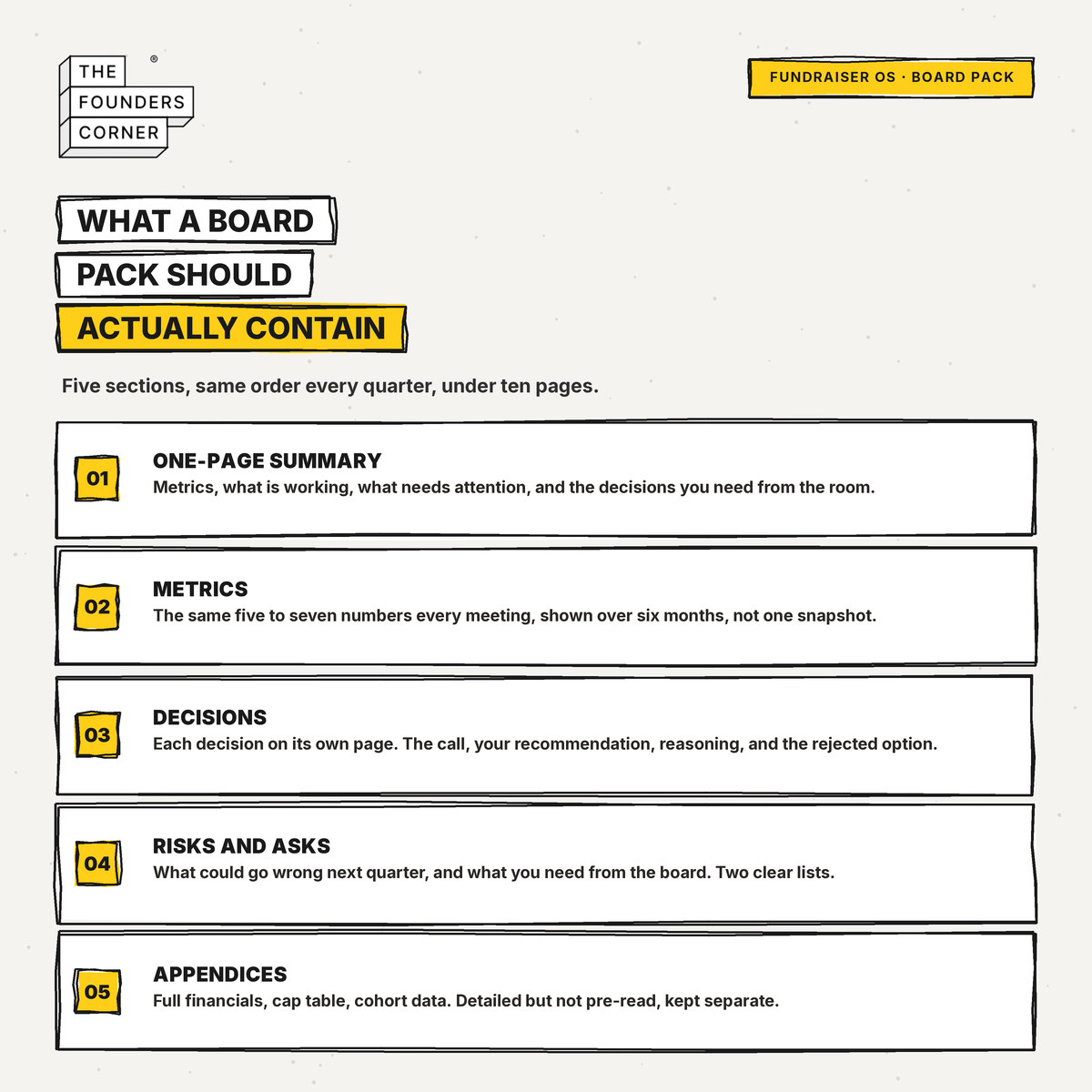
Section one - the one-page summary. This sits at the front of every board pack and never changes position. Headline metrics, the one or two things going well, the one or two things that need the board’s attention, and the decisions you need from this meeting. If a director reads nothing else, this page tells them everything they need to engage intelligently.
Section two - metrics. A table tracking the same five to seven metrics every meeting, shown over the trailing six months, not just the current one. The template includes the standard fields most boards expect - revenue, burn, runway, headcount, and a growth metric specific to your business - with space to add or remove rows as your business evolves.
Section three - decisions. Each decision gets its own page using the same four-part structure every time: the decision itself, your recommendation, your reasoning, and the alternative you considered and rejected. This is the section that turns a board meeting from a briefing into governance, and it is the part most founders have never structured properly before.
Section four - risks and asks. A short, direct section covering what could go wrong in the next quarter and what you specifically need from the board - an introduction, a decision, a piece of expertise, capital. Most founders either skip this section or bury the ask inside a long paragraph. The template forces it into two clear lists.
Section five - appendices. A clearly separated section for anything detailed enough to be useful but not essential to read before the meeting - full financials, cap table, detailed cohort data. The discipline of keeping this separate from the main pack is what keeps the front five pages readable.
How to Use It
Fill in the template the same week, every quarter, so it becomes a habit rather than a scramble before each meeting. The format does the organisational work. Your job is just to fill in what is true this quarter.
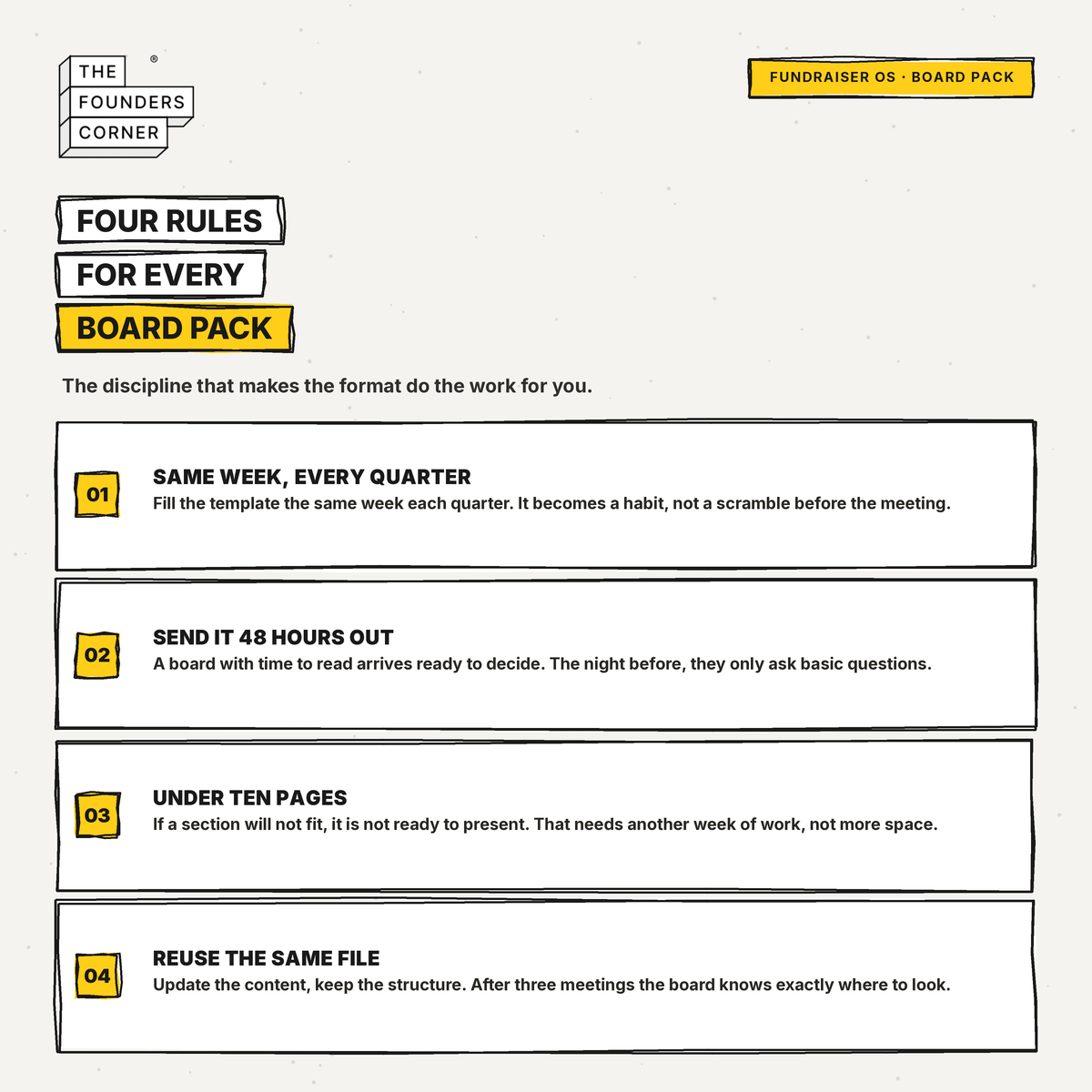
Send it 48 hours before the meeting, not the night before. A board that has time to read the pack arrives ready to discuss decisions. A board that receives it the morning of the meeting arrives ready to ask basic clarifying questions instead.
Keep the main document under ten pages excluding appendices. If a section will not fit inside that limit, the information inside it is not ready to be presented yet - it needs another week of work, not more space in the deck.
The template is not a one-time download. Reuse the same file every quarter, updating only the content inside each section. The consistency is the value. After two or three meetings, your board will know exactly where to find what they need, and the meeting itself becomes about the decisions on the page rather than the page itself.
