

👋 Hey, Chris here! Welcome to BrainDumps—a weekly series from The Founders Corner. If you’ve been reading along, you know this series is a preview of a bigger project. Well, it’s finally here: The Big Book of BrainDumps is out now!
It isn’t a theory book—it’s the founder’s field manual. Inside, you’ll find 70 powerful frameworks distilled from 30+ years scaling software companies to hundreds of millions in ARR, 20+ years investing in 500+ B2B tech startups, and over $1B of shareholder value created. From raising capital to hiring your first VP of Sales, this book turns scars and successes into practical playbooks you’ll return to again and again. I expect most copies will become well-worn, scribbled on, and dog-eared—because it works.
One of the hardest lessons in B2B SaaS is realising that most of the market is not actively looking for your product.
This catches founders off guard all the time.
They build something genuinely valuable, invest heavily into sales and marketing, and then become frustrated when demand doesn’t materialise at the pace they expected. The instinctive reaction is usually to assume the messaging is wrong, the sales team is underperforming, or the product isn’t compelling enough.
But very often the issue is simpler than that.
The market simply isn’t ready yet.
Because at any given moment, only a tiny percentage of businesses are actively in buying mode. The overwhelming majority are either unaware of the problem, tolerating the pain, delaying action, or simply not prioritising the issue highly enough yet.
Once you understand this, your entire approach to go-to-market strategy changes.
You stop expecting every prospect to behave like an active buyer.
And you begin building a system that aligns your marketing and sales efforts with the actual psychology of where prospects sit in their decision-making journey.
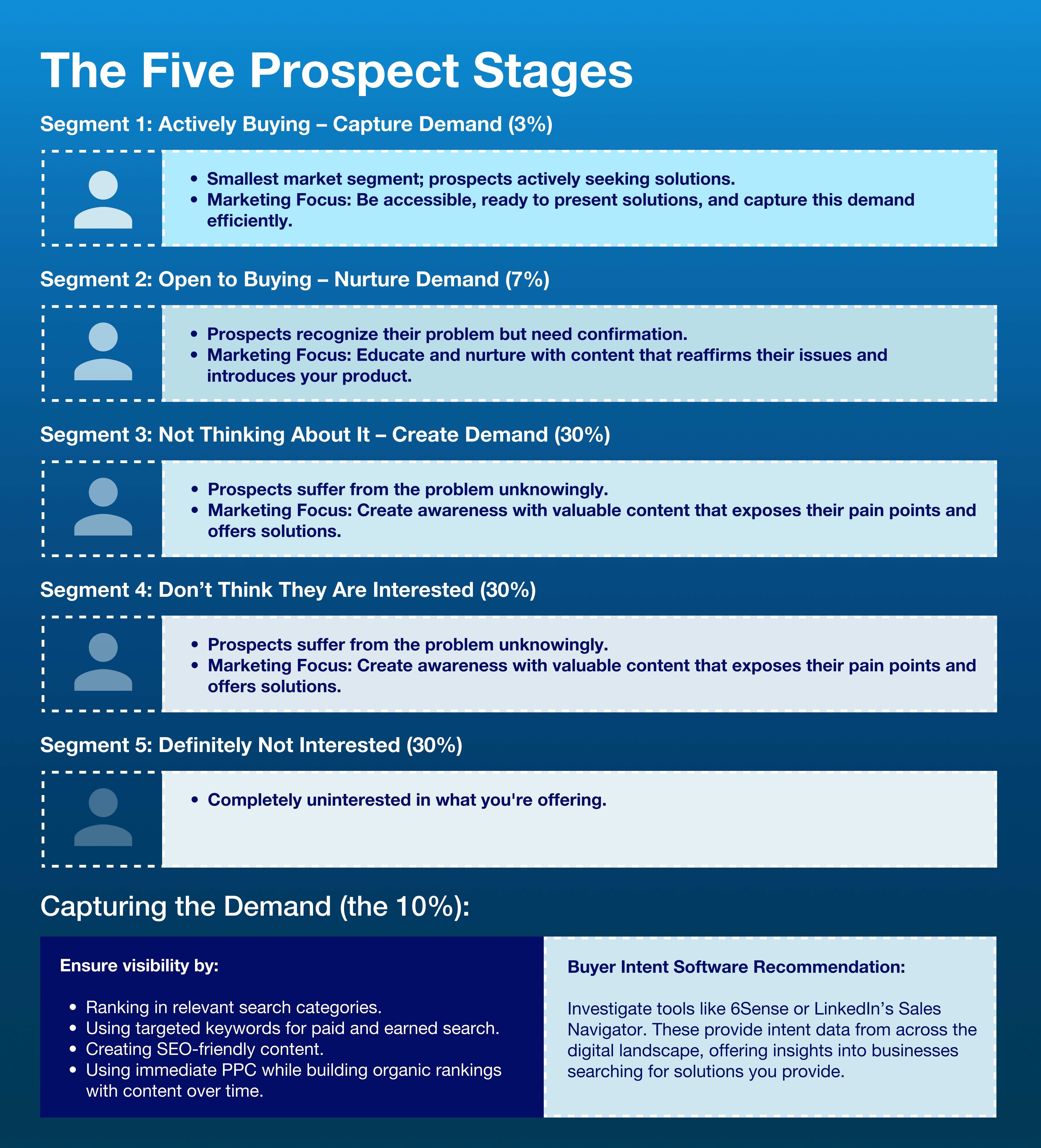
That’s the power of understanding the Five Prospect Stages.
Table of Contents
The Brutal Reality: Only 3% of Your Market Is Actively Buying
The Next 7% Are Waiting To Be Convinced
Most Of The Market Isn’t Thinking About The Problem At All
Another 30% Don’t Even Believe They Need You
Some Prospects Will Never Care - And That’s Fine
Most SaaS Companies Over-Invest In Demand Capture
Great SaaS Marketing Aligns With Buyer Psychology
Understanding This Framework Changes Everything
The Brutal Reality: Only 3% of Your Market Is Actively Buying
This is the statistic that changes everything.
At any given point in time, only around 3% of your market is actively searching for a solution like yours.
That’s it.
These businesses are already problem-aware. They’ve recognised the operational pain, decided it’s important enough to solve, and are now actively evaluating vendors, researching categories, speaking to peers, or shortlisting suppliers.
This is the most commercially attractive segment because the buying intent already exists.
But it’s also where every competitor is fighting.
Most SaaS marketing budgets are disproportionately focused on this tiny slice of the market. Companies obsess over Google rankings, paid search campaigns, review sites, demo requests, and comparison pages because they want to intercept buyers at the exact moment purchasing intent appears.
And to be clear — this absolutely matters.
If prospects are actively looking for solutions and cannot find you, that’s a major problem. Visibility during active buying cycles is critical. Your SEO, content strategy, category positioning, and paid acquisition channels all need to ensure you appear when the market starts searching.
But this is where many SaaS companies make a huge strategic mistake.
They assume this 3% is the entire market opportunity.
It isn’t.
It’s simply the most immediately visible portion.
The Next 7% Are Waiting To Be Convinced
Just beyond active buyers sits another important segment: prospects who are open to buying.
This group is incredibly interesting because they already feel the pain, but they haven’t fully committed to solving it yet. They know something is inefficient, frustrating, or broken, but they may not yet understand the cost of inaction clearly enough to prioritise change.
This is where great marketing becomes educational rather than promotional.
The goal is not hard selling.
The goal is reinforcement.
These buyers respond well to thought leadership, customer case studies, benchmark reports, practical insights, webinars, and educational content because they are subconsciously searching for validation. They want reassurance that the problem is real, worth solving, and commercially important enough to justify investment.
The companies that win here are usually the ones that best articulate the operational pain their audience already suspects exists.
And importantly, this stage requires patience.
Because these prospects are not yet urgently trying to purchase software. They are building conviction.
Most Of The Market Isn’t Thinking About The Problem At All
This is where SaaS marketing becomes significantly harder.
Roughly 30% of the market may actually be suffering from the exact problem your product solves — but they are not actively thinking about it.
The pain is latent.
The inefficiency exists.
The operational drag exists.
The wasted hours exist.
The revenue leakage exists.
But it hasn’t yet surfaced emotionally or strategically inside the organisation strongly enough to trigger action.
These businesses are simply living with the problem.
This is where demand creation becomes critically important.
Because your job is no longer simply capturing existing demand.
Your job is awakening awareness.
This is why some of the best SaaS marketing doesn’t feel like marketing at all. It feels like insight. It highlights hidden inefficiencies, reframes operational problems, exposes industry blind spots, and educates the market on issues prospects may never have fully quantified internally.
The strongest thought leadership creates recognition.
It causes prospects to pause and think:
“Actually… we do have that problem.”
That moment is incredibly powerful because it moves organisations from passive suffering toward active consideration.
And importantly, businesses in this stage often become some of the best long-term customers because the educational journey creates deeper trust and stronger positioning.
Another 30% Don’t Even Believe They Need You
This segment is one of the most misunderstood in SaaS.
These businesses genuinely do not believe your product category is relevant to them. They may not recognise the problem. They may not understand the modern solution landscape. Or they may simply be deeply attached to existing processes.
This is where many founders become frustrated.
The sales conversations feel difficult.
The urgency feels low.
The resistance feels irrational.
But from the buyer’s perspective, they are not resisting your product.
They are resisting change itself.
And this is where psychology becomes hugely important.
Most businesses are not proactively searching for disruption. Operational inertia is incredibly powerful. Existing workflows, even inefficient ones, often feel safer than adopting unfamiliar tools, retraining teams, changing processes, or introducing implementation risk.
This is why late-stage adopters require overwhelming evidence before movement happens.
Case studies matter more.
Social proof matters more.
Category maturity matters more.
Peer validation matters more.
And often, timing matters most of all.
Many businesses in this segment eventually move upward into more active buying stages later as market conditions evolve, competitors force change, or internal leadership priorities shift.
The key is understanding that not every prospect is psychologically ready at the same time.
Some Prospects Will Never Care — And That’s Fine
The final stage is refreshingly simple.
Some companies are simply not interested.
Not now.
Possibly not ever.
And one of the biggest wastes of energy in SaaS is trying to force-fit unwilling markets into becoming customers.
This is where strategic focus matters enormously.
Not every company is your customer.
Not every prospect should enter the funnel.
Not every lead deserves equal attention.
The strongest SaaS businesses become disciplined about where they spend commercial energy.
Because focus creates leverage.
Trying to convince completely uninterested buyers is usually a terrible use of time, particularly for early-stage businesses where resources are already stretched thin.
Great operators learn to identify the difference between “not yet ready” and “fundamentally irrelevant.”
That distinction protects enormous amounts of organisational energy.
Most SaaS Companies Over-Invest In Demand Capture
One of the most fascinating implications of the Five Prospect Stages is how it reframes modern marketing strategy.
Most SaaS businesses allocate the overwhelming majority of their budget toward capturing the existing 3–10% of buyers already in-market.
Paid search.
Competitor bidding.
Comparison pages.
Review platforms.
High-intent keywords.
And while these tactics absolutely matter, they are fundamentally reactive.
You are competing for buyers already looking.
The real long-term advantage often comes from demand creation.
Building trust with the 90% of the market before they enter active buying cycles.
This is where content marketing becomes so strategically valuable. Not because blog posts magically generate leads overnight, but because consistent educational content slowly positions your company as the authority buyers already recognise once urgency eventually emerges.
The businesses that dominate categories long-term are usually the ones that educated the market before the market was fully ready to buy.
Great SaaS Marketing Aligns With Buyer Psychology
The real insight behind the Five Prospect Stages is that buying readiness exists on a spectrum.
Not everyone is at the same stage psychologically.
Some prospects need visibility.
Some need education.
Some need urgency.
Some need validation.
Some need reassurance.
And some simply need time.
The mistake many SaaS companies make is using identical messaging across every stage.
But marketing that works for active buyers often fails completely with early-stage awareness audiences. Likewise, educational thought leadership rarely converts high-intent prospects already evaluating vendors.
The strongest go-to-market strategies adapt communication depending on where the prospect actually sits in the journey.
Because great SaaS marketing is not really about shouting louder.
It’s about meeting buyers at the right moment with the right message.
Understanding This Framework Changes Everything
Once founders truly internalise the Five Prospect Stages, a lot of SaaS growth suddenly starts making more sense.
You stop panicking when every prospect doesn’t convert immediately.
You stop assuming low urgency means low market potential.
You stop treating awareness-building content as secondary.
And perhaps most importantly, you begin understanding that category leadership is often built long before buyers formally enter the funnel.
Because the companies that win in SaaS are rarely just the best products.
They are the companies that best understand buyer psychology before the buying process even begins.
Chris,
Buyer psychology is an important but much overlooked subject.
Most B2B buying decisions fail not because the product was wrong, but because the decision became indefensible later. Buyers worry about exposure, reputation and even career risk. It's why many deals are lost to ‘no decision’: no change is often perceived to be the least riskiest path. The best sellers know this and help buyers build defensible decisions.
The buyer has six tasks across four stages, each of which brings its own risks
> Choose
1. Prioritise a results gap worth acting on now
2. Define expected improvement
3. Do enough due diligence to choose without regret
> Commit
4. Secure approval by making risk explicit
> Deliver
5. Trigger early evidence before patience decays
> Review
6. Defend the decision with hindsight integrity
Most GTM failures are misdiagnosed as messaging, pricing, or confidence problems. In reality, they are decision-defensibility problems.
The best sellers help buyers survive decisions by:
* framing problems as high-priority results gaps
* aligning buying groups around defensible targets
* enabling diligence that is sufficient, transparent but not exhaustive
* making risk explicit and shared
* delivering early evidence of progress
Do it right and growth compounds when fewer decisions are regretted and more are repeated.
More here, including a link to deep dive white paper.
https://clgguy.substack.com/p/how-buyers-survive-decisions
It is a lovely reminder that clarity remains the ultimate goal in our writing, @Chris Tottman I often find that when we trim back the noise, our core message finally has the space to breathe on the LinkedIn feed. Adding a simple, human and personal touch to your opening hook can often boost your post engagement by 15 percent according to recent platform benchmarks. How do you decide which elements to cut when you are refining a draft?