

👋 Hey, Chris here! Welcome to BrainDumps—a weekly series from The Founders Corner. If you’ve been reading along, you know this series is a preview of a bigger project. Well, it’s finally here: The Big Book of BrainDumps is out now!
It isn’t a theory book—it’s the founder’s field manual. Inside, you’ll find 70 powerful frameworks distilled from 30+ years scaling software companies to hundreds of millions in ARR, 20+ years investing in 500+ B2B tech startups, and over $1B of shareholder value created. From raising capital to hiring your first VP of Sales, this book turns scars and successes into practical playbooks you’ll return to again and again. I expect most copies will become well-worn, scribbled on, and dog-eared—because it works.
Cast your mind back to the last time you had a genuinely productive day.
Not busy. Productive.
The kind of day where you shipped something. Built something. Made a real decision that moved the needle.
Now ask yourself — how many meetings were in that day?
Probably not many.
There’s a reason for that.
Somewhere in the last five years, meetings stopped being a tool and became a culture. A default. A reflex. Got a problem? Book a call. Need alignment? Schedule a sync. Not sure what’s happening? Add yourself to the invite.
And nobody questioned it.
Because on the surface, a packed calendar looks like a productive person. It looks like engagement. It looks like leadership.
It isn’t.
It’s just noise dressed up as work.
The average knowledge worker now spends more than half their week in meetings. More than half. Which means the actual work — the thinking, the building, the creating — gets squeezed into the margins. Early mornings. Late evenings. Stolen gaps between calls.
That’s not a productivity strategy. That’s a slow leak.
And it’s costing your business more than you think.
Table of Contents
Meeting FOMO
Selfish Urgency
Commitment Theatre
The Mere Urgency Effect
The Hidden Tax Nobody Talks About
The Meeting Audit Nobody Does
Build a Meeting Constitution
Closing Thoughts
The Silent Killer: Meeting Overload
Let’s talk about another growth tax: too many meetings.
In the post-pandemic world, meetings have metastasised.
Calendar sprawl has replaced strategic thinking.
And the cost is staggering.
Not just in hours — but in cognitive fragmentation.
Let’s unpack the psychology.
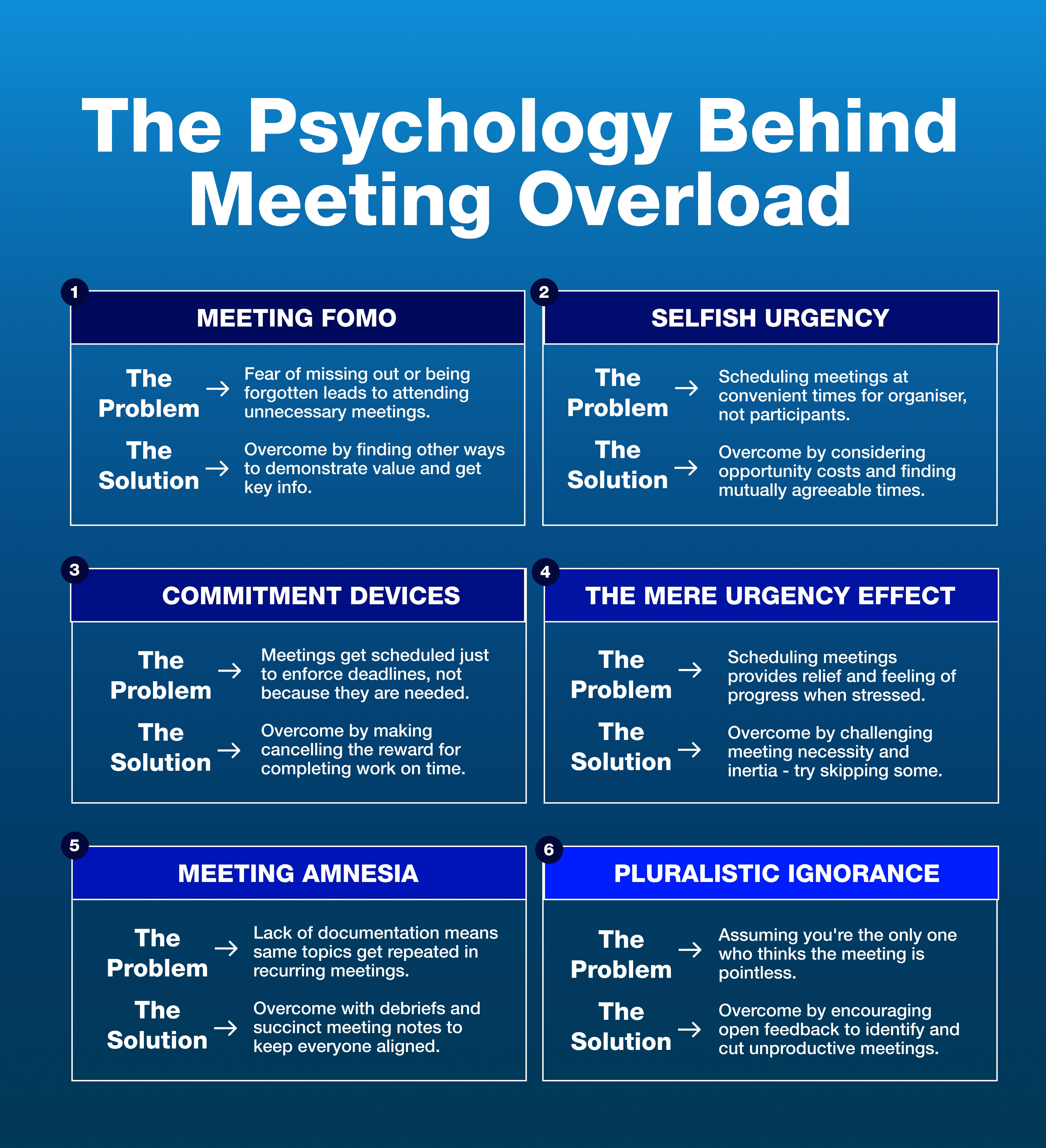
Meeting FOMO
People attend meetings because they’re afraid of being excluded.
They don’t want to miss context.
They don’t want to appear disengaged.
They don’t want political exposure.
So they show up.
Even when they add no value.
Solution?
Normalise absence.
If someone isn’t directly contributing or directly impacted — they don’t attend.
Asynchronous notes replace passive attendance.
Selfish Urgency
Meetings are often scheduled at the organiser’s convenience, not the organisation’s benefit.
This creates fragmentation — particularly in distributed teams.
Before scheduling, ask:
Is this decision synchronous?
Could this be a Loom?
Could this be a Slack thread?
Is this truly collaborative or just informational?
Default to async.
Meetings should be for:
Decision-making
Conflict resolution
Complex alignment
Everything else is noise.
Commitment Theatre
Status meetings often exist to create the illusion of accountability.
Instead of recurring check-ins, shift to:
Clear deliverables
Written updates
Public dashboards
Defined owners
Accountability does not require a Zoom link.
The Mere Urgency Effect
Meetings feel productive.
They create motion.
But motion is not progress.
If a meeting doesn’t produce:
A decision
A documented action
A defined owner
It shouldn’t exist.
Adopt this mantra:
“If it’s not essential, it’s expendable.”
The Hidden Tax Nobody Talks About
Here’s what the calendar doesn’t show you: the cost of switching.
Every meeting you drop into the middle of a deep work block doesn’t just steal 30 minutes — it steals the hour before it (because you’re anticipating it) and the 20 minutes after it (because you’re recovering from it).
Researchers call it attention residue. I call it expensive.
The fix? Time-block your calendar before anyone else does. Protect your deep work hours like they’re a board meeting — because frankly, they’re worth more.
The Meeting Audit Nobody Does
When did you last audit your recurring meetings?
Not just assess them — actually cancel them and see who complains.
If nobody notices the meeting is gone, it shouldn’t have existed. If one person notices, send them an async update instead. If five people notice, maybe it had value — but you’ll find out only by pulling the trigger.
Start with a 30-day meeting moratorium on everything that’s been running for more than six months. Default to cancellation. Let people opt back in with a clear justification.
You’ll be shocked how many don’t.
Build a Meeting Constitution
This is something we did internally and it changed everything.
A one-page document. Three sections. That’s it.
When we meet: Decisions only. Conflict resolution. Real-time collaboration where async genuinely doesn’t work.
How we meet: Agenda required 24 hours in advance. No agenda = automatic decline. Every meeting ends with documented actions and owners.
When we don’t meet: Status updates. Information sharing. Anything that can be a Loom, a doc, or a Slack thread.
Write yours. Share it with your team. Enforce it without apology.
Closing Thoughts
Meeting culture is a proxy for leadership culture.
If your team is drowning in calls, it’s not a calendar problem — it’s a trust problem. Somewhere, someone doesn’t believe things will get done unless they’re watched. Somewhere, decisions are being delayed because nobody feels empowered to make them alone.
Fix the root cause, not the symptom.
Protect your people’s time like it’s your most valuable asset — because it is.
-Chris Tottman
I absolutely love this! I am new to meetings but I can see how people can really get into them.
Agree with this and like the idea of building the meeting constitution. Every meeting should have a pre-meeting check where you validate the meeting is necessary and outcomes we expect are clear. If you can’t define the "Decision to be Made" in one sentence, cancel the meeting and send a memo instead.