

👋 Hey, Chris here! Welcome to The Founders Corner. If you’ve been reading along, you’ll know I have very little patience for theory that fails the moment it meets a real buyer.
This series is a preview of a new book I’ve written with my partners Richard Blundell and Paul Watson — The Selling Software Algorithm: The Go-to-Market Navigation System for B2B Software Leaders.
It isn’t a strategy deck dressed up as a book. Between the three of us we’ve spent close to seven decades inside B2B software as founders, operators, investors and coaches — building companies, exiting some, and quietly breaking a few along the way, which is where most of the real learning lives. Through our work at Vencha we’ve now supported hundreds of founders trying to do the single hardest thing in software: turn a clever product into predictable commercial traction in a market that’s noisier and more crowded than it has ever been.
One pattern shows up again and again. Companies rarely struggle because the product is bad. They struggle because they have no navigation system for going to market. This book is that system.
Last time, we pressure-tested the pain itself: budget presence, urgency, frequency, and the nice-to-have trap that catches founders who mistake interest for spend.
This time, we hold the pain constant and test something founders assume rather than measure: whether now is actually the right moment to be selling into this market at all.
Here’s the failure this piece exists to prevent. A founder does everything this series has asked. The pain is real, tested and funded. The Algorithm sentence is sharp. The homepage passes the swap test. And the pipeline still moves like it’s wading through wet sand, because the buyers aren’t ready, the enabling technology isn’t cheap enough yet, or three better-funded competitors got there eighteen months earlier and have already been bought. Nobody did anything wrong in the sales process. The market simply wasn’t standing where the founder assumed it was.
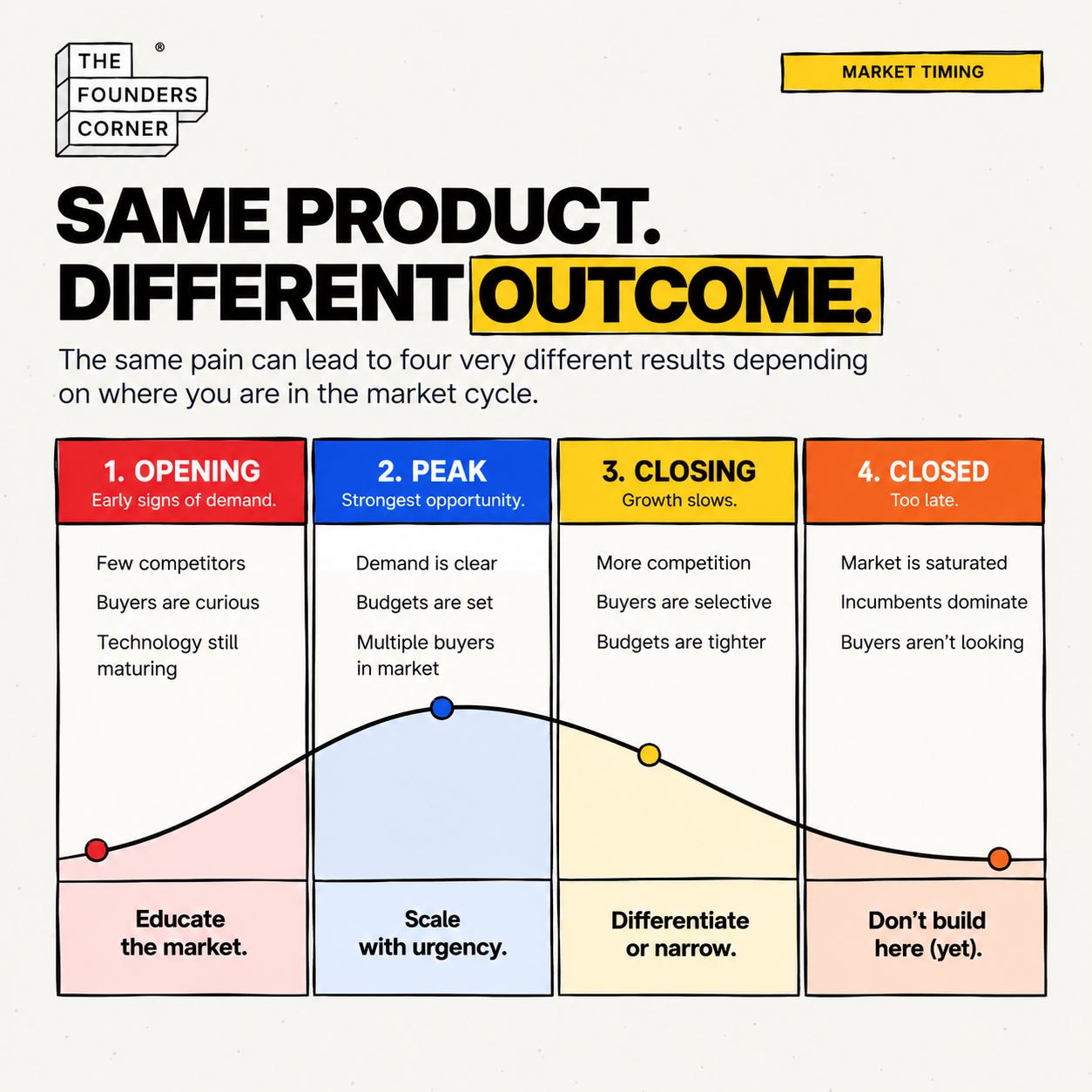
Table of Contents
A Simple Example: Same Product, Two Founders
The Right Product at the Wrong Moment Still Fails
Why Timing Comes After Pain, Not Instead of It
Five Signals, Not One Gut Feeling
Demand Signals: What the Market Is Already Telling You
Technology Readiness and the Cost of Being Early
What the Numbers Say About Timing
Competition and Regulation: The Two Signals You Don’t Control
The Window: Opening, Peak, Closing, Closed
Founder-Market Timing Is Still Timing
The Honest Case Against Timing the Market
Knowing Exactly What You’re Waiting For
What Each Window Asks of You This Quarter
Turning a Feeling Into a Verdict
A Simple Example: Same Product, Two Founders
Picture two founders. Not real ones, but you’ll recognise both.
They build almost the same product: software that pulls supplier data together and produces the risk reports a mid-market procurement team would need if a regulator, or a large customer, ever asked for them.
The first founder launches early. The pain is real. Every procurement lead she speaks to agrees the current process is a mess of spreadsheets and chased emails. Testing calls go brilliantly.
Then the pipeline stalls. Not on price. Not on a competitor. On “let’s revisit this next year.” No regulation requires the report yet. No large customer is demanding it. The data integrations the product depends on are still expensive and fragile, so every implementation turns into a services project. She raises a bridge, then another, and eventually sells the IP for less than her seed round.
The second founder launches four years later, with a thinner product.
By then a rule has a date attached to it. Two of the largest customers in the sector have started writing supplier reporting into their contracts. Integrations are cheap and standard. The buyers who told the first founder “next year” are now calling vendors themselves, with budget and a deadline.
He closes in weeks what she couldn’t close in quarters.
Same pain. Same buyer. Better product, in fact, the first time round. The only thing that changed was the market’s own readiness. That’s the gap this article is about.
The Right Product at the Wrong Moment Still Fails
Founders who’ve done the work in this series — a real pain, a tested Algorithm, a sharp message — still lose deals to timing they never measured.
A genuinely painkiller-grade problem sold two years before the enabling technology is affordable produces a founder convinced they were right.
The same problem sold two years after three well-funded competitors consolidated the category produces exactly the same founder.
One was early. One was late. Both watch the market prove them wrong while being, in every way they can measure, right.
What makes timing so dangerous is that it rarely shows up as a reason. Lost deals get logged as “budget”, “priorities shifted”, “went with the incumbent”, “no decision”. Each of those is true in isolation. Put twenty of them side by side, and a good number are telling you the same thing in different words: not yet, or not any more.
Timing isn’t a vibe. It’s measurable. And it’s worth measuring before you commit the next twelve months to a market, not after.
Why Timing Comes After Pain, Not Instead of It
There’s a reason this sits after the severity test rather than before it.
A timing score on a weak pain tells you nothing useful. If nobody would pay to make the problem go away, it doesn’t matter whether the market is opening or closing. You’re early or late to a party nobody is throwing.
So the order matters. First, is the pain real? That’s the testing calls and the Algorithm. Second, is it severe enough to carry a company? That’s the budget-presence work from last time. Only then does the third question earn its place: is this the moment the market will pay for it?
The book frames buyer readiness as a set of stages, from people who don’t yet know they have a problem through to buyers with procurement approved and budget assigned. Timing is the same idea at the level of the whole market. A market is mostly made of Stage 1 buyers, or mostly made of Stage 5 buyers, and no amount of individual sales skill changes the mix you’ve walked into.
A good salesperson can move one buyer a stage. Nobody moves a whole market a stage on their own budget.
Want to get in front of 250k+ founders and investors?
For sponsorship opportunities across The Founders Corner newsletter and LinkedIn (160k followers), email: founderscornermedia@gmail.com
Five Signals, Not One Gut Feeling
“Is the timing right?” is one of those questions that’s too easy to answer yes to. Founders are optimists by selection. If you weren’t, you wouldn’t have started.
So the diagnostic doesn’t ask it as one question. It runs twenty questions across five categories:
Demand Signals. Whether buyers are already looking, already urgent and already paying.
Technology Readiness. Whether the things your product depends on are mature, affordable and in your buyers’ hands.
Competitive Landscape. Whether the space is empty, crowded, consolidating or quietly complacent.
Regulatory and Macro. Whether the rules and the wider economy are pushing buyers towards you or holding them back.
Founder-Market Timing. Whether you, specifically, are positioned to move inside this market right now.
Each category contributes equally to the overall percentage. Twenty percent each, no exceptions.
That’s a deliberate choice, and it matters more than it looks. Founders always have a comfortable category: the one they talk about fluently in pitch meetings. Equal weighting means you can’t talk yourself into a good score by being strong in that one.
A brilliant founder-market fit doesn’t rescue a market with no demand signal.
A red-hot demand signal doesn’t rescue a founder with no domain expertise and no network to move fast inside it.
Five scores show you which leg of the stool is missing. One gut feeling only tells you how confident you feel.
Demand Signals: What the Market Is Already Telling You
This is the category where founders most often confuse their own conviction with the market’s.
It asks four things. Whether search trends and interest in the problem are rising. Whether customers are actively looking for something like your solution, rather than needing to be educated into wanting it. How urgently they need it solved. And whether they’re already willing to pay for solutions in the space.
The second question is the one that sorts markets fastest.
If you have to explain the problem before you can sell the solution, you’re doing category education. That’s an expensive, slow job, and it’s usually done by whoever has the most money, which is rarely the seed-stage company.
If buyers arrive already describing the problem in their own words, already comparing vendors, already asking about pricing, the market has done the education for you.
The evidence for this is usually sitting in plain sight:
Inbound language. Are prospects using your category words, or are you supplying them?
Search behaviour. Is the volume around the problem flat, falling or inflecting? Trend tools won’t tell you everything, but a two-year flat line is information.
Buying behaviour elsewhere. Are adjacent vendors hiring sales teams, or cutting them? Are RFPs mentioning the problem by name?
Workarounds with a cost. Are buyers already paying consultants, contractors or internal headcount to deal with this by hand?
A market stuck at “would be helpful eventually” scores very differently from one where buyers describe their hair as on fire. No amount of positioning work changes which one you’re actually in. Positioning helps you win the market you’re in. It doesn’t move you to a different one.
Technology Readiness and the Cost of Being Early
Every product rests on things it doesn’t control. Infrastructure, data access, devices, integrations, models, standards, the skills inside your buyer’s team.
Technology Readiness is the question of whether those things are mature, affordable and already in your buyers’ hands, or whether your go-to-market quietly depends on them arriving.
Being early here is brutal, because the cost doesn’t show up as a lost deal. It shows up as an expensive win.
The customer signs. Then implementation takes six months instead of six weeks, because the integration your product assumed doesn’t exist yet, so your engineers build it bespoke. Then the customer’s team can’t use half the product, because the skills it assumes haven’t reached them yet. Then the margin on the account is negative, and the reference you hoped for turns into a cautionary tale.
When the enabling technology isn’t ready, you don’t just sell slower. You end up paying to build the market’s infrastructure on your own balance sheet.
There’s a flip side worth watching for. Readiness can shift fast, and when it does, a market that was hostile for years can open in months. The founders who win those moments are usually the ones who’d been watching the specific thing that was missing, and recognised it the day it arrived.
What the Numbers Say About Timing
This isn’t just intuition. The evidence points the same way, though it deserves to be read carefully.
Start with the best-known attempt to measure it. In his 2015 TED talk, Idealab founder Bill Gross described scoring 100 Idealab companies and 100 companies from outside Idealab on five factors: idea, team, business model, funding and timing.
Timing came out on top, accounting for 42% of the difference between success and failure. Team came second at 32%, then idea at 28%, business model at 24%, and funding last at 14%.
The point Gross drew from it is the useful part. Almost every other factor can be changed after you start. You can add a business model, raise more money, rebuild the team, refocus the idea. You can’t move the market’s calendar.
It’s worth being honest about the limits. Gross rated the companies himself, it wasn’t a peer-reviewed study, and the percentages overlap rather than adding to 100. Treat 42% as a strong signal from an experienced operator, not a law of nature.
Then look at what kills companies now. CB Insights’ 2026 update on 431 VC-backed startups that shut down since 2023 put bad timing at 29% of failures. Not a footnote. Nearly a third.
And look at the most famous before-and-after in the startup canon.
Webvan delivered groceries ordered online. It raised close to $800 million, built its own warehouses, and shut down in 2001, laying off around 2,000 people.
Instacart launched in 2012 doing broadly the same job for the customer. The difference wasn’t the idea. By then smartphones were everywhere, buyers were used to ordering online, and the company could use existing supermarkets as its infrastructure rather than building its own. Sequoia’s Michael Moritz, whose firm backed both companies, has pointed to Webvan’s early timing as part of the difference.
Same pain. Same buyer. Roughly a decade apart.
Neither example is pure timing, and I wouldn’t claim it is. Webvan’s capital-heavy model would have struggled in most years. But the comparison shows exactly what Technology Readiness means in practice: the same job, done on infrastructure that didn’t exist the first time.
If you’re building right now, these five are worth your time
The Test That Tells You If Anyone Will Actually Pay: five weighted dimensions, and the guard rail that caps an unfunded pain at 55 however urgent it sounds.
The 9-Step GTM System Every Founder Should Build Before They Scale: nine steps, one living document, so every new hire knows who to target and what to say.
Why Most Founders Are Solving the Wrong Pain Entirely: ten pains go into the room, three come out, and only those three ever move a deal.
Would Anyone Notice If Your Competitor Stole Your Homepage?: seven seconds, one armour-piercing message, and the swap test most hero lines fail.
The AI Search Playbook That Gets Your Startup Recommended: three prompts that show whether a model puts you on the shortlist when a buyer describes their exact pain.
Competition and Regulation: The Two Signals You Don’t Control
Two of the five categories describe forces entirely outside the company. They’re the ones founders are most tempted to wave away, because there’s nothing to do about them on Monday morning. That’s exactly why they need scoring.
Competitive Landscape reads the state of the field. An empty space can mean an untapped opportunity, or it can mean other people already tried and learned something you haven’t. A crowded space can mean proven demand, or it can mean the category is consolidating and the window for a new entrant is shutting. Incumbents who look comfortable and slow can be the best signal of all, because complacency is an opening.
The trap is reading competition in only one direction. “Nobody else does this” is not automatically good news. “Five people do this” is not automatically bad news. The question isn’t how many competitors exist. It’s what their presence tells you about where the market is on its own curve.
Regulatory and Macro reads the weather. Rules that force buyers to act. Rules that stop them acting. Budget cycles tightening or loosening. Whole sectors under pressure, or flush.
The clearest example of regulation turning from background noise into a market is privacy software around GDPR.
OneTrust was founded in Atlanta in 2016, after GDPR had been approved but before it became enforceable in May 2018. By the time the deadline arrived, the product was already proven in the market, and the company went on to top Inc.’s 2020 list of fastest-growing private companies in America with three-year revenue growth of more than 48,000%. One of its investors later put its success down to founding at such an opportune moment.
Notice what that founder did and didn’t do. He didn’t create the demand. He couldn’t. He read a dated, public, falsifiable signal, a regulation with an enforcement date, and built so the product was ready on the day buyers were forced to look.
That’s what timing looks like when it’s done deliberately rather than discovered afterwards.
The Window: Opening, Peak, Closing, Closed
Alongside the overall score, the diagnostic assesses which of four windows you’re standing in, built from the demand and competitive signals read together.
Closed. Conditions are hostile. The honest posture is to wait and watch.
Opening. Signals are building. The moment to build quietly and prepare.
Peak. Demand is strong and the field hasn’t consolidated yet. Strike now. This won’t last.
Closing. The advantage is fading. Competitors are consolidating, buyers are settling on default choices, and each new deal costs more than the last.
The diagnostic then returns one of four verdicts, running from Wait & Watch through Build Quietly and Prepare & Position to Strike Now. Each comes with a genuinely different recommended posture, not just a different colour on a dashboard.
Why read demand and competition together? Because either one alone misleads.
Strong demand with no competitors can be Peak, or it can be a market so early that nobody else has noticed yet, and you’re about to pay for everyone’s education.
Strong demand with lots of competitors can be Peak too, or it can be Closing, with the land already carved up.
The window is where those two signals meet. Neither is enough on its own.
Founder-Market Timing Is Still Timing
The category most founders skip past is the one about themselves.
It asks about four things: the strength of your network in this specific market right now, the depth of your domain expertise, how complete your team is, and whether the resources exist to go all-in today rather than in six months.
That last one catches more founders than any other. A market at Peak doesn’t wait for your next round to close.
A founder with no relevant network entering a market at its peak window is still badly timed. Just in a different way from a founder with perfect domain expertise entering a market that hasn’t woken up yet.
The first one is too slow for the market. The second one is too fast for it. Both lose the window.
This is where timing stops being something that happens to you and becomes partly something you can change. You can’t make the regulation arrive. You can spend the next two quarters building a network inside the buyer community, hiring the one person with deep sector credibility, or getting the money in place so you can move when the signal turns.
Timing is a property of the founder and the market together, not the market alone.
The Honest Case Against Timing the Market
It would be odd to write this without giving the sceptics a fair hearing, because some of their objections are good.
“Nobody can time a market.” Investors have argued for decades about whether anyone can reliably time the stock market, and most of the evidence says it’s very hard to do consistently. Why would startups be different?
“The best founders create the moment.” Some categories really were created by someone who refused to wait. If everyone had run a timing diagnostic, a few great companies would never have started.
“The evidence is shakier than it looks.” Gross scored his own companies. CB Insights relies on post-mortems written after the fact, when “bad timing” is a kinder story than “we got it wrong.”
“Waiting is a decision too.” Every quarter spent watching is a quarter a competitor might spend building.
All four are fair. None of them is an argument for not looking.
On timing markets: the diagnostic isn’t predicting next quarter’s price. It’s reading conditions that move slowly and visibly, like adoption, regulation and competition. That’s closer to checking the weather than calling the stock market.
On creating the moment: the founders who did tended to have unusually strong founder-market timing, a deep network, the money to educate a market and the patience to do it. That’s one of the five categories, not an exception to them.
On shaky evidence: agreed, which is why the numbers here are signals, not proof. But the direction is consistent across very different sources, and nobody seriously argues that timing doesn’t matter.
On waiting: yes. Which is why only one of the four verdicts says wait, and even that one comes with a specific thing to watch for.
“Being right too early looks exactly like being wrong, right up until someone else gets the credit.”
Knowing Exactly What You’re Waiting For
Here’s the part of the output I’d pay most attention to.
Where a category scores below fifty percent, the diagnostic doesn’t just flag weakness. It names the specific trigger worth watching for:
Search trends inflecting upward. The market starting to look for the problem on its own.
Incumbents showing complacency. Slower releases, rising prices, unhappy customers saying so in public.
Regulation shifting from headwind to tailwind. A rule getting a date. A rule being relaxed.
The network and team catching up to the opportunity. The hire made, the relationships built, the round closed.
That turns “we’re too early” from a vague feeling into a specific, falsifiable condition you can actually check for next quarter.
This is the difference between waiting and drifting. A founder who’s drifting says “the market isn’t there yet” every quarter, and means it, and never says what “there” looks like. A founder who’s waiting can tell you the exact signal, where they’ll see it, and what they’ll do the week it shows up.
If you can’t say what you’re waiting for, you’re not waiting. You’re hoping.
What Each Window Asks of You This Quarter
A window is only useful if it changes what you do. Here’s how I’d read each one.
If you’re in a Closed window, cut burn to the minimum that keeps you close to the market. Stay in the conversations. Keep a list of the specific triggers you’re watching and review it monthly. Don’t hire a sales team into a market that can’t buy.
If you’re in an Opening window, build quietly. Win the first few design partners, learn the language buyers use, and get the implementation playbook right while the stakes are low. This is when you earn the references the Peak will need.
If you’re at Peak, move. This is the moment to put money behind sales and marketing, because every quarter of delay is a quarter a competitor uses to become the default. The work you did in the Opening window is what lets you move fast without breaking.
If the window is Closing, be honest about where you can still win. That usually means narrowing: a segment the consolidators are ignoring, a use case they serve badly, a geography they haven’t reached. Trying to fight the leaders head-on in a closing market is how good companies spend their last round.
The common thread: the right posture depends far more on the window than on how good your product is. A great product in a Closed window should behave very differently from a great product at Peak.
Turning a Feeling Into a Verdict
Most founders have a feeling about their timing. Very few have a verdict they could defend to a sceptical board member.
This is exactly what the Market Timing Diagnostic exists to do: twenty questions, five categories, roughly five minutes. It returns your overall timing score, the window you’re standing in, a verdict from Wait & Watch to Strike Now, and, for any category below fifty percent, the specific trigger worth watching for.
Run it on the market you’re in now. Then run it on the adjacent market you keep being told you should look at. The comparison is often more useful than either score on its own.
And if the verdict isn’t the one you wanted, remember what it’s for. It isn’t telling you the idea is bad. It’s telling you when, and what to watch for in the meantime.
Next in the series, we assume the timing is right and turn to the people already selling into that same window: your competitors, and exactly where you do and don’t beat them.
-Chris Tottman
A painkiller-grade problem, sold at the wrong point in the market’s own readiness curve, still produces a slow, unpredictable pipeline.
The Market Timing Diagnostic scores five signal categories and returns a verdict, from Wait & Watch to Strike Now, so timing stops being a guess.
Try it below
