

In 2014, a Lagos-based operator named Olumide Soyombo started writing personal checks into startups he liked.
No fund. No LPs. No committee.
Just his own money and his own judgment.
By the time TechCrunch profiled him in 2021, that habit had produced 33 documented investments. One of them was an early check into what would become Paystack. Stripe later acquired it for a reported $200M.
Nobody at Sequoia approved that decision. Nobody at a16z was in the room.

One person decided. The money moved.
That’s the entire category this issue is about.
Founders spend enormous energy mapping the venture capital landscape. Who’s raised what fund. Who’s on partner track. Who’s “still deploying” this quarter.
Almost none of that energy goes toward an older, much less visible source of capital: individuals who write checks with their own money, on their own timeline, answering to no one.
We spent the last several weeks building a working directory of 184 of them. Across the US, UK, Europe, India, Southeast Asia, Australia, Japan, China, Israel, Africa, and Latin America.
Not firms. Not funds. People.
Here’s a sense of what’s in it, why this category behaves so differently from the institutional world, and what’s waiting in the full directory for Premium subscribers.
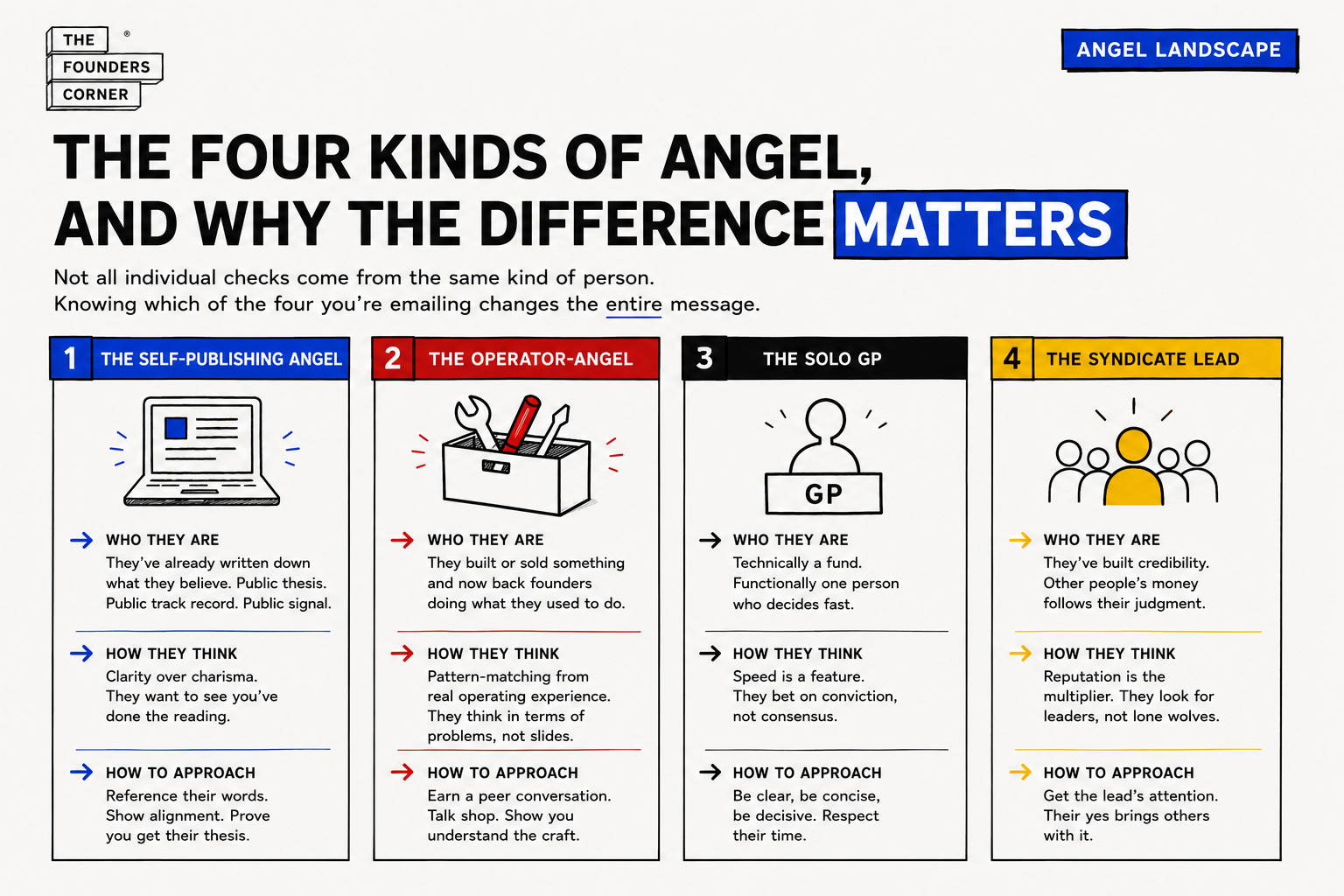
The four kinds of angel, and why the difference matters
Not all individual checks come from the same kind of person. The distinction changes how you should approach each one.
The self-publishing angel. These are the easiest to research, and often the easiest to reach, because they’ve already told you exactly what they want. Fabrice Grinda has written on his own blog about a personal portfolio that press has pegged in the hundreds of companies. Charlie O’Donnell has run the same personal blog documenting his NYC pre-seed thesis for over a decade. Elizabeth Yin built a public following around her own investing philosophy before she and her co-founder ever raised outside capital for Hustle Fund. If someone in this category has published their thesis, your job is to prove you read it. Not to pitch them the generic version of your deck.
The operator-angel. Someone who built or sold something, and now recycles capital and pattern recognition back into people doing what they used to do. Auren Hoffman built SafeGraph and LiveRamp before becoming known in press for well over 200 personal angel checks. Immad Akhund runs Mercury and is publicly known for the personal angel investing he discusses on his own X account. These people are pattern-matching against their own operating experience. The strongest pitch to them sounds like a peer conversation, not a fundraising ask.
The solo GP. Technically a fund, but functionally a single decision-maker who moved fast enough that “angel speed” became their whole brand. Charles Hudson at Precursor. Semil Shah at Haystack. Turner Novak at Banana Capital. The check comes from a vehicle, but the yes or no is one person’s call, usually within days, not months.
The syndicate lead. Someone who has built enough personal credibility that other people’s money follows their judgment. Joakim Achrén runs a 220-member gaming syndicate out of Helsinki most founders outside gaming have never heard of. Jennifer Kan runs a named climate syndicate. Getting time with the lead is often more valuable than the check itself. Their yes brings other checks with it.
Knowing which of the four you’re emailing changes the entire message.
What the regional pattern actually tells you
The directory isn’t evenly spread. The unevenness is informative.
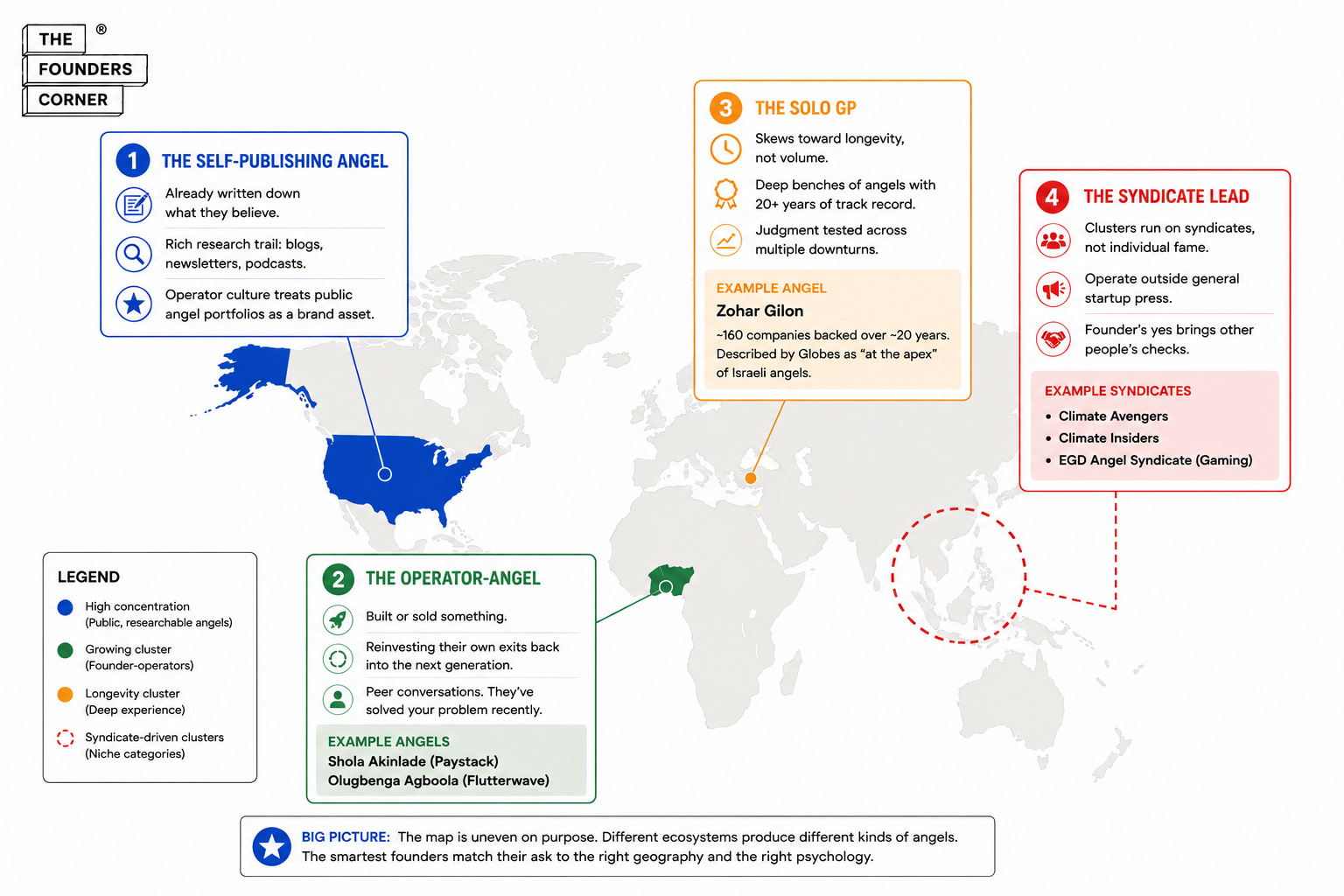
The densest cluster of self-published, easily researchable individual angels sits in the US. Unsurprising, but worth noting why. American operator culture treats a public angel portfolio as a personal brand asset. So the research trail (blogs, newsletters, podcast appearances) is unusually rich.
Africa tells a different, and frankly more interesting, story. The individual angels we found there are concentrated heavily around Lagos, and they are almost entirely founders reinvesting their own exits directly back into the next generation of companies. Shola Akinlade (Paystack) and Olugbenga Agboola (Flutterwave) aren’t professional investors moonlighting as angels. They’re operators for whom angel investing is a direct, personal extension of having just built the thing themselves. If you’re building in African fintech, these are conversations with people who solved your exact problem in the last five years. Not investors who read a memo about it.
Israel’s angel scene skews toward longevity rather than volume. Zohar Gilon has been at this for roughly two decades. Globes describes him as sitting “at the apex” of Israeli angels, with something in the neighborhood of 160 companies backed. That’s not a person chasing a hot sector. That’s a person whose judgment has been tested across multiple downturns, which is exactly the kind of angel worth having in a hard round.
And the climate-tech and gaming clusters barely overlap with the “famous angel” list at all. They run almost entirely on syndicates (Climate Avengers, Climate Insiders, EGD Angel Syndicate) most generalist founders have simply never encountered, because they don’t show up in general startup press. If you’re in either category and you’re only pitching generalist angels, you’re skipping the people most likely to actually understand what you’re building.
Why this category is underpriced by most founders
VCs operate on a clock. A fund has a deployment period, a reporting cycle to LPs, and eventually a fundraise of its own that depends on showing enough deployed capital and enough markups. That structural pressure is why the same 40 to 50 firms get pitched relentlessly. They have to say yes to someone, on a schedule, whether or not this is the best possible month for it.
Individuals answering only to themselves don’t have that pressure. That cuts both ways.
The upside: no committee, no partner-track politics, no “let me run this by the team.” If the person you’re talking to is convinced, the money can move in days.
The downside: no obligation to reply at all. A cold, generic pitch to someone with zero deployment pressure is trivially easy to ignore, because ignoring it costs them nothing.
That second point is the real reason most founders underuse this category. Not because the people are hard to find, but because the approach that works on a VC associate (persistence, volume, a clean deck) actively backfires here. The angels who publish their own thesis are telling you, in their own words, exactly what would make them say yes. Almost nobody reads it before pitching them anyway.
What’s actually inside the full directory
The version unlocked for Premium subscribers is the complete working file. Not a summary.
184 individually verified people, organized by region and by type (self-publishing angel, operator-angel, solo GP, syndicate lead)
Current role, affiliation, and sector focus for every entry
Publicly documented notable investments, cross-checked across multiple sources, with inflated or unverifiable portfolio counts deliberately excluded rather than repeated uncritically
A note on exactly how each person is publicly known as an angel, so you know precisely where to go and read their own words before you reach out
A firm/affiliation index and a region-by-region breakdown for fast filtering
A preview of what’s locked inside
We’re not spoiling all 184. Here’s a taste of who’s waiting behind the paywall.
🔒 A Brooklyn solo GP who has published the same personal investing blog for over a decade, and still writes checks up to $250K directly from it
🔒 A Kenyan accelerator CEO whose portfolio companies have created 200+ jobs, quietly one of East Africa’s most active individual backers
🔒 A Finnish gaming syndicate lead running 220 members and 30+ investments most Western generalist founders have never heard of
🔒 A Thiel Fellow turned longevity-biotech solo GP whose second fund closed at $22M, and who still personally reviews every deal
Every one of those is a real, sourced entry in the sheet. Name, affiliation, and exactly how to start researching them properly before you reach out.
Why we built this as a Premium asset
We don’t gate news recaps you could read anywhere. We gate the research that changes what you do this week. The kind of proprietary list that would otherwise cost real money through an institutional data provider, or real hours doing it yourself one profile at a time.
Premium subscribers get:
The full 184-entry Individual Angel Directory, this issue
Every past and future proprietary database and framework we publish
Early access to new research before the free list sees it
No filler, no ads. Just the operator-grade material
If you’ve been on the fence about upgrading, make it this issue. One real conversation with the right individual, someone who can just decide and just wire it, can move faster than three institutional intros combined.
Paid subscribers also get:
✓ 60+ additional tools covering every other stage of fundraising and running a company: pitch deck screening, investor research agents, due diligence, term sheet analysis, and data room management.
Start your 7-day free trial → Cancel anytime.
Get the full directory below
184 names. Sorted, sourced, and ready to work from.