

👋 Hey, Chris here! Welcome to The Founders Corner. If you’ve been reading along, you’ll know I have very little patience for theory that doesn’t survive contact with a real buyer.
This series is a preview of a new book I’ve written with my partners Richard Blundell and Paul Watson — The Selling Software Algorithm: The Go-to-Market Navigation System for B2B Software Leaders.
It isn’t a strategy deck dressed up as a book. Between the three of us we’ve spent close to seven decades inside B2B software as founders, operators, investors and coaches — building companies, exiting some, and quietly breaking a few along the way, which is where most of the real learning lives. Through our work at Vencha we’ve now supported hundreds of founders trying to do the single hardest thing in software: turn a clever product into predictable commercial traction in a market that’s noisy, cautious, and more crowded than it has ever been.
One pattern shows up again and again. Companies rarely struggle because the product is bad. They struggle because they have no navigation system for going to market. This book is that system.
Last time we found the person who holds the pen — the Economic Buyer, understood not as a job title but as a human being making a personal bet.
But here’s the thing nobody tells you. You can have exactly the right person in the room and still lose.
Because that person doesn’t decide in isolation. They decide inside a company — one with its own history, its own competing priorities, its own internal logic about what gets funded and what quietly dies in committee. Put the perfect buyer inside the wrong company and the deal stalls anyway: the culture resists change, procurement grinds, the problem you solve just isn’t visible enough to the people who control the budget.
So the second part of the algorithm asks you to lift your gaze from the person to the organisation.
And it starts by retiring a word most founders love: ideal.
Table of Contents
Aim for the Middle of the Bullseye
Why “Ideal” Is Too Forgiving
The Clone List
The Four Dimensions of Perfect Customer DNA
The Paragraph That Ties It Together
The Question That Sharpens Everything: What Must Be True?
From Profile to Market Map
Aim for the Middle of the Bullseye
Picture a dartboard.
Your ideal customers sit somewhere in the inner rings — good, respectable scoring territory between the treble and the centre. They’re worth having. But this exercise isn’t about the inner rings.
It’s about the absolute centre of the bullseye. The middle of the middle. The tiny zone where everything you do lands with maximum effect and minimum resistance.
Most founders never aim there, because aiming there means accepting how small it is. It feels like leaving the rest of the board on the table. But the centre is precisely where your value stops being plausible and starts being inevitable — and inevitability is the only thing that builds a repeatable go-to-market motion.
The whole of this chapter is about navigating, deliberately, to that centre.
Why “Ideal” Is Too Forgiving
You’ll know the term Ideal Customer Profile. It’s a useful starting point, and there’s nothing wrong with it as a first pass. Most ICPs describe a target in broad strokes — sector, size, a use case, maybe a couple of technology assumptions. They live as a tidy slide and act as a loose compass for sales and marketing.
The problem is that “ideal” is too forgiving.
It describes the kinds of companies that could buy — which is comforting, and comfort is exactly the issue. It never forces the team to confront the difference between where value is genuinely inevitable and where it’s merely possible.
So when we work with founders, we push past ideal and insist on perfect. Not because perfection exists in some romantic sense, but because the word forces a harder scale of thinking. Perfect asks the questions ideal lets you dodge: Where does the pain actually concentrate? Where does adoption happen smoothly? Where do we become an invaluable painkiller rather than a nice-to-have vitamin?
That one-word upgrade — ideal to perfect — is the cheapest, highest-leverage change most software companies never make.
The Clone List
Here’s where it gets concrete, and the mantra is: start simply.
Sit down with your team and pick three customers you would happily clone.
Not the biggest logo, chosen for vanity. Not the most prestigious brand, if the sale and the implementation were actually painful. Choose the ones where the fit felt almost unfair — where the sales cycle was clean, implementation was straightforward, value arrived early, the product got used properly, and the renewal happened without a negotiation. Somewhere in your customer base, if you have any real traction at all, a small handful of these exist. And the thought that always follows is the same: if we could find twenty more like them, we could build something properly scalable.
That instinct is correct. The discipline is turning it into a definition the whole organisation can pursue without debate.
So reflect on those three with real honesty. Their sector, size, internal dynamics, leadership culture. How the sale actually unfolded. What messaging landed. How long procurement took, how many stakeholders were involved, how fast they moved from curiosity to commitment. Who leaned in during onboarding, and who resisted. How they talk about you today.
Capture the attributes they share. Your first list will be messy, and that’s completely fine — the goal isn’t polish, it’s to surface signals you can later refine into non-negotiables. And you’ll quickly notice something important: what makes a customer “perfect” is rarely just demographic. It’s a blend of structural constraints, cultural posture, and behavioural readiness.
Which brings us to the DNA.
The Four Dimensions of Perfect Customer DNA
Set aside two focused hours with senior people from Sales, Marketing, Product, Tech and Customer Success. Laptops closed, phones away, pens out. If the room can agree on a Perfect Customer DNA, you’ll save yourselves months of wasted effort later.
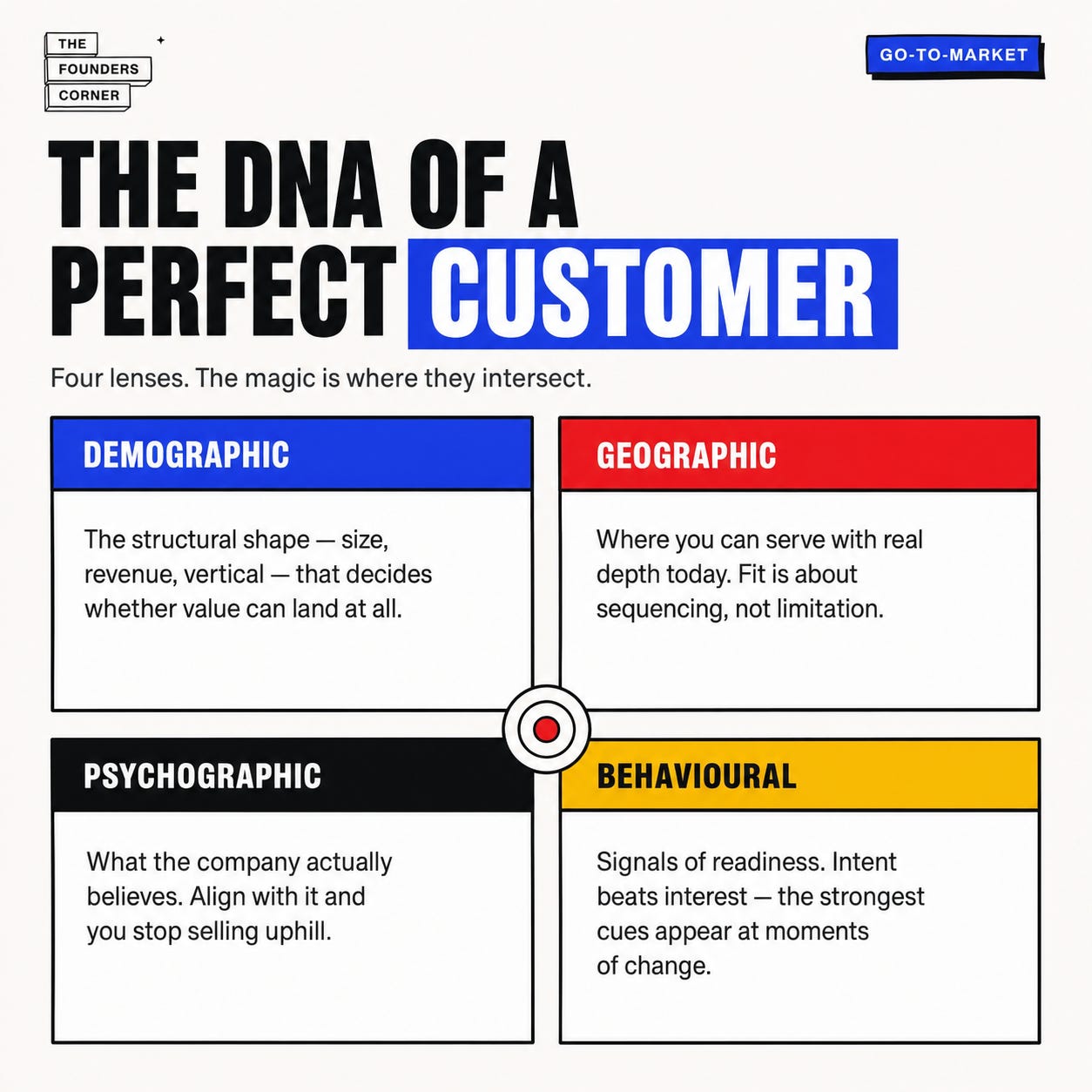
Perfect Customers have a recognisable DNA, and it shows up consistently across four dimensions. Each one is useful alone. The real magic happens when you force them to intersect.
Demographic — the structural conditions for value. The visible shape of the organisation: size, headcount, revenue band, funding stage, business model, vertical. These aren’t administrative details, they’re constraints that shape urgency, budget ownership and procurement behaviour. Selling to a fifty-person agency is a fundamentally different sport from selling to a five-thousand-person enterprise, even when the surface problem looks identical. Demographic clarity forces an uncomfortable truth: not every company that could use your software should buy it today. Some are too small to feel the pain acutely; some so large the pain is diluted across layers of management. Ask: at what size, in which industries, and at what stage does urgency replace mere experimentation?
Geographic — where learning and momentum are fastest. This one gets underestimated constantly, usually by ambitious teams eager to prove global relevance. But in the early years, proximity determines your learning speed, relationship depth and service quality. A concentrated region within realistic travel distance lets you meet customers face to face, watch them use the product in context, and build trust the only way it gets built early — through immediate presence and responsiveness. Selling across time zones before you have a repeatable engine just introduces hidden costs: slower feedback loops, fragmented support, quiet dilution of focus. Geographic fit isn’t about limitation. It’s about sequencing. You earn the right to expand once you’ve proven repeatability somewhere you can serve exceptionally well.
Psychographic — what the organisation actually believes. This moves past what a company is and into what it values. Some businesses are wired for innovation and speed; they reward experimentation and tolerate imperfection. Others prize control, predictability and compliance, where stability is success and change is managed cautiously if at all. If your solution meaningfully supports a declared organisational value — security, sustainability, resilience, inclusion — that value isn’t incidental. It belongs in your DNA, because it determines whether your message feels aligned or alien. When belief, behaviour and benefit point the same way, you stop selling uphill, and the decision starts to feel consistent with who the organisation believes itself to be.
Behavioural — signals of readiness and momentum. If psychographics tell you what a company believes, behaviour tells you whether it’s ready to act right now — and intent is far more valuable than abstract interest. The strongest signals appear at moments of change, because organisations rarely adopt new software when everything is calm. They move when something has shifted: a newly appointed COO or Head of Risk arriving with a mandate, a funding round or merger exposing gaps in existing processes, a public commitment to an AI or transformation programme. Behaviour also shows up in adoption patterns — early experimenters create fast learning and referenceability; late waiters create long cycles and internal resistance. These cues are the breadcrumbs that lead you to real fit before your competitors even arrive.
Individually, each lens is insight. Forced to intersect, they produce a picture precise enough to act on.
The Paragraph That Ties It Together
Once the four dimensions are on the wall, synthesise them into a single paragraph that feels concrete, human and commercially grounded. Something like this:
Our Perfect Customer is a mid-market healthcare services organisation, employing between 1,000 and 3,000 people and generating £250m to £750m in annual revenue, operating across multiple sites in the UK or Northern Europe. They’re led by an Economic Buyer tasked with improving efficiency, compliance and reporting without adding headcount, who wants to be seen internally as the person who modernised how the business runs. They value innovation but operate in a regulated environment, so trust, reliability and defensibility matter deeply. They’re actively exploring automation and AI, feel mounting pressure from fragmented data and manual processes, and are motivated to act because the current state is creating frustration, risk and repeated leadership scrutiny.
Read that back. There’s a real company in it. You could walk into a room and recognise them. That’s the bar — evidence-led, specific enough to be a forcing function, not a tidy slide that comforts everyone and commits no one.
The Question That Sharpens Everything: What Must Be True?
There’s one question that sharpens this entire process more than any other:
What MUST be true about a customer for your software to deliver maximum value?
Ask it slowly, and insist on specifics. Not “it would help if…” Not “ideally they…” Must.
In every successful software business we’ve worked with, there’s at least one non-negotiable condition that makes the product genuinely click. Maybe they must operate in a regulated environment where reporting accuracy is career-critical. Maybe they must already run a specific platform you integrate with cleanly. Maybe leadership must treat security or ESG as a board-level concern that attracts real budget, not a slogan. Maybe the buyer must be under an explicit mandate to fix this this year, not “at some point.”
These conditions become your final qualification lens. They protect you from chasing customers who might buy but will never become delighted — and delighted customers are the only ones who compound. Refine it until you can state the non-negotiable in one clean sentence: “We deliver maximum value when a company is heavily regulated, managing risk in silos, and under constant board-level scrutiny to prove compliance.”
When you can say it that plainly, you’ve found the cherry on the cake. You now know exactly what has to be present for value to be inevitable.
From Profile to Market Map
Here’s where most teams stumble. They do the thinking, produce a beautiful profile — and then drift straight back into opportunistic selling, because they never translate the profile into a living list of real accounts.
Don’t be that team. Turn the DNA into a Market Map, in stages.
First, build a long list of roughly 500 organisations that fit the DNA well enough to be worth consideration. Then overlay the behavioural signals — the leadership changes, the funding events, the stated mandates — to drill down to around 100 Focus accounts, where fit is strongest and early momentum is most likely. That focused list, matched to the Economic Buyers inside each account, becomes the thing your Sales, Marketing and Product effort actually points at.
That’s the shift: from hopeful generalisation to a repeatable way of navigating directly to the customers where you win.
Because “ideal” describes who could buy. “Perfect” tells you where the value is inevitable. One is a comforting slide. The other is a map.
Next in the series, we reach the part of the algorithm that turns all this precision into urgency: the three visceral pains that make an Economic Buyer stop tolerating the status quo and finally decide that doing nothing is no longer an option.
-Chris Tottman
Most founders lose their raise before they ever send the first email.
The ones who close have something the rest don’t: they know exactly how investors read a pitch deck before you’re even in the room, which AI prompts are quietly transforming how founders prepare, how to turn a cold outreach into a warm conversation, what a two-minute briefing can do that a ten-slide deck can’t, how to stress-test your pitch before an investor ever sees it, and how to build a fundraising narrative that actually sticks.
That edge isn’t luck. It’s 30 years sitting across the table from founders, 500+ investments, and the patterns that quietly decide who gets funded and who gets ghosted — now distilled into a system you can use today.
We’ve packaged all of it into 60+ premium tools. One subscription.
Start your 7-day free trial → Cancel anytime.
Start with these six. They’ve already changed the outcome for thousands of founders before you — here’s what happens when it’s your turn:
Your Pitch Deck’s First Reader Isn’t Who You Think — Before any human sees it, something else decides its fate. Know what it is before you hit send.
The 6 Claude Prompts That Change How You Raise — Most founders use AI to write emails. The ones closing rounds use it like this instead.
The Claude Prompt That Turns a Cold Outreach Warm — One prompt. The difference between ignored and in the room.
The Two-Minute Investor Briefing — Investors don’t have time. This format respects that — and gets the meeting anyway.
I Asked Claude to Reject My Pitch — Here’s What It Found — The holes investors find but never tell you about. Find them first.
How to Build Your Fundraising Narrative — Not your deck. Not your numbers. The story that makes both of them land.
Every raise has two sides: the founders who get the meeting, and the ones who wonder why they didn’t. Upgrade now — and make sure you’re on the right one.
A loyal customer is worth more than a crowd that applauds, scrolls onward, and leaves the cash register untouched.