

Every year, thousands of founders walk into Y Combinator interviews convinced they’re ready.
Most walk out without a cheque.
And here’s the uncomfortable truth: it’s rarely the idea that loses the room. It’s the founder.
After 20+ years backing startups, I’ve watched the same patterns play out again and again. The founders who get funded aren’t always the ones with the best ideas. They’re the ones who know themselves — who can answer the questions that matter, with specificity and conviction, under pressure.
The problem? Most founders have no idea how they’d actually perform until they’re already in that room.
So I built something to change that.
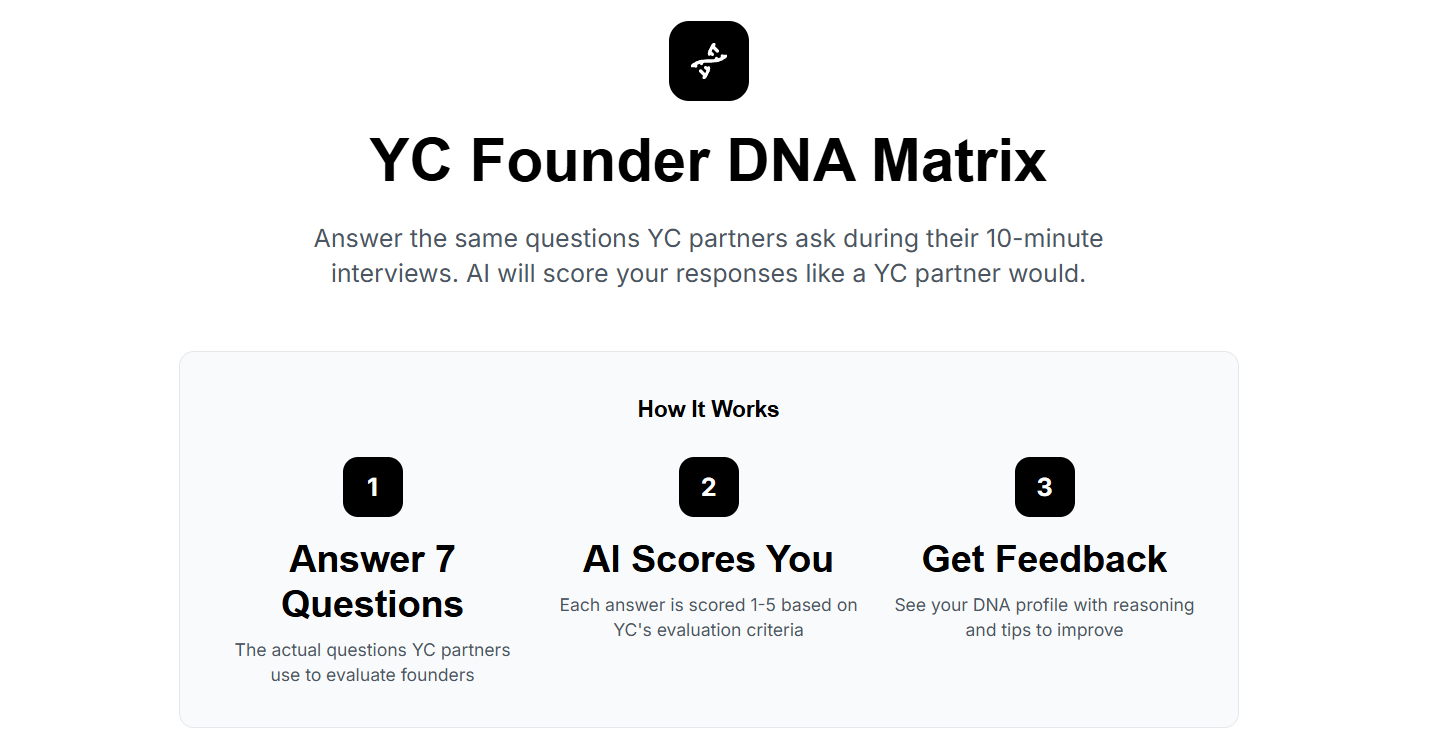
The YC Founder DNA Matrix asks you the same questions YC partners ask during their 10-minute interviews. AI scores your answers the way a partner would. You get a full DNA profile — seven traits, individually scored, each with an honest assessment and a concrete tip to close the gap.
This is a walkthrough of exactly how it works.
Brought To You By SkipUp.ai
You sent the email. They were interested. Then life got in the way - yours, theirs, both - and the thread went cold.
That investor meeting never happened. That customer call never got booked. That partnership died in someone’s inbox.
It happens dozens of times a month. And every one of those dead threads is a deal, a cheque, or a customer you never closed.
SkipUp fixes the part of your funnel nobody talks about. CC skip@skipup.ai and it reads the thread, finds the time, and follows up relentlessly until the meeting is in the calendar. Without you lifting a finger.
First 10 meetings free. No credit card required.

→ Your next meeting is already waiting. Book it at skipup.ai
How It Works
The tool is built around three steps.
You answer seven questions — the actual questions YC partners use to evaluate founders. AI scores each response 1–5 based on YC’s evaluation criteria. Then you get your DNA profile: a breakdown of every trait, where you’re strong, where you’re soft, and what to do about it.
Simple. But what it reveals is rarely what founders expect.
Let’s walk through each question.
The 7 Questions
Question 1 — Determination
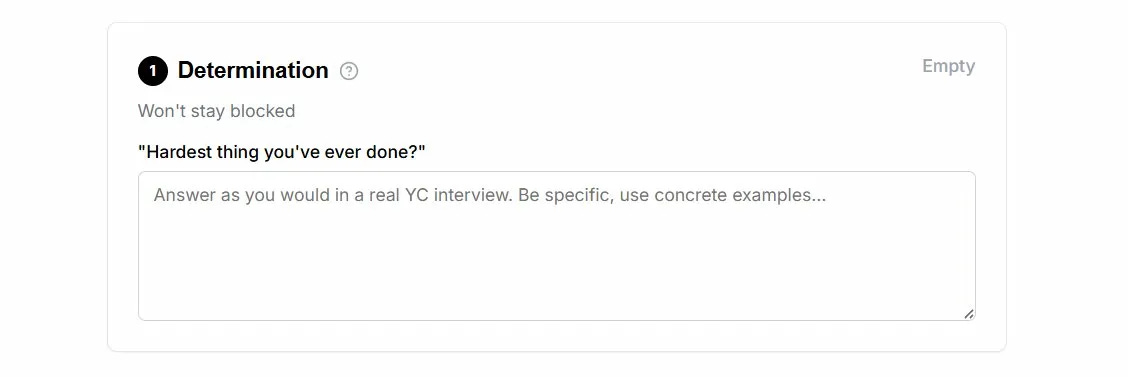
This is the first question for a reason.
YC isn’t looking for the most objectively difficult challenge you’ve ever faced. They’re looking at the texture of your answer. Did you give up and regroup? Or did you find a way through — not around, not over, through?
The highest-scoring answers are hyper-specific. A name. A date. A number. An outcome. Something that makes the stakes real.
Vague answers about “learning to cope with uncertainty” or “pushing through a tough period” score a 2.
A founder who can describe the exact moment they almost quit — and precisely why they didn’t — scores a 5.
Question 2 — Flexibility
How would you handle it if your current approach stopped working?
YC has funded some of the most dramatic pivots in startup history. YouTube started as a video dating site. Slack was an internal tool for a gaming company. Instagram was built on the bones of a Foursquare clone.
The common thread isn’t the pivot itself. It’s the speed and ego-freedom with which it happened.
YC wants founders who can kill a beloved idea the moment data contradicts it — and immediately start building the next one. The highest scorers here don’t just say they’re willing to pivot. They describe specific experiments they’ve already killed, and the logical direction they’d move in next.
That’s the level of specificity YC is looking for. Not “I’m open to pivoting.” A body count of dead ideas.
Question 3 — Imagination
“What’s unconventional but true about your market?”
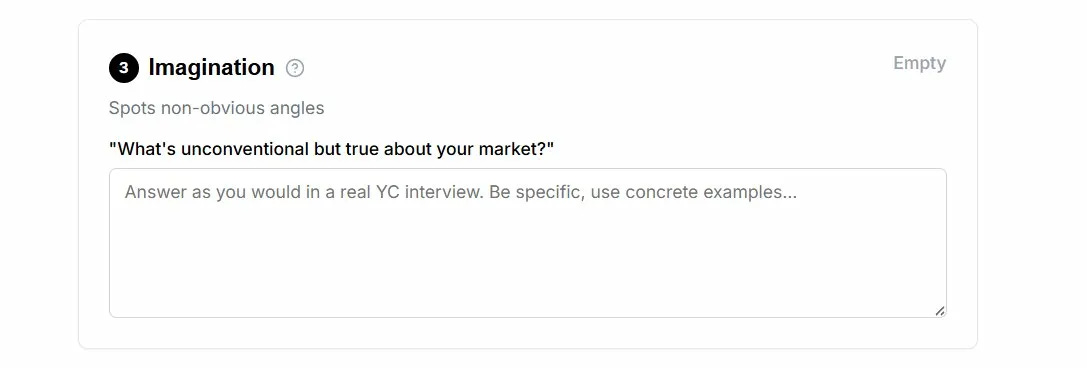
This is the question most founders get completely wrong.
It separates the founders who’ve genuinely thought from first principles from those who’ve absorbed conventional wisdom and repackaged it. YC wants the insight that makes you wince slightly when you say it out loud — the one that sounds wrong at first, but is defensible with data.
Here’s the test: if your answer could appear in a mainstream industry report, you’ve failed it. If it makes a seasoned investor pause and say “huh” — you’ve passed.
Question 4 — Friendship
Describe your relationship with your co-founder — including the tensions.
Paul Graham famously wrote that YC looks for founders they’d want to be friends with.
Not because YC is a social club. But because friendship is a proxy for a very specific set of qualities — intellectual curiosity, genuine warmth, the ability to disagree without contempt, and the kind of intensity that makes people want to go to war alongside you.
This trait is assessed through the quality of your co-founder relationship and your ability to describe it honestly. The founders who score poorly here describe their partnership in press-release language. The founders who score well tell the truth — including about the friction.
Question 5 — Naughtiness
Tell me about a time you bent the rules to get something done.
YC doesn’t want criminals. But they do want founders with what they call a “piratical gleam” — an ability to find loopholes, game systems cleverly, and do things that larger, slower organisations have declared impossible.
What scores a 4 or 5: building a bot that automated something everyone said couldn’t be automated. Finding a regulatory gap that let you move faster than incumbents. Getting a meeting with someone “impossible” to reach through a genuinely clever system hack.
If you’ve never bent a rule cleverly, you may be too polite to win.
Question 6 — Founder–Problem Fit
“Why are you the right person to solve this problem?”
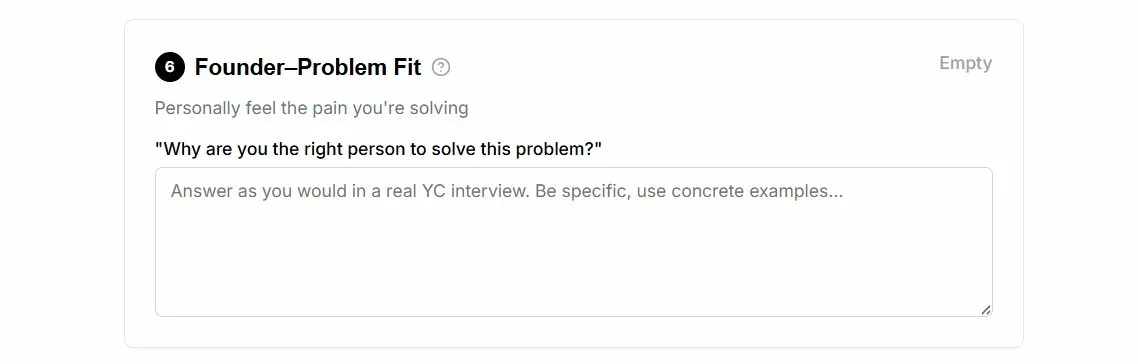
The best founders don’t choose their problems. They discover them.
Often through years of living in an industry, feeling a frustration so acutely that they had no choice but to fix it. YC has learned, painfully, that founders who parachute into a space because it’s large or trending rarely build the best companies in it.
Your answer to “why you” should make one thing obvious: if you don’t build this, something important stays broken. Not because the market is big. Because you are the person who actually understands the problem.
Question 7 — Execution
“What did you ship last week?”
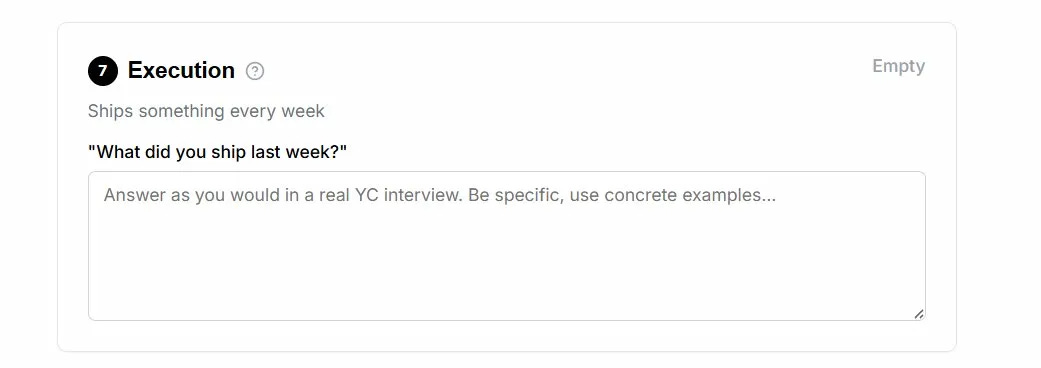
YC is a speed cult. Not for its own sake — but because speed is a proxy for learning, and learning is everything at the early stage.
A founder who can’t answer this question specifically is signalling that their default mode is planning, not doing.
The ideal answer is almost embarrassingly concrete. A version number. A user count. A specific feature. A piece of content that started 10 real conversations. If your answer involves the phrase “working on” rather than “shipped” — you’re in trouble.
Your DNA Profile
Once you’ve answered all seven questions, the Matrix generates your Founder DNA Profile.
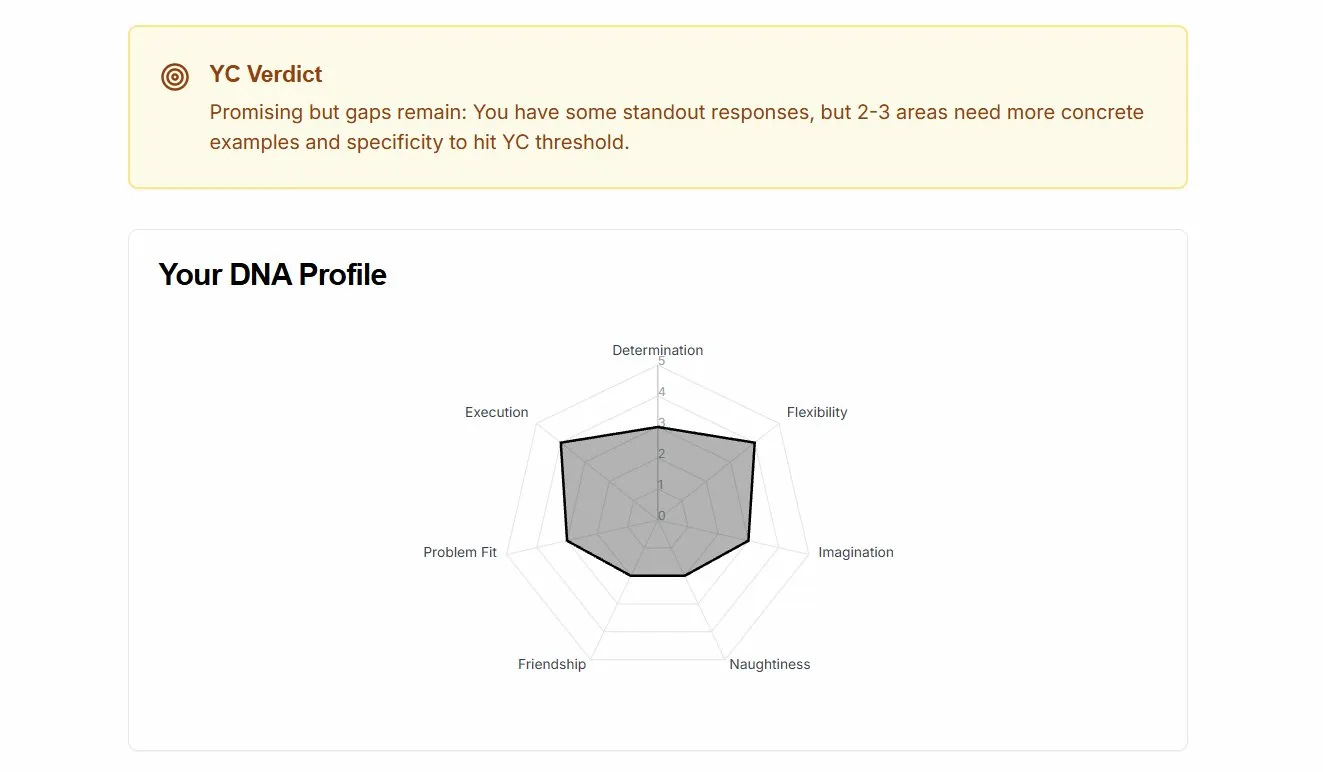
This is a radar chart that maps your scores across every dimension at once.
It comes with a YC Verdict — a frank, plain-English summary of where you stand. Not encouragement. Assessment. The kind of direct feedback most advisors are too polite to give you.
Each score also comes with two things: an AI Assessment that explains exactly why you received that score, and a How to Improve tip that is specific, actionable, and written in the voice of someone who has sat across from hundreds of founders.
The difference between a 3 and a 5 is never vague. It’s always a specific thing you said — or didn’t say.
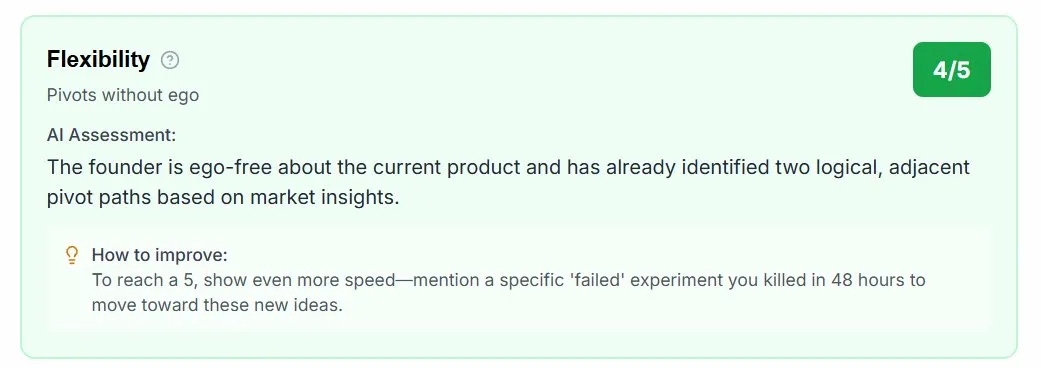
Where you did well — and the precise move needed to go from a 4 to a 5.
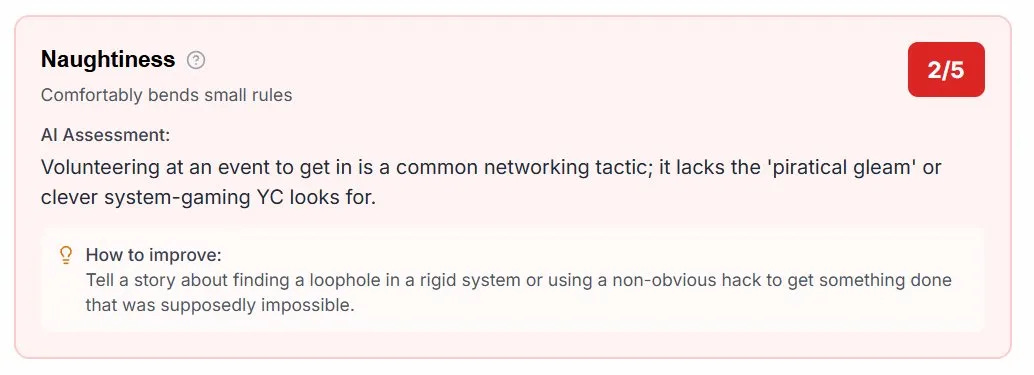
Where the gap is — and exactly what a higher-scoring answer looks like.
What Founders Get Wrong
Here’s the pattern I’ve seen after watching hundreds of founders go through this tool.
Almost everyone overestimates Determination. Almost everyone underperforms on Execution and Naughtiness.
Determination is the trait founders most want to believe they have. It’s practically a founder identity badge. And yet when pressed for a specific story with real consequences and a real outcome — most produce something soft and generic.
“I pushed through a difficult time and came out stronger.”
That’s a motivational poster. Not a YC-worthy answer.
Execution is the silent killer. Founders who’ve been building for six months and can’t name a concrete thing they shipped last week are building in their heads. They’re confusing depth of thought with depth of work. YC doesn’t fund thinkers-who-will-build. It funds builders.
And Naughtiness — the most misunderstood trait in the matrix — isn’t a question about ethics. It’s a test of resourcefulness. Of whether you have the instinct to find asymmetric advantages. If your best story is politely negotiating a discount, that’s not naughtiness. That’s good manners.
How to Get the Most From It
The Matrix is only as useful as the honesty you bring to it.
Answer as if you’re in the room. Write like you’re speaking to a partner who will push back. No hedging, no throat-clearing — just the facts and the story.
Be hyper-specific. Dates. Names. Numbers. Generalities are the enemy of a high score, every time.
Don’t try to game the AI. It’s trained to recognise the same evasions YC partners have seen thousands of times. Hedged language, vague superlatives, and humble-bragging all score lower than you’d expect.
Do it with your co-founder. Compare profiles. The gaps and mismatches between co-founders are often as revealing as the individual scores.
Revisit it monthly. Your Execution and Flexibility scores should change meaningfully month on month. If they don’t — that’s information.
The YC Founder DNA Matrix wasn’t built to predict whether you’ll get into YC. Plenty of great founders haven’t.
It was built to give you the honest, specific self-knowledge that most founders only get when they’re already in the interview — or already rejected.
The founders who thrive don’t just have the traits. They know which ones they have, which ones they lack, and what they’re doing about the gap.
That clarity is, in itself, a form of determination.
The YC Founder DNA Matrix is available exclusively to paid subscribers of The Founders Corner.
If you’re already a subscriber, you can access it directly below. If not, this is what your subscription gets you — tools built from 20+ years of backing founders, designed to give you an honest edge before the moments that matter.
The interview is 10 minutes. The preparation is everything.
→ Access the YC Founder DNA Matrix below