

Let’s be honest about how most 13-week cash flow forecasts actually get built.
Someone (usually the most overworked person in finance) pulls the bank export on Monday morning. Chases down AR aging. Begs ops for the vendor payment schedule. Opens last week’s model, prays the formulas didn’t break, reconciles three conflicting versions of “the truth,” and spends the rest of the day making it look presentable enough to survive a board meeting.
This happens every week, at almost every company. And it’s happening while the cost of getting it wrong keeps climbing. According to a widely cited U.S. Bank study, roughly 82% of small businesses that fail point to cash flow problems as a contributing cause. Not lack of customers. Not a bad product. A failure to see the crunch coming in time to act. JPMorgan Chase Institute research on hundreds of thousands of small businesses found the median company holds only about 27 days of cash buffer, meaning most businesses are roughly four weeks from empty at any given moment. A forecast that only gets built when someone has a spare afternoon isn’t a forecast. It’s a lagging indicator dressed up as a leading one.
I’m going to show you exactly how to fix that. Not by hiring someone, not by buying FP&A software with a five-figure annual contract, but with Claude and the raw exports you already have sitting in a folder somewhere.
This isn’t a “here’s a cool AI use case” post. This is the exact prompt sequence, in order, that takes you from a messy folder of CSVs to a CFO-ready, scenario-driven cash flow model: the kind you’d normally pay a fractional CFO or a finance ops agency to build for you.
Why the 13-week window is the one that actually matters
Every finance leader has an opinion on forecast horizons, but the 13-week window wins for a simple reason: it’s the shortest window long enough to actually do something about what it shows you.
Monthly forecasts are too blunt. They smooth over the exact week a covenant gets tight or a vendor threatens to pull terms. Annual forecasts are directionally useful but useless for “can we make payroll in six weeks.” The 13-week model sits in the one spot where granularity and runway overlap: you’re forecasting actual weekly receipts and disbursements, with enough lead time to actually react before the number goes negative.
The problem has never been that this model isn’t valuable. The problem is that building it properly (weekly granularity, dozens of categories, full traceability back to source data) is expensive in time, and time is the one resource finance teams never have a surplus of.
That’s the gap Claude closes.
What you need before you touch a single prompt
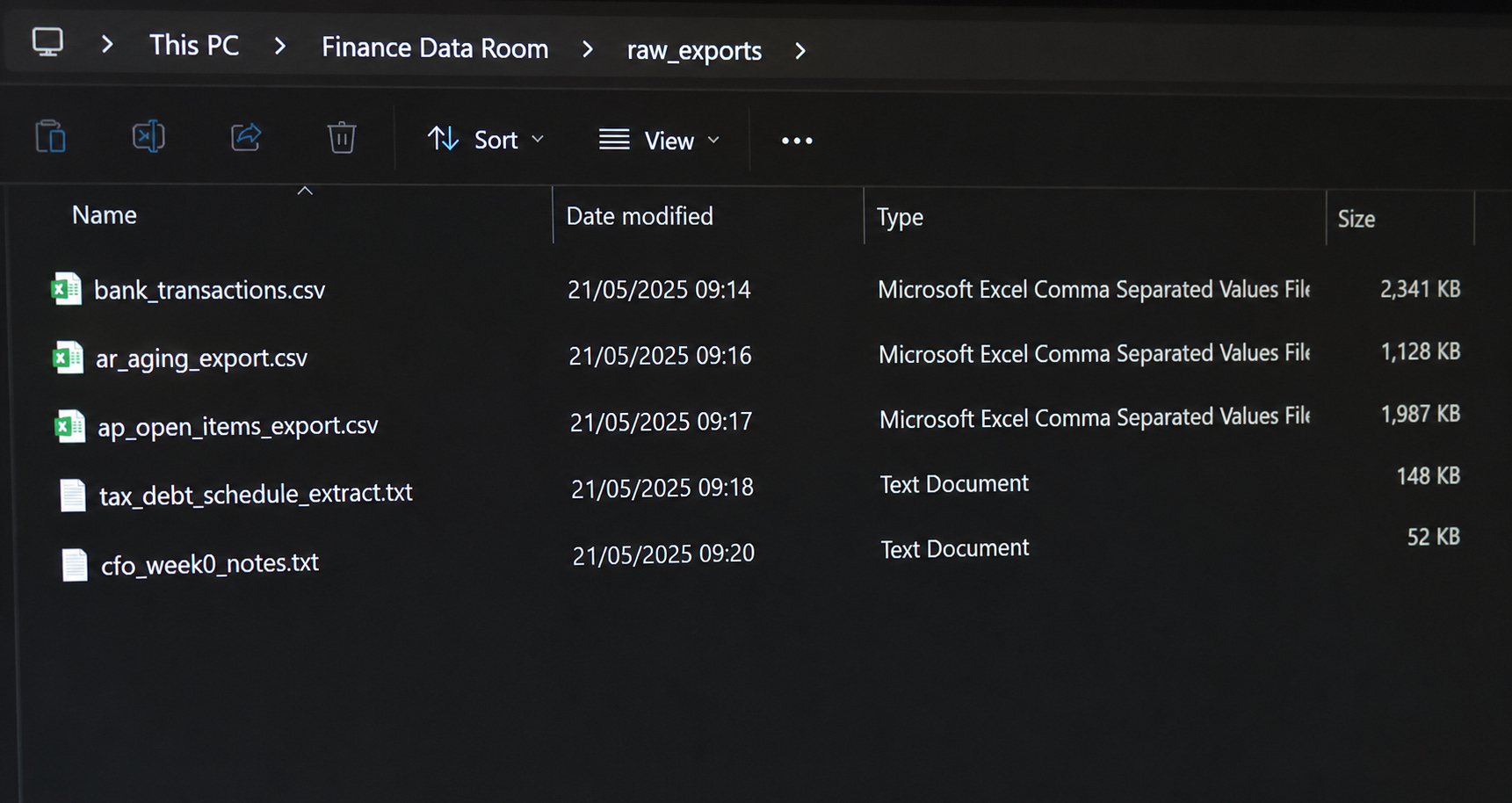
Here’s the part that surprises people: you don’t need clean data. You don’t need a finance ops team to “prep the inputs” first. You need the same messy exports your company already produces every week:
A bank transaction export (CSV): your real cash position and recent activity
An AR aging report: who owes you, and how late they are
An AP open items export: what you owe, and when
Whatever qualitative context lives outside your systems: a notes file, a tax payment schedule, anything that isn’t in a report but still changes the forecast
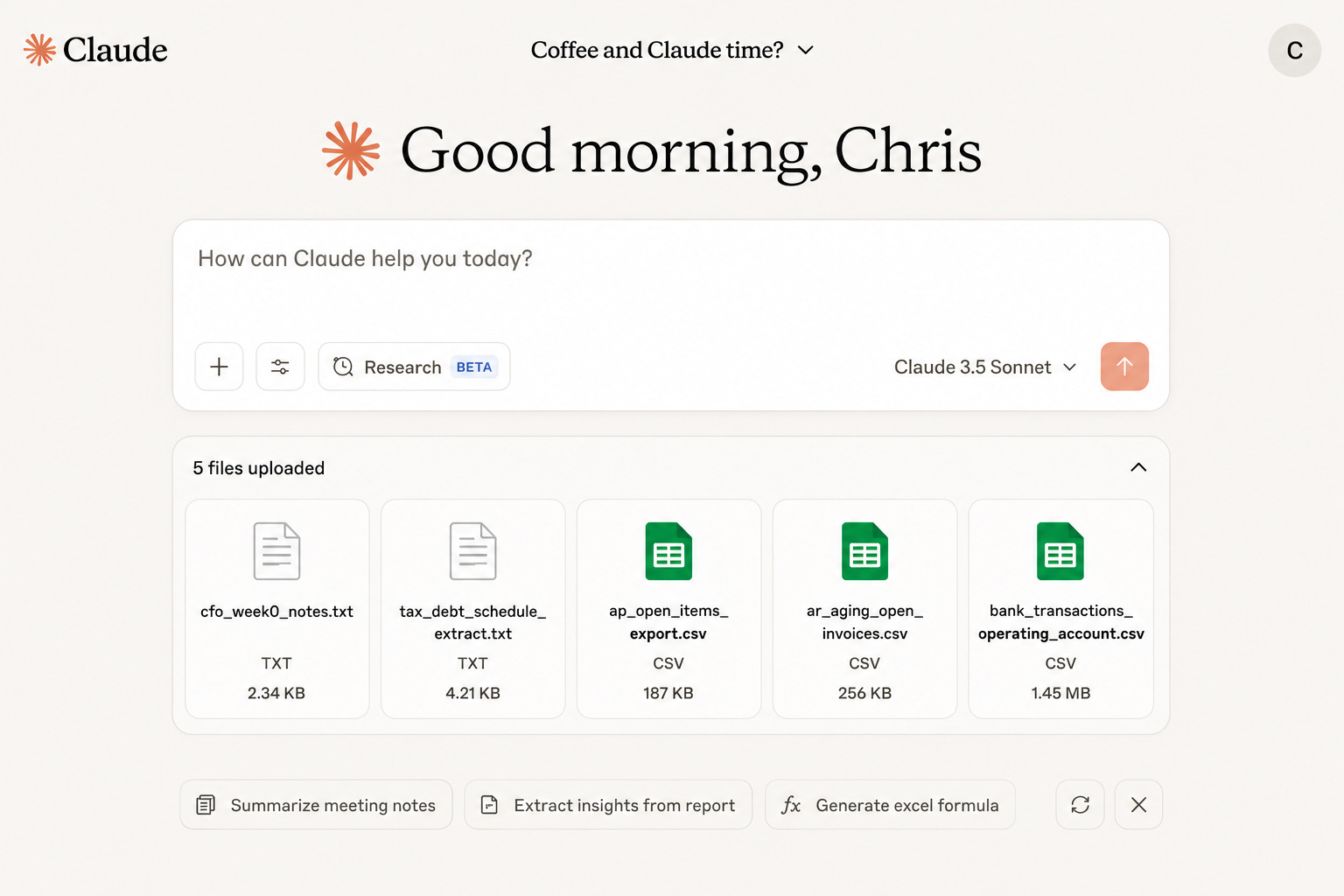
You are not cleaning this data before you hand it over. That’s the point. Claude does the reconciliation, the categorization, and the structuring, and shows you its work while it does it, instead of handing you a black box.
Step 1: Give Claude the raw files and a brief that leaves no room for guessing
Vague prompts produce vague models. If you want a CFO-grade output, you tell Claude exactly what “done” looks like: the format, the required sections, and the bar you’re holding it to.
Prompt 1: Kick off the build
I uploaded Week 0 finance exports for [Company Name]. Please build the
first version of a 13-week cash flow forecast as a downloadable Excel
model.

The Excel model should include:
- The weekly forecast (receipts, disbursements, net cash flow, ending
  balance)
- Source mapping (which line came from which file)
- An audit trail
- Flagged exceptions or assumptions that need my sign-off
- A scenario tab (base case, downside, upside)
- A one-page CFO summary
Claude reads every file, reconciles the bank balance against the AR/AP detail, sorts transactions into real categories (payroll, vendor payments, marketing spend, tax obligations), and lays out the full 13-week grid. Then it builds all of it into an actual .xlsx file. Not a chat response describing a spreadsheet. An actual file you open, hand off, or drop straight into a board deck.
What comes back isn’t a wall of numbers. It’s a dashboard. Opening cash. Ending cash by scenario. The lowest point the balance touches across all 13 weeks. How many weeks dip below your minimum threshold. The swing between best and worst case. That last metric, weeks below threshold, is usually the first number a CFO actually asks for.
If this is useful, don’t stop here
This same “raw files in, working model out” pattern is the backbone of everything we build at The Founders Corner. We just usually point it at fundraising instead of finance ops. If you’re a founder juggling both, these are worth your time next:
The Claude Guide Every Founder Should Run Before Fundraising: the nine prompts that replicate how modern VC firms screen your deck with AI before a partner ever opens it
The Claude Prompt That Turns a Cold Email Into One a VC Actually Reads: the five-prompt system behind the outreach that gets a reply instead of an archive
The Two-Minute Investor Briefing Every Founder Should Be Running: a Claude research agent that builds a full investor briefing before every meeting
I Asked Claude to Reject My Pitch Until It Couldn’t. Then I Raised.: the adversarial prep system that finds every weak point in your pitch before an investor does
How to Build Your Fundraising Narrative With Claude: the five-prompt playbook for turning your raw story into the argument that actually closes rounds
Step 2: Force Claude to show its receipts, not just its answer
A forecast nobody trusts is a forecast nobody uses. Before you touch scenarios, sensitivity, or anything CFO-facing, the model needs to survive scrutiny: every number traceable back to the exact file it came from.
Prompt 2: Force an audit trail
Before we move on, validate the model against the source files. Show
me the base case matching the Excel model exactly: opening cash,
ending cash, minimum cash, and which week that minimum falls in. Flag
anything you had to estimate or infer rather than pull directly from
source, and don't let those numbers into the final output without my
sign-off.
This is the prompt that separates “an AI made a spreadsheet” from “a model I’d stake my name on.” Claude walks back through its own work, confirms the base case ties out to the workbook line by line, and (this is the part that matters) separates what it knows from what it had to assume. Every finance person has been burned by an assumption that quietly became a fact three tabs later. This prompt kills that risk before it ever reaches a board deck.
🔒 You’ve built a working model. Here’s what turns it into the one your CFO actually runs the business on.
Everything above already puts you ahead of most companies’ weekly process. Here’s exactly what’s waiting below the paywall:
✅ Prompt 3: The scenario build. Three linked scenarios (Downside Stress, Management Action, and Upside Tailwind), all feeding the same live dashboard, so toggling between them updates ending cash, minimum cash, and weeks below threshold instantly. Not three static copies. One model, three futures.
✅ Prompt 4: The sensitivity levers. Turns hardcoded assumptions into real, adjustable sliders (AR collection timing, retail/marketplace receipts, discretionary marketing reduction, AP stretch, purchase commitment delay), so anyone on your team can ask “what if we stretched AP by two weeks” and get a live answer in seconds, no formulas touched.
✅ Prompt 5: The cash movement chart. The single visual most likely to replace three pages of your next board deck: receipts, disbursements, and net cash flow, plotted across all 13 weeks.
✅ Prompt 6: The CFO summary. The one page that actually gets read: current position, trajectory, scenario range, the week you come closest to the edge, and a recommendation, written the way a CFO actually talks.
✅ The full six-prompt sequence, copy-paste ready, built to adapt to your own company’s finance stack. Swap in your categories, your thresholds, your scenario names, and run it as your own recurring weekly workflow.
Paid subscribers also get:
✅ 50+ additional tools covering every other stage of running and financing a company: fundraising narrative and pitch prep, investor research and outreach, meeting prep, term sheet analysis, and data room management. The same tool stack this cash flow workflow came from.