

👋 Hey, Chris here! Welcome to The Founders Corner. If you’ve been reading along, you’ll know I have very little patience for theory that doesn’t survive contact with a real buyer.
This series is a preview of a new book I’ve written with my partners Richard Blundell and Paul Watson — The Selling Software Algorithm: The Go-to-Market Navigation System for B2B Software Leaders.
It isn’t a strategy deck dressed up as a book. Between the three of us we’ve spent close to seven decades inside B2B software as founders, operators, investors and coaches — building companies, exiting some, and quietly breaking a few along the way, which is where most of the real learning lives. Through our work at Vencha we’ve now supported hundreds of founders trying to do the single hardest thing in software: turn a clever product into predictable commercial traction in a market that’s noisy, cautious, and more crowded than it has ever been.
One pattern shows up again and again. Companies rarely struggle because the product is bad. They struggle because they have no navigation system for going to market. This book is that system.
Too Long; Didn’t Read (TL;DR)
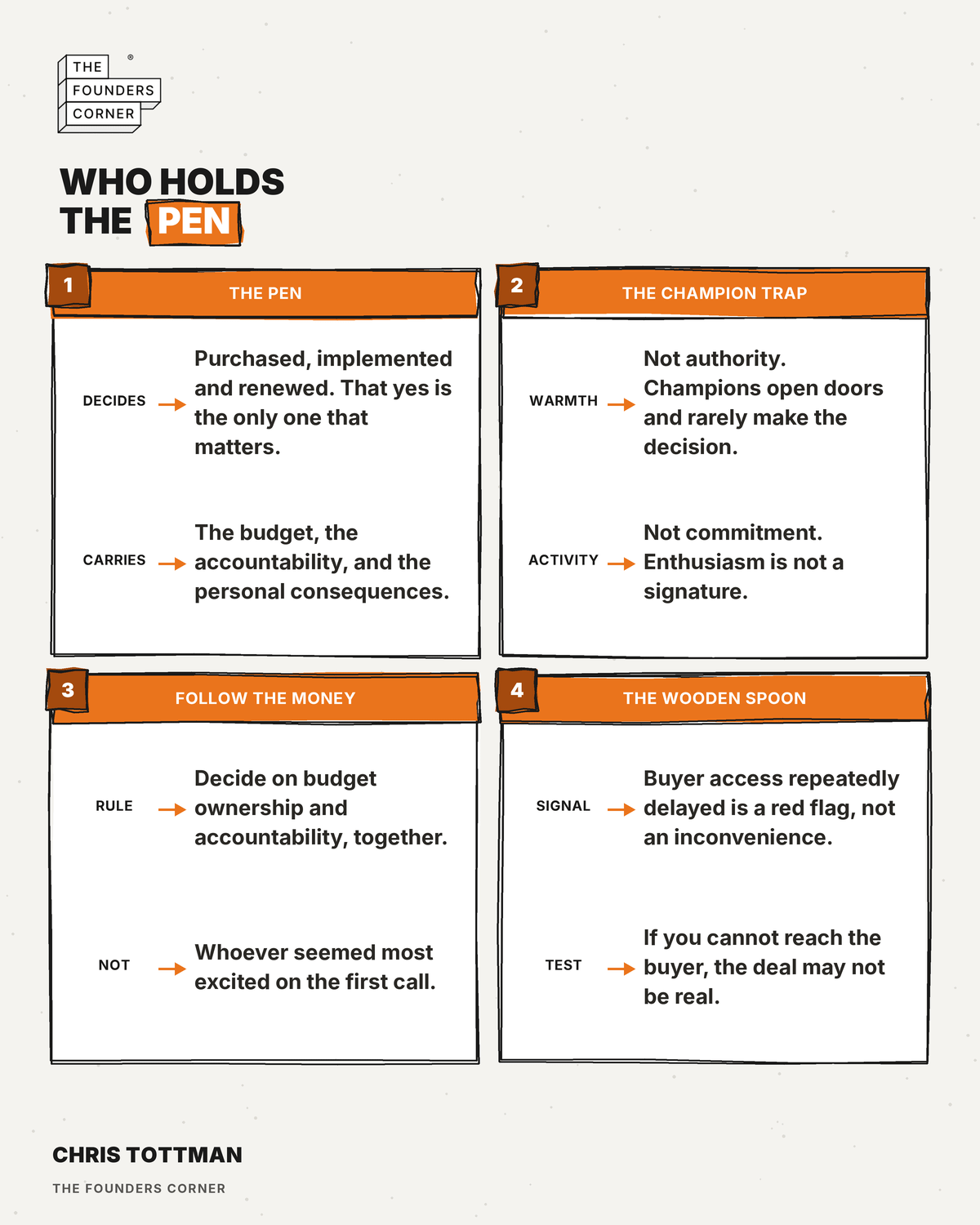
The Economic Buyer is the person who ultimately decides whether your software is purchased, implemented and renewed. They carry the budget, the accountability, and the personal consequences of the decision.
Beware the Champion trap: the enthusiastic first contact who loves your demo almost never holds the pen. Warmth is not authority. Activity is not commitment.
To find the real buyer, follow the money — and get your own team aligned on budget ownership and accountability before you get anywhere near a pitch.
Behind every title is a human being navigating ambition, pressure, insecurity and hope. Operational pain almost always becomes personal pain.
Economic Buyers buy software when they can also see personal advantage in its success: a defensible decision, calmer Mondays, protected reputation, career progress, and cover from blame.
Never let a first meeting with an Economic Buyer become a demo. Discovery is a diagnosis: start with their context, ask what success looks like for them personally, and test yourself by writing their internal summary of the conversation.
The Wooden Spoon Test: if access to the Economic Buyer is repeatedly delayed or resisted, that’s a red flag — you may be stirring a deal that will never come to the boil.
Last time, we landed on a single sentence — the spine of the whole Selling Software Algorithm:
Our software is perfect for a clearly defined Economic Buyer, in a tightly defined Perfect Customer Profile, who’s struggling with the three most visceral pains our software solves.
Now we start pulling it apart, one component at a time, because the strength of the whole equation depends on the clarity of each part. And it begins where almost every software business quietly comes unstuck.
Not in the product. Not even in the pitch.
In the simple question of who your software is really for.
Here’s the trap. The person who loves your demo the most — the one who replies quickly, gets it instantly, and promises they can “sell this internally” — is almost never the person who can actually buy it. Founders pour weeks into that relationship, mistake the warmth for progress, and wonder months later why the deal quietly died.
Let me show you who really holds the pen. And, more importantly, what they’re actually buying when they say yes.
Table of Contents
Who is the Economic Buyer in a B2B software deal?
Why do B2B deals die even when my champion loves the product?
How do I find out who really controls the budget for a software purchase?
What motivates a B2B Economic Buyer beyond the job title?
What are Economic Buyers actually buying when they buy software?
How should I run a discovery meeting with an Economic Buyer?
How to tell if a stalled software deal is ever going to close.
Who is the Economic Buyer in a B2B software deal?
Let’s be clear straight out of the gate.
An Economic Buyer isn’t the person who likes your demo the most. It isn’t the user who’ll log into your product every morning. And it certainly isn’t the enthusiastic first contact who tells you they can champion this from the inside.
The Economic Buyer is the person who ultimately decides whether your software is purchased, implemented and renewed.
They carry the budget. They carry the accountability. And whether they admit it or not, they carry the personal consequences of getting the decision right or wrong. Their signature releases the funds. Their name sits against the budget line your solution affects. They can approve the whole thing — or block it with a single flick of the pen.
Organisations are full of people who can slow a deal down, complicate it, or quietly kill it. But only one person can properly approve it and drive adoption. That “yes” is the only one that ultimately matters.
If the Economic Buyer isn’t aware of your solution, isn’t engaged, and isn’t convinced throughout the sales cycle, your deal is always at risk of missing a heartbeat. It drifts into procurement limbo. It stalls under internal politics. Or it dies quietly, without anyone ever telling you why.
So the first discipline is brutally simple: you and your team must be able to point at one person and say, with confidence, that’s who we need to convince.
Why do B2B deals die even when my champion loves the product?
Most founders don’t fail this test because they’re careless. They fail it because of the Champion.
The Champion is usually the first person to show genuine enthusiasm. They see the potential quickly. They recognise the inefficiency and want their day to run more smoothly. They speak your language, they help you navigate the organisation, and they’re often the reason you get a second meeting at all.
Champions are not optional. They’re frequently the doorway.
But Champions don’t sign contracts, and they don’t usually control budget. They don’t have to defend your proposal when leadership scrutiny arrives. They can influence the decision. They rarely make it.
This is why your narrative has to resonate with two very different people at once.
The Champion cares about workflow and execution — they want the process to work, and they want their day to be smoother. The Economic Buyer cares about business outcomes, risk and credibility — they need the decision to be defensible, their quarter to be more predictable, and their leadership story to hold under pressure.
See the deal through that dual lens and you stop mistaking everyday enthusiasm for genuine authority. You stop orbiting someone supportive but powerless. And you start building a path that can actually reach the signature on the dotted line.
Warmth is not authority. Activity is not commitment. Hold onto that.
How do I find out who really controls the budget for a software purchase?
So how do you find the real one?
Follow the money. And accept that it often leads you higher up the org chart than you first assumed.
This sounds obvious until you sit in a room — as we have, many times — with three whip-smart founders from the same company who all give a different answer to the same question. One is certain the buyer sits in Finance. Another assumes Operations. A third insists it’s IT.
They can’t all be right, and the disagreement is quietly costing them every deal.
We worked with an AI recruitment business for years where the instinct was always to target Heads of Talent or People. Sometimes that was correct. But just as often the CFO turned out to be the real decision-maker, because they could see the whole-organisation financial advantage of hiring more efficiently — an advantage no departmental head could unlock alone.
The lesson isn’t that one function is always the buyer. It’s that you have to decide, together, based on budget ownership and accountability — not based on who seemed most excited on the first call.
Get your own team aligned on this before you get anywhere near a pitch.
What motivates a B2B Economic Buyer beyond the job title?
Here’s where most founders stop, and where the real work actually begins.
Too many look at the Economic Buyer and see only a label. CFO. COO. VP of Operations. Head of HR. They build their messaging around the responsibilities of the role, talk confidently about operational efficiency, and assume the decision is driven entirely by logic.
Logic matters. But it’s nowhere near the whole story.
Behind every title is a human being navigating ambition, pressure, insecurity and hope. And that personal dimension shapes buying behaviour far more than most founders realise.
Picture a day in their life. They wake early — often earlier than they’d like — into a day already crowded with noise. On the commute they’re turning over the mortgage, a holiday they promised the family, maybe elderly parents they’re helping to care for. Then they walk into work and lead a department that’s expected to perform, reporting to someone who wants results without excuses. They sit in leadership meetings where targets are reviewed and pressure gets redistributed. And they carry a bonus whose importance never shows up on a spreadsheet, but is often the thing that makes their personal maths work.
Now connect that back to your software.
The operational pain you’re selling into almost always becomes personal pain. A broken process doesn’t just slow the business down — it reflects badly on the leader responsible for it. A dependence on spreadsheets doesn’t just create inefficiency — it creates friction between teams, and quiet moments of embarrassment when the numbers don’t reconcile or the report lands late. A recurring issue that generates weekly complaints becomes an emotional weight, because it sits on that person’s shoulders in every one-to-one, every Monday meeting, every board update.
Over time those irritations chip away at confidence and erode credibility. They turn leadership into apologising and justifying, rather than steering and improving.
Senior leaders guard their reputation because reputation is their currency of influence. Your job is to understand exactly where that currency is being quietly depleted.
What are Economic Buyers actually buying when they buy software?
Which brings us to the single most useful idea in this whole chapter.
Economic Buyers buy software when they can also see personal advantage in its success.
The operational benefits have to be there — nobody’s arguing otherwise. But it’s the emotional, reputational and career benefit that creates urgency. They buy when they can picture the relief of removing a nail from their boot. When they can imagine calmer Mondays and cleaner reporting cycles. When they believe the decision will protect them from blame, position them for promotion, or help them deliver the objective that secures the bonus.
That framing isn’t cynical. It’s respectful.
Leadership roles are high-pressure and high-consequence. Great founders don’t ignore that reality — they build their narrative around it. When your product helps a leader deliver visible progress, even incrementally, you stop being a vendor and become an ally. Sometimes even a friend.
One HR leader at a large home-improvement retailer told us, with real pride, about the day his CEO held him up in front of the other leaders as the example of AI innovation done well. That kind of internal moment is pure gold. When your software helps create it, you’re no longer selling a tool. You’re helping someone tell a better story about their own competence and momentum.
And when you translate value into their language, make it defensible. “Saves time” is vague. “Cuts time-to-hire by 28 days” or “reduces screening effort by 80 percent” gives them something they can stand behind in a room full of scrutiny.
How should I run a discovery meeting with an Economic Buyer?
If you’re lucky enough to secure an hour with an Economic Buyer, here’s advice worth its weight in gold: never let that first meeting become a demo. Ever.
It feels harmless — even productive. You’re proud of what you’ve built, the silence is uncomfortable, and clicking through screens feels safe. But the moment discovery turns into a feature tour, you’ve handed control away. Your job in that room isn’t to present. It’s to understand.
The best Economic Buyer meetings feel far closer to a diagnostic consultation than a sales pitch. A good doctor doesn’t prescribe before they understand the symptoms, and they ask more questions than you expect because accuracy matters more than speed. Adopt exactly that posture.
Come prepared. Read their LinkedIn properly — not to memorise their CV, but to understand the shape of their journey and the pressures that come with it. Form a hypothesis about where pressure is building before you ever speak. Then, in the room, start with their context, not your product. Ask about the department’s goals for the next twelve months. Ask what risks keep surfacing in leadership conversations. Ask what’s been tried already, and why it failed. Ask them to walk you through the process your software improves — and where it frustrates, embarrasses or slows them down.
Then listen as if your life depended on it, because every answer is a window into what they value and how they decide.
Before the meeting closes, ask the one question that reveals more than any other: what does success look like for you personally if this works — and how would that world feel? That gently shifts the conversation from software towards ambition, reputation and the human meaning of progress. And that shift is often the moment a deal genuinely begins.
Here’s a test for afterwards: could you write the buyer’s own internal summary of the conversation on their behalf? The problem as they see it, the cost of leaving it unresolved, the reason to act now, the likely risks, the next steps? If you can, you did the work. If you can’t, then however pleasant it felt, you were still operating on assumption.
How to tell if a stalled software deal is ever going to close.
We often suggest founders keep a wooden spoon on their desk. Not as a gimmick, but as a quiet reminder.
Without the Economic Buyer genuinely engaged, it’s remarkably easy to find yourself stirring the same opportunity over and over — warming it gently, adding ingredients, adjusting the seasoning, convincing yourself progress is being made — when in reality nothing is ever going to come to the boil.
You can build a wonderful relationship with a Champion. You can run brilliant demos for users, gather warm feedback, refine proposals, and pour hours into supporting internal conversations. All of it can feel productive. And all of it stays fragile without the conviction and sponsorship of the person who actually holds the pen.
So when access to the Economic Buyer is repeatedly delayed or resisted, don’t treat it as a minor inconvenience. It’s a signal — often a red flag. A Champion who won’t involve the ultimate decision-maker is frequently protecting uncertainty, not progress.
There are calm, professional ways to insist on that access. Frame the meeting as necessary for accuracy, not persuasion — you’re asking for time to understand, not to sell. Anchor it to risk: similar projects fail when senior context is missing, and thirty minutes upfront materially reduces that risk. Offer a tight agenda, and promise explicitly that there’ll be no demo and no pitch. And be prepared, at least mentally, to walk away — because if you can’t reach the buyer after repeated professional attempts, you have to question whether the deal is real at all.
This is why the Economic Buyer sits at the very start of the algorithm. They are the human centre of every meaningful sale.
Understand them. Respect them. Help them win.
Do that, and everything downstream — the sales cycle, the approval path, the adoption, the references — becomes dramatically easier.
Next in the series, we take this same discipline and point it at the second part of the sentence: not the person, but the company. How to define your Perfect Customer Profile with enough precision that it becomes a forcing function — and stops you wasting a single week on the accounts that were never going to buy.
—Chris Tottman
Frequently Asked Questions
Who is the Economic Buyer?
The person who ultimately decides whether your software is purchased, implemented and renewed. They carry the budget, the accountability, and the personal consequences of the decision. Their signature releases the funds, and they can approve the whole thing or block it with a single flick of the pen.
What is a Champion, and why aren’t they enough to close a deal?
The Champion is usually the first person to show genuine enthusiasm — they speak your language, help you navigate the organisation, and are often the reason you get a second meeting at all. But Champions don’t sign contracts and don’t usually control budget. They can influence the decision; they rarely make it. Warmth is not authority, and activity is not commitment.
How do I identify the Economic Buyer in a target account?
Follow the money, and accept it often leads higher up the org chart than you first assumed. Decide as a team based on budget ownership and accountability — not on who seemed most excited on the first call. In one AI recruitment business, the real decision-maker was often the CFO rather than the Head of Talent, because only the CFO could see the whole-organisation financial advantage.
Why do deals stall even when everyone I talk to loves the product?
Because organisations are full of people who can slow a deal down, complicate it, or quietly kill it — but only one person can properly approve it and drive adoption. If the Economic Buyer isn’t aware, engaged, and convinced throughout the sales cycle, the deal drifts into procurement limbo, stalls under internal politics, or dies quietly without anyone telling you why.
What does an Economic Buyer actually buy?
Personal advantage alongside operational benefit. They buy when they can picture the relief of removing a nail from their boot: calmer Mondays, cleaner reporting cycles, protection from blame, positioning for promotion, and delivery of the objective that secures the bonus. The emotional, reputational and career benefit is what creates urgency.
What should the first meeting with an Economic Buyer look like?
A diagnostic consultation, never a demo. Come prepared with a hypothesis about where pressure is building, start with their context rather than your product, ask about goals, risks, and what’s been tried before, and close with the question that reveals more than any other: what does success look like for you personally if this works?
What is the Wooden Spoon Test?
A reminder that without the Economic Buyer genuinely engaged, you can stir the same opportunity over and over — warming it, adding ingredients, adjusting the seasoning — and it will never come to the boil. If access to the buyer is repeatedly delayed or resisted, treat it as a red flag and question whether the deal is real.
How do I get access to the Economic Buyer when a Champion is blocking it?
Insist calmly and professionally. Frame the meeting as necessary for accuracy, not persuasion; anchor it to risk, since similar projects fail when senior context is missing; offer a tight agenda with an explicit promise of no demo and no pitch; and be prepared, at least mentally, to walk away if repeated professional attempts fail.
Most founders lose their raise before they ever send the first email.
The ones who close have something the rest don’t: they know exactly how investors read a pitch deck before you’re even in the room, which AI prompts are quietly transforming how founders prepare, how to turn a cold outreach into a warm conversation, what a two-minute briefing can do that a ten-slide deck can’t, how to stress-test your pitch before an investor ever sees it, and how to build a fundraising narrative that actually sticks.
That edge isn’t luck. It’s 30 years sitting across the table from founders, 500+ investments, and the patterns that quietly decide who gets funded and who gets ghosted — now distilled into a system you can use today.
We’ve packaged all of it into 60+ premium tools. One subscription.
Start your 7-day free trial → Cancel anytime.
Start with these six. They’ve already changed the outcome for thousands of founders before you — here’s what happens when it’s your turn:
Your Pitch Deck’s First Reader Isn’t Who You Think — Before any human sees it, something else decides its fate. Know what it is before you hit send.
The 6 Claude Prompts That Change How You Raise — Most founders use AI to write emails. The ones closing rounds use it like this instead.
The Claude Prompt That Turns a Cold Outreach Warm — One prompt. The difference between ignored and in the room.
The Two-Minute Investor Briefing — Investors don’t have time. This format respects that — and gets the meeting anyway.
I Asked Claude to Reject My Pitch — Here’s What It Found — The holes investors find but never tell you about. Find them first.
How to Build Your Fundraising Narrative — Not your deck. Not your numbers. The story that makes both of them land.
Every raise has two sides: the founders who get the meeting, and the ones who wonder why they didn’t. Upgrade now — and make sure you’re on the right one.
Identifying the true decision-maker can significantly impact your sales strategy and outcomes. Avoiding the Champion trap ensures you're not misled by enthusiasm without authority.
The leader’s reputation above should rest partly on his willingness to defend those below.
Senior officials may call him difficult because he demands sound priorities, realistic schedules, and fair treatment. His team will call him when something is truly wrong because they know he will listen before reaching for the disciplinary form.
Being easy to manage is a modest virtue. Being safe to follow is a greater one.