

There’s a brutal truth about fundraising that nobody tells you until you’ve already sat through three polite rejections:
VCs don’t invest in companies. They invest in narratives about companies.
Two founders can be building near-identical products, in identical markets, with identical traction, and one walks away with a term sheet while the other spends six months collecting passes. The difference, more often than not, comes down to one thing: the story they tell, and how they tell it.
Ben Horowitz, co-founder of a16z (the firm behind Airbnb, Stripe, and Facebook) put it plainly:
“The mistake people make is thinking the story is just about marketing. No, the story is the strategy. If you make your story better, you make the strategy better.”
This isn’t feel-good startup advice. It’s operational reality. And in 2025, it matters more than it ever has.
The fundraising landscape has changed. Most founders haven’t caught up. 📊
Here’s what the data actually looks like right now:
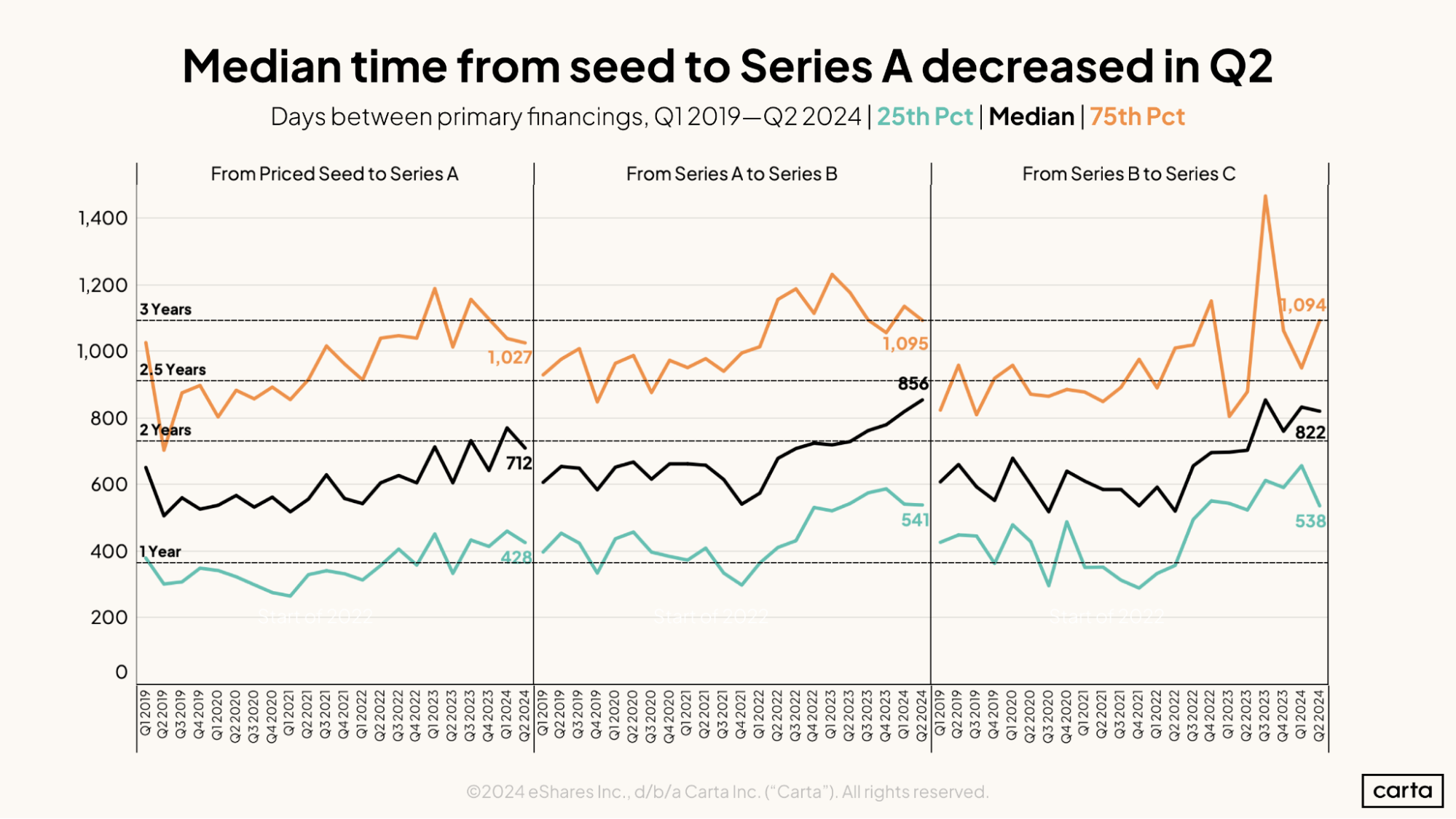
The median time to close a seed round has more than doubled: from 68 days in 2021 to 142 days in 2025 (Carta/PitchBook). Series A timelines have stretched to an average of over two years from seed. Founders are now pitching an average of 58 investors over a 12-week cycle to close a round.
Meanwhile, on the other side of the table, VCs are receiving more inbound than ever. The result? Attention has collapsed.
According to DocSend’s research, investors spend an average of just 3 minutes and 44 seconds reviewing a pitch deck, and 42% of all decks are never read to completion.
That means you have roughly 224 seconds to make a VC believe your company is worth their time, their partners’ time, their capital, and their reputation.
224 seconds.
In that window, most founders are still explaining what their product does. The founders who raise are using that time to make investors feel why the world needs it to exist.
The problem isn’t that founders don’t know their companies. They know them too well. That’s the trap. Most founders tell their story in the order it happened to them. VCs need to hear it in the order it needs to land.
Claude solves this. Not by writing your story for you, but by helping you excavate the real one, structure it as a deliberate argument, and test it against every objection before a VC does.

Here’s the five-prompt sequence to do exactly that.
First: what a fundraising narrative actually needs to do 🎯
A fundraising narrative is not a company description. It’s not a product walkthrough. It’s not a list of achievements arranged on slides.
It’s a persuasive argument, structured to move a specific reader from scepticism to conviction, in under four minutes, using only the information that matters.
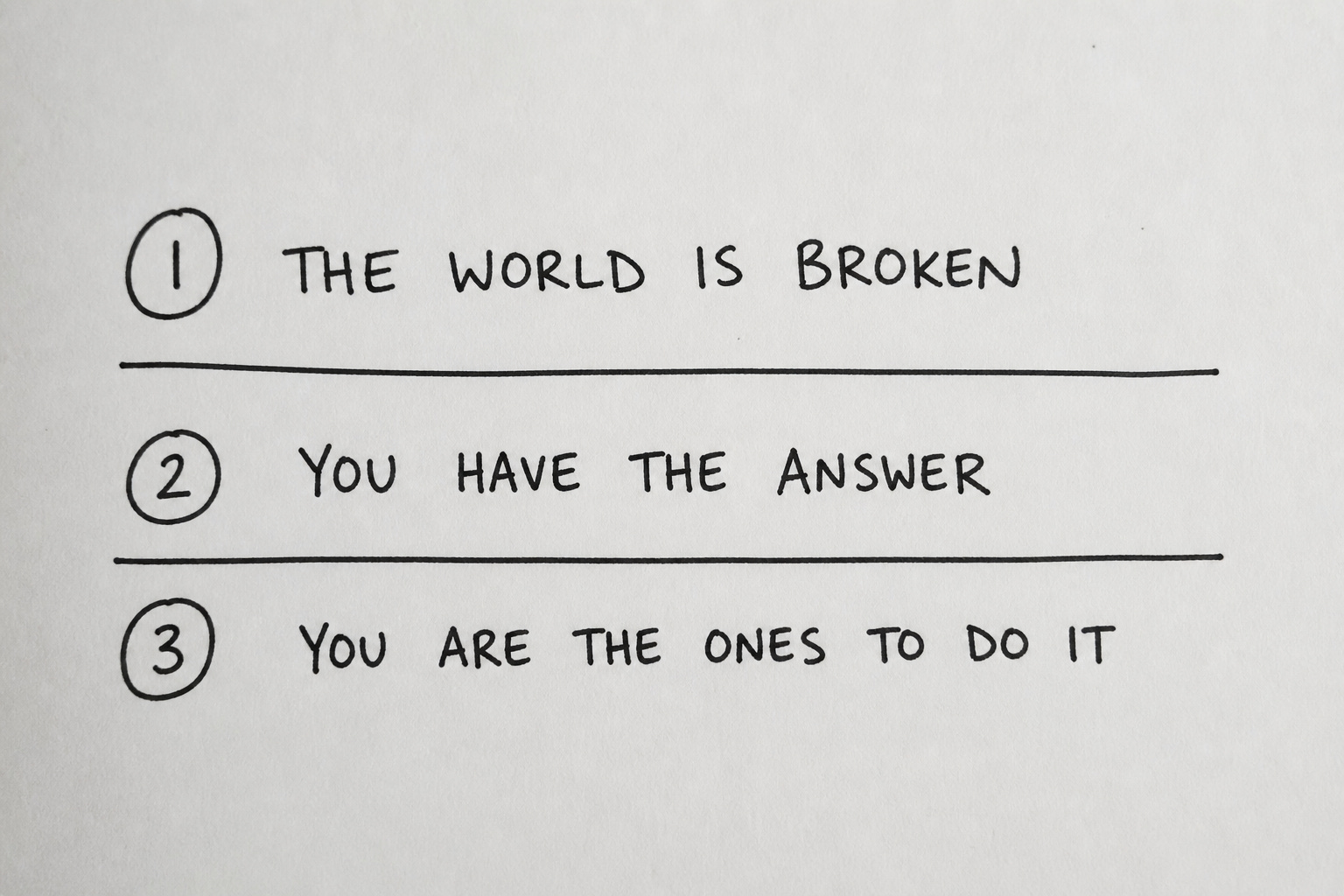
That argument has to work at three distinct layers simultaneously:
Layer 1 → The world is broken
Establish that a significant, specific problem exists, and existing solutions are failing the people who have it. This is where investor belief begins, before you’ve mentioned your product once. Most founders skip over this layer because they’re so eager to get to the solution. That’s exactly why their pitches don’t land.
Layer 2 → You have the answer
Introduce your solution not as a clever idea, but as the inevitable response to the problem you’ve just made real. The key word is inevitable. Not innovative, not disruptive. Inevitable. It has to feel like this solution was always coming, and you got there first.
Layer 3 → You are the ones to do it
Make the case that your team’s background, your timing, and your traction make you uniquely positioned. Proof over assertion: every claim backed by something verifiable.
The reason most pitches fail? They’re strong on Layer 2 and weak on Layers 1 and 3.
Founders spend most of their deck explaining the product and barely enough time establishing why the problem is truly painful or why they specifically are the right people to solve it. The result is a pitch that explains a company without making an investor feel they’d regret missing it.
Test your narrative right now: Can you tell your story in three sentences (one per layer) where each sentence makes the next feel necessary? If you can’t, the structure needs work before the wording does.
Prompt 1: Extract your raw material 📋
Before you can build a narrative, you need to surface the real ingredients. Most founders start with a polished pitch. Don’t. Start with the truth: messy, unedited, and direct.
The question-by-question format below forces you to think about each element in isolation. That matters, because VCs evaluate each element in isolation. Answering everything at once lets you hide behind the whole. Answering one at a time exposes exactly where your thinking is thin.
💬 Copy this prompt into Claude (new conversation)
I'm going to give you the raw story behind my company. I need you
to help me build a fundraising narrative. Don't edit or structure
anything yet. Just ask me each of these questions one at a time,
and wait for my full answer before moving to the next:

1. What problem does your company solve, and how did you personally
   discover it was real?

2. Who specifically suffers from this problem, and what does their
   day look like because of it?

3. Why do existing solutions fail them? What have they already tried?

4. What is your solution, and what's the core insight that makes it
   work when others haven't?

5. What's the earliest evidence that this solution works?

6. Why is now the right time? What's changed in the world that
   makes this possible or urgent today?

7. Why are you the right team? What do you know or have that
   others don't?

After I've answered all seven, reflect back what I said and identify:
(a) the most emotionally resonant moment
(b) the clearest proof point
(c) the biggest gap or assumption I haven't addressed
⚡ Why this works: The reflection at the end is where the real work happens. Claude will surface the assumption you’ve stopped questioning, the one you’ve been too close to see. Run through this fully before moving on.
🔒 The rest of this article is for paid subscribers
You’ve just built the foundation. What comes next is where fundraises are won or lost.
Prompt 1 gets your raw material on the page. Prompts 2 through 5 turn it into something that actually closes rounds. Here’s what you’re unlocking:
Prompt 2 imposes the seven-stage narrative structure that consistently outperforms every other framework in VC meetings, with a scoring system that tells you exactly which sections are weak and why.
Prompt 3 is the language overhaul. It strips every piece of inside-out jargon from your draft and replaces it with the specific, human, cost-naming language that makes investors lean forward. There’s a before-and-after table that shows exactly what this transformation looks like in practice.
Prompt 4 is the adversarial stress-test: Claude plays a hostile VC partner actively looking for the reason not to invest, surfaces every weak assumption before a real investor does, and delivers a verdict on the single section that would most change the outcome of your pitch.
Prompt 5 is the compression test that forces your narrative into three formats (two minutes, thirty seconds, and one sentence) and asks the diagnostic question that reveals whether what you’ve built is a pitch or just a story.
Paid subscribers also get:
✅ The complete copy-paste prompt library: all five prompts templated with fill-in variables for your stage, sector, and investor type, so you’re never starting from scratch
✅ The narrative canvas: a structured one-page worksheet to fill in before running any of these prompts, so you arrive at Prompt 1 with your thinking already organised
✅ The investor archetype guide: how to shift your language, emphasis, and proof points depending on whether you’re talking to a thesis-driven fund, a traction-first investor, or a founder-focused angel. They don’t evaluate the same way. Your pitch shouldn’t sound the same either.
✅ Six annotated real narrative structures from actual seed and Series A raises, with honest notes on what landed, what nearly killed the deal, and what the founder would change if they were doing it again
✅ 50+ additional tools covering every stage of the fundraising process and beyond: investor research, outreach, meeting prep, term sheet analysis, data room management, post-meeting follow-up, and more
This is the material that turns a solid narrative into a repeatable fundraising engine.
Prompt 2: Build the seven-stage structure 🏗️
Once you have your raw material, the next step is imposing the right structure. For VC fundraising, a modified “why now” sequence consistently outperforms every other narrative framework. Each stage earns the next: the investor is pulled forward, not pushed.
Here’s the sequence and what each stage has to accomplish:
