

There is a question almost every founder avoids asking because the answer might be uncomfortable: is our homepage messaging better, worse, or roughly the same as our competitors?
Not gut feel. Not “I think ours is clearer.” Actually, objectively, side by side.
I have been testing a tool that answers this question directly. It is called the Messaging Benchmarker, and it runs your homepage and up to five competitor homepages through the same seven messaging tests, scores each one out of 100, and hands you a detailed breakdown of where you are winning and where you are losing ground.
Here is exactly how it works, and why every founder building in a competitive market should be running this regularly.
Brought to you by Accio Work
Most founders are still operating like it is 2015.
Manually sourcing products. Chasing suppliers. Managing stores. Launching campaigns piece by piece.
Accio Work replaces all of it with an agentic workspace that actually executes.
A team of specialised AI agents handles product sourcing, supplier negotiation, store management, and marketing on your behalf. Not as suggestions. As actions.
Built with verified capabilities and deep integrations into the tools founders already use, it moves from idea to execution without friction.
No setup. No complexity. Just output.
You stay in control. The agents do the work.
Try Accio Work here with a 7-day free trial.
Why Your Messaging Benchmark Matters More Than You Think
Most founders spend enormous amounts of time and money driving traffic to their homepage. Paid ads, SEO, outbound, events. All of it funnels back to that one page.
And yet very few founders have any objective measure of whether that page is doing its job compared to the alternatives a potential customer has already seen before landing on yours.
Your visitor has almost certainly visited your competitor’s website before or after yours. They are making a comparison. The question is whether that comparison is going in your favour.
The Messaging Benchmarker gives you the data to find out.
Step 1: Enter Your Company Details
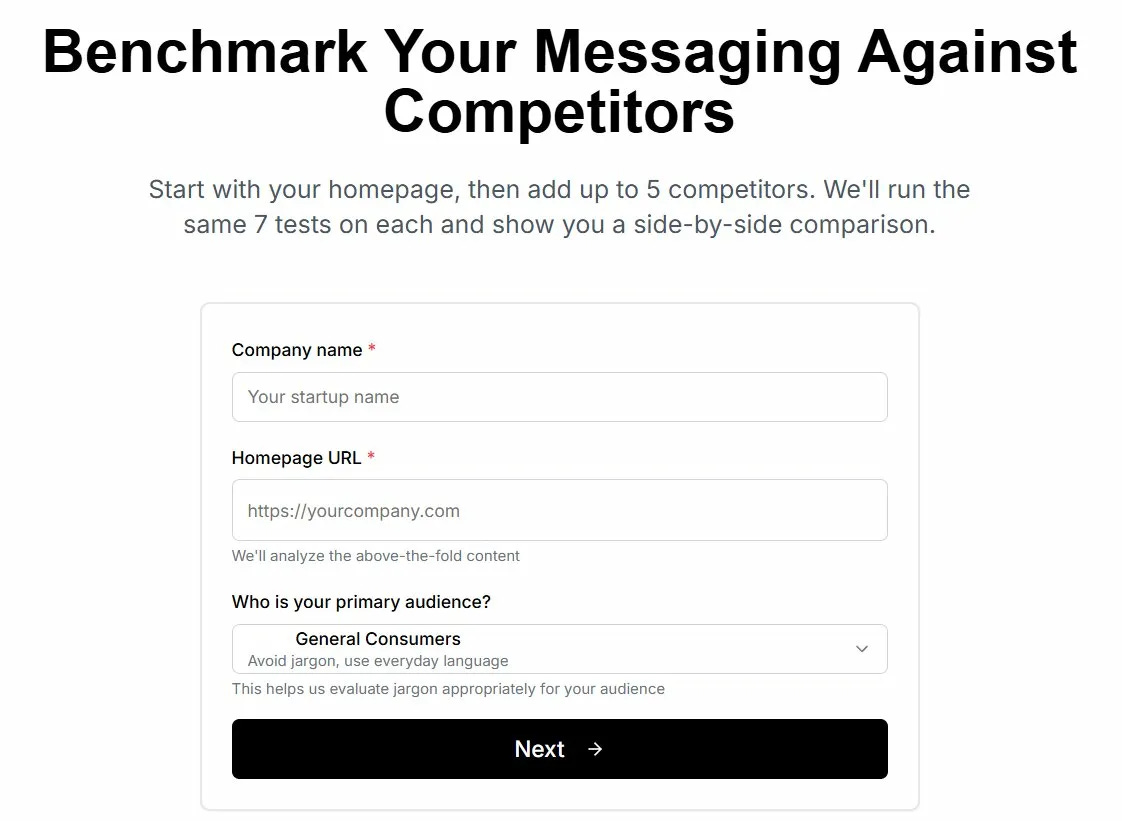
The tool opens with a clean, simple form. You enter your company name, your homepage URL, and you select your primary audience from a dropdown.
That last input matters more than it sounds. The tool evaluates your messaging differently depending on who you are trying to reach. If you select General Consumers, it flags jargon and penalises complexity. If you are targeting technical buyers or enterprise decision makers, the rubric adjusts accordingly.
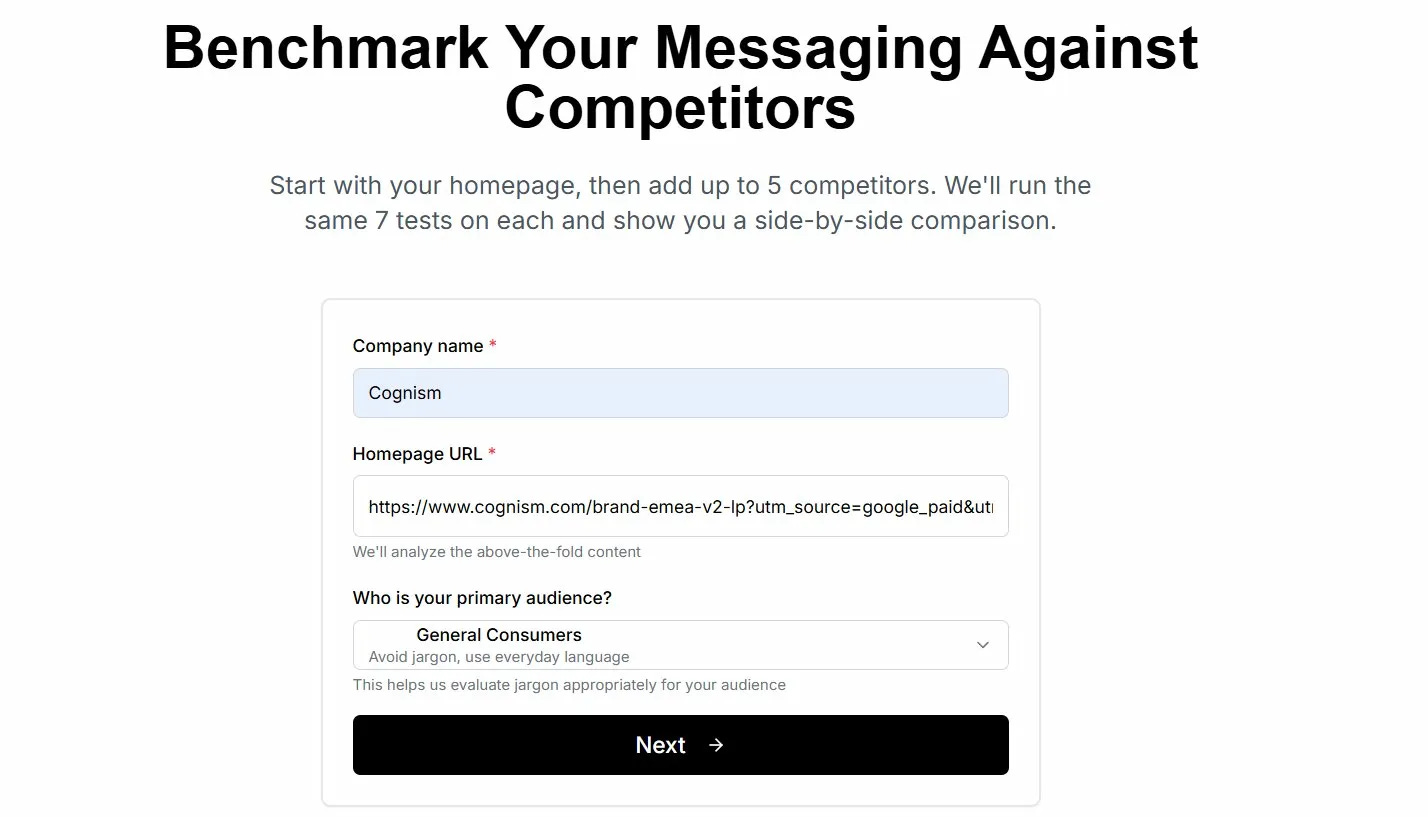
In my test, I used Cognism as the subject company, dropped in their homepage URL, and kept the audience set to General Consumers. Once those three fields are filled, you hit Next and move on to adding your competitors.
Step 2: Add Your Competitors
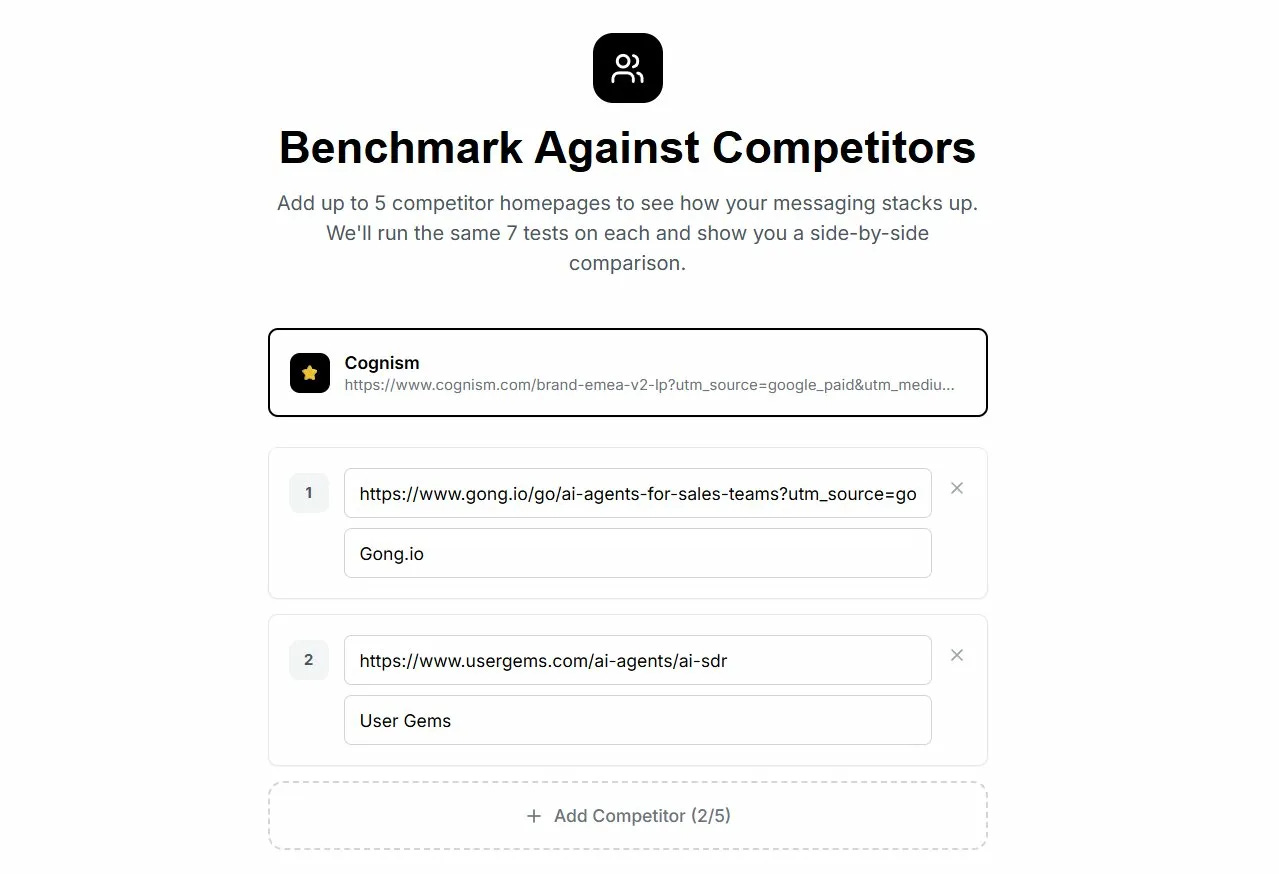
This is where the benchmark gets interesting. The tool lets you add up to five competitor URLs alongside your own. Each one gets the same seven-test analysis, run on the same criteria, scored on the same scale.
For my test, I was looking at the AI sales agent category, so I added Gong.io, User Gems, and Alta as the three main competitors I wanted to stack Cognism against. You simply paste the URL and give it a name. The interface is fast and clean. Adding a competitor takes about ten seconds.
Once your list is set, you kick off the analysis.
Step 3: The Analysis Runs Automatically
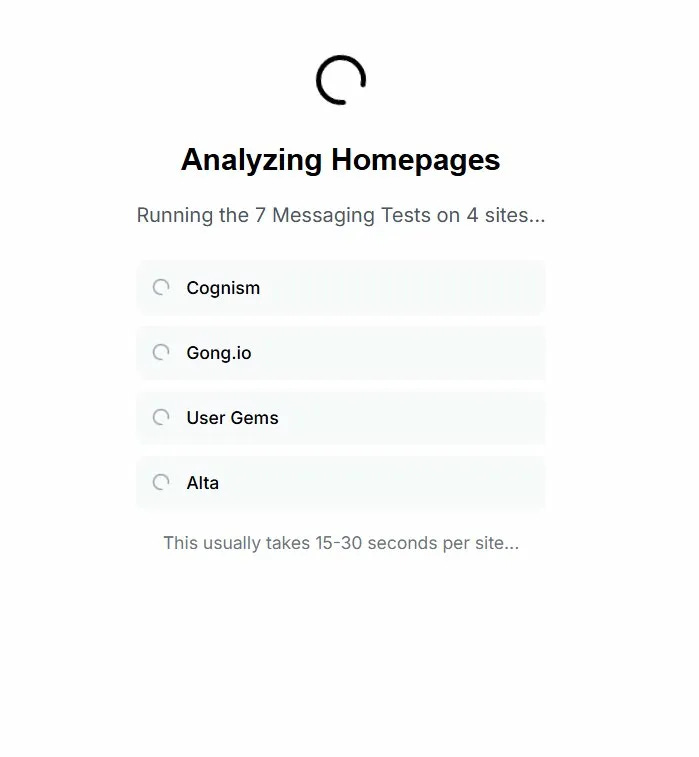
The tool runs each site through its seven tests in sequence. You can watch the progress in real time as it works through each company on your list. Cognism. Gong.io. User Gems. Alta.
Each analysis takes roughly 15 to 30 seconds per site, so you are looking at a couple of minutes total for a full benchmark. Grab a coffee. By the time you are back, your results are ready.
Step 4: Read Your Benchmark Scores

The results page opens with a clear scoring summary across all four companies. In the Cognism test, the scores came back like this:
Cognism (You): 67/100
Gong.io: 70/100
User Gems: 49/100
Alta: 50/100
That is genuinely useful data. Cognism is close to Gong.io, well ahead of its other two competitors, but not leading the category. There is a specific, measurable gap to close.
Below the scores, the tool generates a full messaging report for your company, complete with detailed observations, friction points, and rewrite suggestions. This is where the real value lives.
Step 5: The Messaging Radar
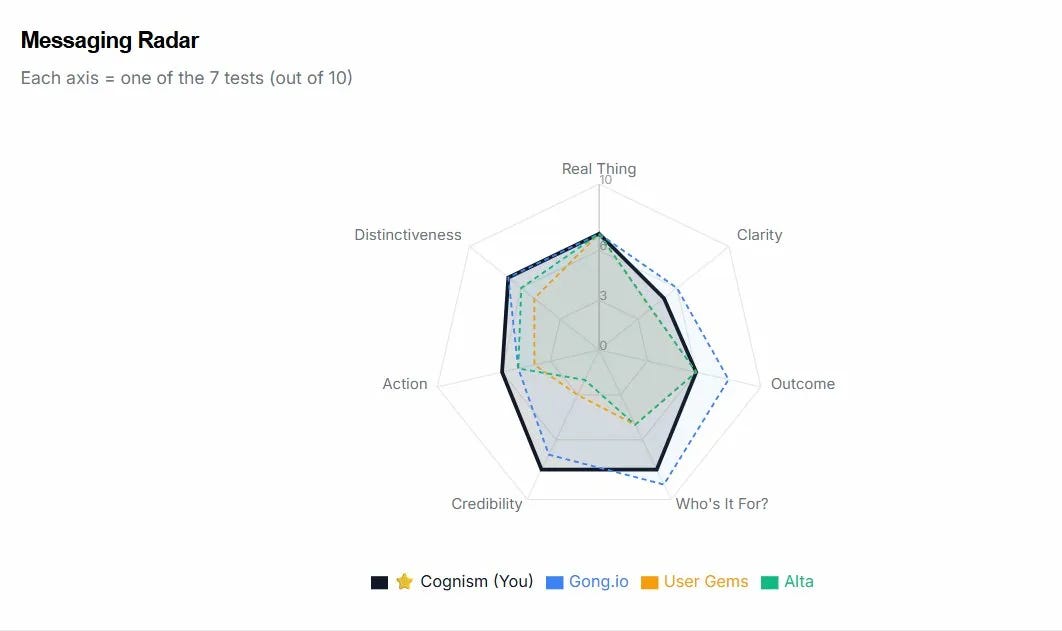
The radar chart is the most immediately visual part of the output. It maps all four companies across the seven individual test dimensions:
Real Thing, Clarity, Outcome, Who’s It For, Credibility, Action, and Distinctiveness.
You can see at a glance not just where your overall score sits, but which specific dimensions are dragging it down. In the Cognism test, the radar shows the company performing strongly on Distinctiveness and Clarity, but losing ground on Outcome and Credibility relative to Gong.io.
That tells a founder something precise and actionable. Not “your messaging could be better” but “your messaging is not clearly communicating outcomes, and your credibility signals are weaker than your main competitor.”
That is the kind of insight that changes what you actually fix.
Why Founders Should Be Running This Regularly
Here is the practical argument for making this part of your workflow rather than a one-off exercise.
Your competitors update their messaging. Gong ran a rebrand. A new player entered your category with a sharper value proposition. Your paid landing pages were written six months ago and nobody has pressure-tested them since.
The benchmark takes under five minutes to run. Running it once a quarter, or every time a major competitor does something visibly different to their positioning, is a low-effort way to stay calibrated on whether you are still winning the messaging battle.
The founders who tend to fall behind on positioning are not the ones who have bad instincts. They are the ones who stopped checking.
Try It Yourself
Paid subscribers get access to the Messaging Benchmarker, as well as 50+ additional tools in our library. Here are the five tools used most frequently by our audience
The Number That Will Decide Your Company’s Survival - A practical runway and burn calculator that lets you model the financial impact of every decision you are agonising over, from new hires to lost customers, before you make them.
The Investors Who Actually Write Cheques In 2026 - A Family Office Fit Engine that matches your stage, sector, raise size, and geography against the layer of private capital that does not call itself venture but writes a lot of the early cheques.
The Due Diligence Playbook: What VCs Actually Analyse Before They Invest - An inside look at how venture capital firms evaluate founders, financials, structure, and scalability, plus a downloadable template that mirrors how real VCs structure their reviews.
IRR vs MOIC: The Two Numbers Every Founder Must Understand - The simple but widely misunderstood distinction between how much you made and whether it was worth the time, and why understanding both changes how you negotiate every future fundraising conversation.
The Number Every Investor Checks Before You Do - A 36-month revenue forecasting tool built around the five inputs that move a forecast more than anything else: growth rate, net revenue retention, CAC payback, hiring lag, and churn.
This is what a paid subscription to The Founders Corner gets you. A library of tools built for the decisions founders are actually making, updated every week. Not theory. Not frameworks to screenshot and forget. Tools you open, use, and walk away from with something concrete.
If you are already a paid subscriber, the Messaging Benchmarker is waiting for you below.
If you are not yet, now is a good time.