

👋 Hey, Chris here! Welcome to BrainDumps—a weekly series from The Founders Corner. If you’ve been reading along, you know this series is a preview of a bigger project. Well, it’s finally here: The Big Book of BrainDumps is out now!
It isn’t a theory book—it’s the founder’s field manual. Inside, you’ll find 70 powerful frameworks distilled from 30+ years scaling software companies to hundreds of millions in ARR, 20+ years investing in 500+ B2B tech startups, and over $1B of shareholder value created. From raising capital to hiring your first VP of Sales, this book turns scars and successes into practical playbooks you’ll return to again and again. I expect most copies will become well-worn, scribbled on, and dog-eared—because it works.

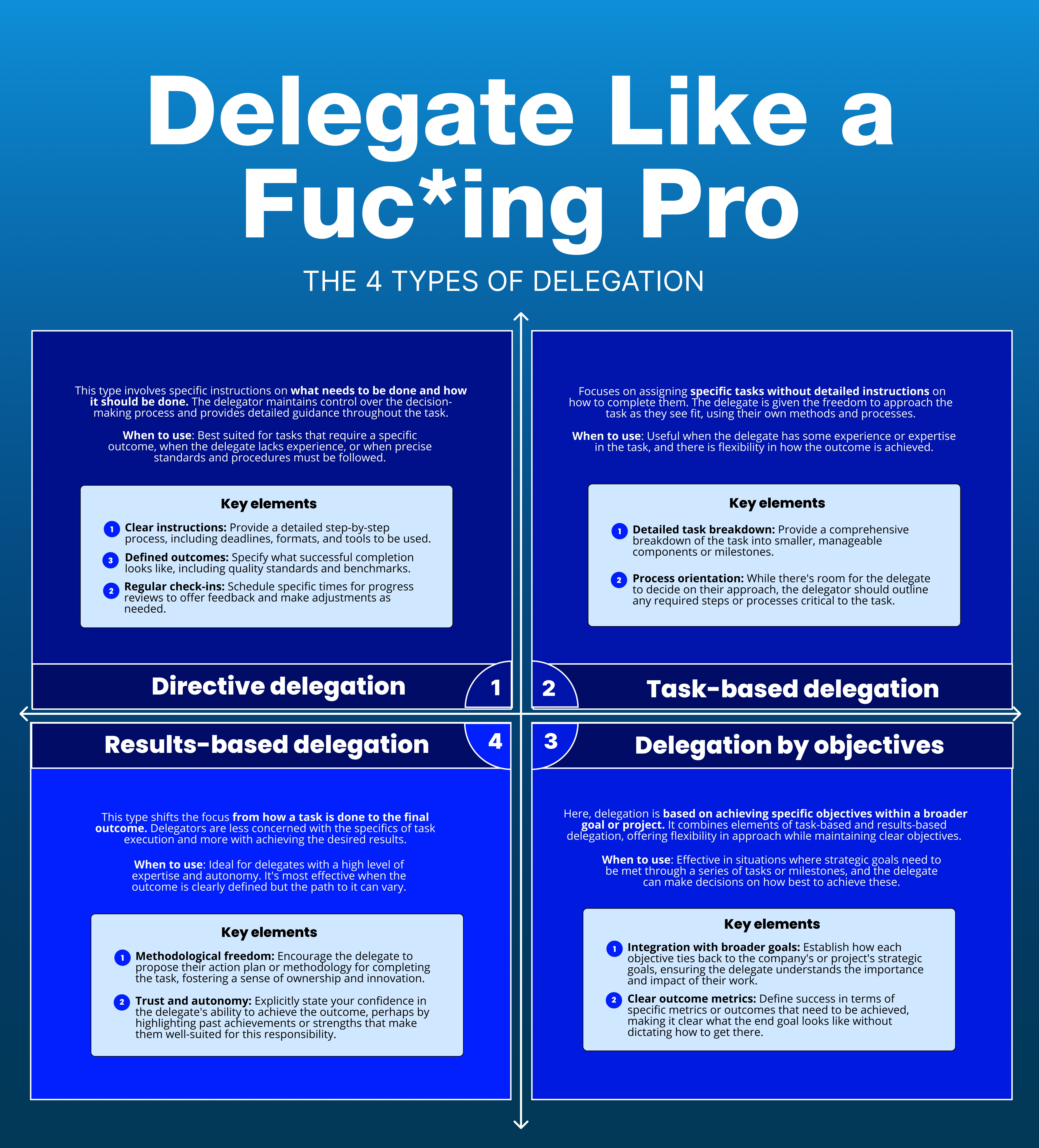
Most founders think they’re good at delegation.
They’re not.
They think delegation means assigning tasks.
It doesn’t.
Delegation is not about offloading work.
It’s about transferring ownership.
And if you don’t master it, you become the ceiling of your company.
Table of Contents
Delegation Is a Leadership Multiplier
1️⃣ Directive Delegation — Precision Over Autonomy
2️⃣ Task-Based Delegation — Structure with Flexibility
3️⃣ Results-Based Delegation — Outcomes Over Activity
4️⃣ Delegation by Objectives — Building Leaders, Not Doers
The Real Skill: Knowing When to Flex
What Most Founders Get Wrong About Delegation
The Hidden Constraint: Your Ability to Let Go
Closing Thoughts
Delegation Is a Leadership Multiplier
True delegation is an art form. When done properly, it does three things simultaneously:
Reduces your operational load
Builds capability in your team
Increases organisational velocity
When done badly, it creates confusion, resentment, and rework.
Delegation is not binary. It’s not “delegate” or “don’t delegate.”
It’s a spectrum.
And knowing where you sit on that spectrum — for each person and each situation — is what separates operational founders from strategic ones.
Let’s walk through the four levels.
1️⃣ Directive Delegation — Precision Over Autonomy
At the most hands-on end is directive delegation.
This is where you define the steps, the process, and sometimes even the wording.
It’s appropriate when:
Stakes are high
Precision matters
The person is new
The process is compliance-driven
Failure is expensive
Think onboarding a new SDR into your CRM workflow.
Or guiding a junior ops hire through a customer escalation process.
Directive delegation provides clarity. It reduces ambiguity. It protects standards.
But here’s the danger:
If you stay here too long, you create dependency.
Directive delegation should be a training phase — not a permanent management style.
2️⃣ Task-Based Delegation — Structure with Flexibility
This is where most founders should live most of the time.
You define:
The task
The deliverables
The deadline
The success criteria
But not the method.
For example:
“Run the product launch webinar. Secure two speakers. Deliver 200 signups. Coordinate with marketing.”
How they achieve it? That’s theirs.
Task-based delegation builds confidence. It develops judgement. It fosters ownership.
And most importantly — it starts to shift control from process to outcome.
3️⃣ Results-Based Delegation — Outcomes Over Activity
Now we’re moving into mature territory.
Results-based delegation focuses on what, not how.
You define the destination.
They design the route.
“Reduce churn by 15% over the next quarter.”
“Improve onboarding conversion from 45% to 60%.”
“Shorten sales cycle by 20%.”
You don’t tell them how to do it.
You set expectations, agree on measurement, and establish review cadence.
Then you step back.
This is where trust becomes operational.
And this is where innovation starts to emerge — because autonomy breeds creativity.
4️⃣ Delegation by Objectives — Building Leaders, Not Doers
At the far end of the spectrum lies strategic delegation.
Here, you’re not assigning tasks or even results.
You’re assigning ownership of a business objective.
“Own the enterprise expansion strategy.”
“Launch and scale the new product line.”
“Own our European go-to-market.”
This is leadership development in action.
You communicate vision and guardrails — but they decide:
Features
Roadmap
Resource allocation
Strategy
Execution
This is how you build a leadership team.
And if you want to scale beyond £5M, £10M, £50M ARR — this level becomes non-negotiable.
The Real Skill: Knowing When to Flex
The mistake isn’t using directive delegation.
The mistake is using it everywhere.
Great founders flex.
New hire? Directive.
Mid-level operator? Task-based.
Senior leader? Results or objectives.
Delegation maturity is situational intelligence.
And if you’re still involved in approving social media copy or editing every proposal, you don’t have a capacity problem.
You have a control problem.
What Most Founders Get Wrong About Delegation
They jump levels too fast.
They read something like this, get excited, and go straight to results-based or objective delegation with people who are not ready for it.
And then they say, “Delegation doesn’t work.”
No — your sequencing doesn’t work.
Delegation is earned. Not given.
You don’t hand someone ownership of a revenue target if they’ve never owned a process.
You don’t give strategic autonomy to someone who hasn’t demonstrated tactical reliability.
Great operators move people up the ladder deliberately:
Directive → Task → Results → Objectives
Each level is a proving ground.
Skip a step, and you create chaos disguised as empowerment.
The Hidden Constraint: Your Ability to Let Go
Here’s the thing no one tells you:
Most delegation problems are not team problems.
They’re founder problems.
You say you want leverage.
But you keep rewriting Slack messages.
You say you trust your team.
But you override decisions at the last minute.
That’s not leadership.
That’s control dressed up as quality.
Every time you step in unnecessarily, you send a signal:
“I don’t trust you to own this.”
And over time, your team believes you.
They stop taking initiative.
They wait for approval.
They optimise for not being wrong — instead of moving fast.
If you want high-agency operators, you have to tolerate imperfect execution in exchange for scale.
Closing Thoughts
Delegation is not about doing less.
It’s about building a machine that can do more — without you.
The best founders are not the ones who get everything right themselves.
They’re the ones who create environments where other people can.
That only happens when ownership moves.
From you → to your team → to your leaders.
So the question isn’t “am I delegating?”
It’s:
Am I creating people who can operate without me?
Because if the answer is no, you’re not scaling a company.
You’re scaling your own workload.
-Chris Tottman
Delegation turns out to be one of the only real ways to scale from the early days.
It is also one of the hardest things to let go of, which is probably why it holds so many founders back.
One shape or another, most of the founders I speak to on Millennial Masters end up saying the same thing.
🔗 https://millennialmasters.net/p/power-of-saying-no-delegation
Great post! https://krogrules.com formalise delegation through rule logic for AI agents (and humans).