

👋 Hey, Chris here! Welcome to The Founders Corner. If you’ve been reading along, you’ll know I have very little patience for theory that doesn’t survive contact with a real buyer.
This series is a preview of a new book I’ve written with my partners Richard Blundell and Paul Watson — The Selling Software Algorithm: The Go-to-Market Navigation System for B2B Software Leaders.
It isn’t a strategy deck dressed up as a book. Between the three of us we’ve spent close to seven decades inside B2B software as founders, operators, investors and coaches — building companies, exiting some, and quietly breaking a few along the way, which is where most of the real learning lives. Through our work at Vencha we’ve now supported hundreds of founders trying to do the single hardest thing in software: turn a clever product into predictable commercial traction in a market that’s noisy, cautious, and more crowded than it has ever been.
One pattern shows up again and again. Companies rarely struggle because the product is bad. They struggle because they have no navigation system for going to market. This book is that system.
Last time, we sharpened the Perfect Customer Profile down to the one condition that must be true.
This time, we turn that profile into a list of real companies, and then into something considerably more useful than a list.
Here’s the failure mode this piece exists to prevent. A team does the DNA work properly, exports 500 companies, filters down to 100, and puts the result in a spreadsheet. Everyone agrees it’s a good list. Nobody opens it again. Six weeks later the team is working exactly the accounts that happened to reply to something, and the list is a tab in a file in a folder. Nobody decided to abandon it. It just never became something a person could look at and recognise.
Table of Contents
A Simple Example: The Wall You Walk Past
Seeing the Battlefield Clearly
Turning Companies Into People
Why Faces Change the Question You Ask
A Rhythm, Not a Sprint
Preparation, Not Surveillance
From 500 to 100 to Named Buyers
What Changes Inside Your Company
Building Your Own Face Book
A Simple Example: The Wall You Walk Past
Think about how you know the people in your life. You don’t hold a record of their job titles and contact details. You recognise their faces, and everything else hangs off that.
Now think about how your team knows its market. If you asked your best rep to name fifteen target accounts without opening anything, could they? If you asked your product lead which specific company a roadmap request came from, would they know? If a new starter joined on Monday, how long before they could pick your top twenty companies out of a lineup?
In most software businesses the honest answers are no, no, and never. The market exists in the company as a data object rather than a shared mental picture, and a data object can’t be obsessed over. That’s the gap this whole exercise closes.
Want to get in front of 250k+ founders and investors?
For sponsorship opportunities across The Founders Corner newsletter and LinkedIn (160k followers), email: founderscornermedia@gmail.com
Seeing the Battlefield Clearly
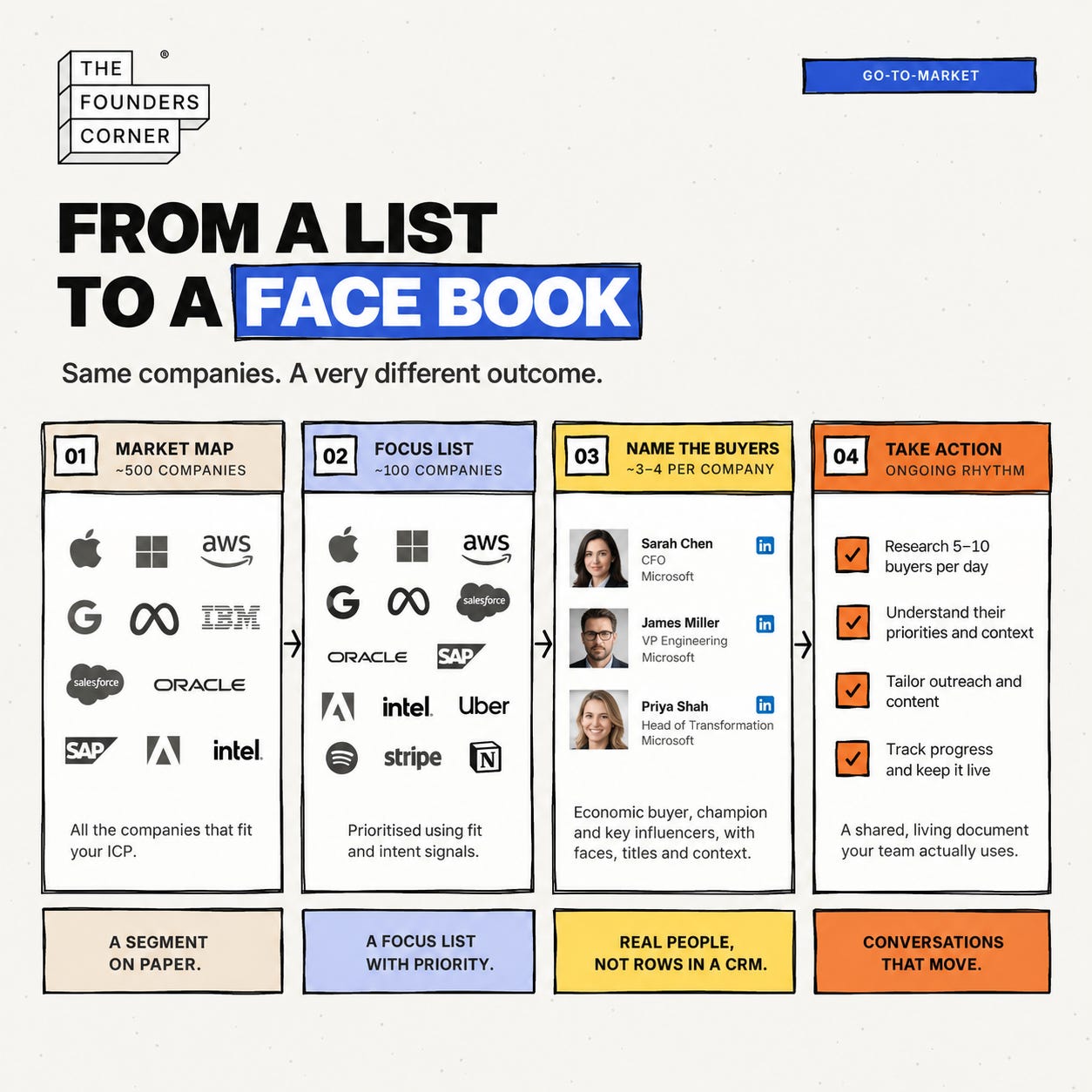
Once you have a Market Map of roughly 500 organisations that fit your Perfect Customer DNA, the instinct is to treat it as a spreadsheet. Filter, sort, export, forget.
The founders who get the most out of this list build it as a logo wall instead: a slide, board or dashboard that shows the companies together in one place. Perfection is not the goal, and chasing it is the main reason this step never gets finished. Private companies won’t have a clean logo. Subsidiaries sit inside group structures nobody can untangle in an afternoon. Some of the names will be wrong in six months.
None of that matters. Visibility is the goal. You need to be able to look at one screen and say, these are the companies that matter, and have everyone in the room agree.
The map earns its keep by being present. It reminds you daily where the real opportunity sits, which is the only reliable defence against the thing that actually derails most go-to-market plans: an inbound enquiry from a company that isn’t on it, arriving at 4pm on a slow Thursday, looking far more exciting than it is.
Turning Companies Into People
A Market Map shows you the battlefield. The Market Map Face Book introduces you to the people fighting on it.
For each priority account, you identify the most likely Economic Buyer, often with two or three adjacent decision-makers, and attach a face to each name. In practice that usually means a LinkedIn photo placed alongside a name, title and company in a shared document or board.
It sounds almost trivially simple, and it is. That’s not an argument against it. The reason it works has nothing to do with the sophistication of the artefact and everything to do with what a face does to the person looking at it.
Why Faces Change the Question You Ask
When people are rows in a CRM, outreach becomes mechanical. You’re working a list, and the measure of a good morning is how much of the list you got through.
When those same people have faces, careers and public narratives attached, the question in your head changes. “How do we get in” turns into “what’s happening in their world right now”. That’s a different piece of work, it takes longer, and it produces something a buyer can tell apart from the other nine emails they got that morning, usually within the first sentence.
Senior buyers expect to be understood. The fastest way to lose credibility with one is to demonstrate, in your opening line, that you haven’t spent ten minutes learning who they are or what they’re dealing with. Most outbound fails on that single point long before anyone evaluates the product.
A Rhythm, Not a Sprint
This isn’t built overnight, and it shouldn’t be. A good pace is five to ten Economic Buyers researched per day, enough to maintain momentum without rushing the thinking.
For each person, the job is to understand what’s publicly available: career path and tenure, the language they use on LinkedIn, what they write about or comment on, the initiatives they reference, the pressures implied by their role, and any public signal of transformation, growth, risk or change happening around them.
Ten a day gets you through a hundred accounts in a fortnight of real work. Founders resist that arithmetic, because two weeks feels enormous when the pipeline is thin. Set it against the alternative, which is months of undifferentiated outreach into the same hundred companies with none of that context, and it stops looking slow.
Preparation, Not Surveillance
Somebody in the room always raises this, and they’re right to.
There’s a line, and it’s clearer than it first appears. You’re reading what these people have chosen to publish about their professional lives, in public, largely in the hope that people in their industry will read it. A CFO posting about a transformation programme is not disclosing a secret. They’re signalling.
What you’re building is the preparation any competent adviser would do before a first meeting, held in a document rather than in someone’s head. The test is simple: if you’d be uncomfortable telling the buyer how you came to know something, don’t use it. Everything in a good Face Book passes that test easily.
From 500 to 100 to Named Buyers
The Face Book follows a sequence, and skipping a stage is what produces a database that looks complete and tells your team nothing.
Stage one narrows 500 organisations down to a Focus list of roughly 100, using intent signals to find the accounts that both fit structurally and show some sign of movement.
Stage two attaches three to four potential contacts per account: the actual Economic Buyer, a second signatory or co-owner of the budget, a likely internal Champion, and a relevant functional leader who influences the decision. Then you enrich, with verified email addresses, direct dials, LinkedIn URLs and seniority.
Only once that’s done does the list become usable, actionable and precise. Before it, you have a market segment. After it, you have a hundred companies and three hundred people, and a rep who knows exactly who to call on a Monday morning without asking anyone.
What Changes Inside Your Company
The output is a document. The effect is cultural, and it’s the part founders don’t anticipate.
Teams who’ve built a Market Map and a Face Book talk differently. They reference companies and buyers by name in meetings. Product decisions get connected back to real accounts rather than to abstractions about the market. Sales and marketing stop arguing, mostly because they’re finally working from the same mental picture instead of two versions of it.
The change I’d point to most, though, is what happens to rejection. When a deal dies inside a clearly defined territory, it isn’t a referendum on your product any more. It’s one data point in a hundred, you know precisely which one, and you pull the next company off the long list and carry on. That sounds like a small thing. Over eighteen months of building a company, it’s most of the difference between a team that keeps going and one that quietly loses its nerve.
Building Your Own Face Book
This is exactly what Step 6 of the Builder produces alongside the ICP Grid: your Focus accounts, with the Economic Buyer and Champion attached to each one and a note on why they’re worth researching first.
Next in the series, we take those three visceral pains and turn them into an actual content plan: one pillar per pain, mapped to the stage of readiness we covered a few weeks back.
-Chris Tottman
Most market maps are a spreadsheet with a filter applied. Nobody on the team could pick the accounts out of a lineup.
The Selling Software Algorithm Builder Step 6 attaches named Economic Buyers and Champions to your Focus accounts, so your team recognises the market instead of just filtering it.